Showing posts with label Tommy Lee Jones. Show all posts

Saturday, September 23, 2023

On the Run

The Fugitive
Director: Andrew Davis
Cast: Harrison Ford, Tommy Lee Jones, Joe Pantoliano, Sela Ward, Julianne Moore
Released: August 6, 1993

Oscar nominations:

Best Picture (lost to Schindler's List
Best Supporting Actor - Tommy Lee Jones (won)
Best Cinematography (lost to Schindler's List
Best Sound Effects Editing (lost to Jurassic Park
Best Film Editing (lost to Schindler's List
Best Original Score - James Newton Howard (lost to John Williams for Schindler's List
(I guess this is what happens when two of Spielberg's movies come out in the same year!)


This is a movie where I've seen many bits and pieces in my youth, but I honestly don't think I ever watched the entire thing from start to finish until just recently. I was very familiar with this movie because my it was one of my brother's favorite movies and he had the VHS and whenever he watched it, I sometimes watched parts of it too. There are only two scenes I remember really well: the speech that Tommy Lee Jones gives (you know the one I'm talking about) and when Harrison Ford jumps from the waterfall because that was just insane. 

I also vaguely remembered that this is based on a TV show from the '60s with the same name, but I wasn't familiar with it. I've never seen it and never plan to, so I have no idea how similar it is to the movie. 

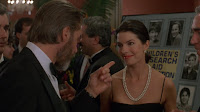
The movie moves pretty fast at the beginning because it wants to get to the, you know, fugitive part, but first we need to set up how Harrison Ford becomes The Fugitive. He plays Dr. Richard Kimble, a vascular surgeon at Chicago Memorial Hospital. He's being aggressively interrogated at the police station because his wife has just been murdered. The movie intercuts with him being interrogated to flashbacks of earlier that evening where he and his wife, Helen (Sela Ward) are attending a black-tie fund raiser at the Four Seasons to raise money for the Children's Research Fund. We see a fellow doctor friend come up to Richard and thank him for loaning him his car. When I watched this the first time (the second time is when I took notes), I totally paid this line no attention; heck, I barely paid that guy any attention. Later, when he and his wife are driving back home, Kimble gets a call asking if he can come in to help with an emergency at the hospital. "I'll wait up for you" is the last thing his wife tells him. 

Back at the police station, Kimble tells them it was a one-armed man who killed his wife and he got into a fight with him. It seems like the police are adamant that Richard killed his wife, which I get, it usually it is the husband. At first, I thought the police don't even investigate this claim of a one-armed man, which I thought was odd because that is a pretty specific description and surely they can check records to see how many males have one arm in the Chicago area. Well, it turns out they do because later we'll find out the man who did kill her (spoiler alert: Harrison Ford is indeed innocent) claims the police have already talked to him and he had an alibi. 

The Chicago PD thinks Kimble killed his wife because she comes from a wealthy family and when they ask him if she's insured, he tells them she was and that he was the sole beneficiary. Sure, that doesn't look good, but it's not like this DOCTOR was hard up for money. Unfortunately, that's not the only thing that looks bad for Dr. Kimble. We next jump to the trial where we learn there was no forced entry and nothing was missing. The most damning evidence of all may be Helen's 911 call which they play for the jury. Even though her head has just been bashed in and there's blood coming out of her mouth, she is able to reach for the phone and call 911. Yeah, she's gasping for breath and whispering but she does get a lot of information out. She tells the dispatcher, "He's still here in the house" and "He's trying to kill me" (which she says twice). When the dispatcher asks her if her attacker is still in the house (I guess she didn't hear Helen tell her that), Richard, who heard something, starts walking up the stairs. Helen must have known it was him and starts saying "Richard, Richard", calling for his help. Then the next thing she says is, "He's trying to kill me." Yeah, that doesn't sound good. Then she dies. It's kind of messed up that her last actions would end up sending her innocent husband to prison. Not just prison, but a death sentence. 

Now that I think of it, while I know there is some questionable evidence against him, it is crazy that he was found guilty. Surely they processed the crime scene and found unknown DNA on both Richard and Helen. Unless this was before the time when DNA wasn't as prevalent. I feel like now they wouldn't have enough to convict him. 

The next scene is Richard being transferred to death row in an armored truck with three other inmates, the driver, and two prison guards. Now, by this time, we're probably ten minutes into the movie, but as for real time, I have no clue. It feels like all this has happened in the last twenty-four hours, but obviously that can't be possible. Oh, well, I guess it's not that important. 

All the prisoners are wearing yellow jumpsuits and their hands and feet are shackled. On the way there, one of the prisoners pretends to need medical attention by foaming at the mouth (yuck!) and when the younger guard goes on to check on him, the inmate has a siv and stabs him in the chest. This causes a chain reaction and the old guard gets his shotgun and shoots the inmate. Everything goes to chaos and the driver drives the bus off the road and it rolls several times down a ravine. There's no way anyone should be alive after this, or at the very least, there's no way anyone should be able to walk away from this horrific crash unscathed, but three people do end up walking away unscathed! 

The driver and two of the inmates are dead, but the two prison guards, Kimble, and another inmate are still alive. The guard who was stabbed is unconscious and needs medical help, not to mention help to get him off the bus. The older guard asks Kimble to give the hurt guard medical attention since he knows he's a doctor and Kimble requests to be unlocked. The guard throws the keys at him and he frees his hands. Now I was a little confused by the next scene. I couldn't tell if he accidentally dropped the keys or if it was purposeful because they drop right in front of Copeland, the other inmate who survived, who is able to take the keys and free himself. I fee like this had to be an accident because surely he would unlock the chain around his ankles and why would he let a convict go free. I'm not sure what Copeland was in for, but I'm guessing whatever it was, it can't be good. But whether it was an accident or purposeful that he got those keys, it's a good thing he did because they hear a train in the distance. It just so happened that their bus landed upside down right on a train track. (That's unlucky!) Even though I don't think Kimble would have wanted Copeland to escape, I also don't think he would want him to be killed by a train. 

They all hear the fast approaching train and Kimble firsts ask the older guard to help with with the wounded guard, but he saves his own ass and gets out. Next he asks Copeland to help him, but he (not surprisingly) also escapes. Kimble grabs the unconscious guard and just tosses him out of the bus where we see him flop down a hill. Kimble jumps from the bus literally seconds before the train hits it. After hitting the bus, one of the train cars becomes detached from the rail and starts following Kimble, who, mind you, still has his ankle shackles on, so he's trying to outrun this runaway train while he can barely run. This seems a little....unbelievable. Also, is this a nod to Indiana Jones when he's running away from the huge boulder? Kimble does manage to jump out of the way.
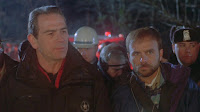
Not long after, U.S. Marshall Samuel Gerard (Tommy Lee Jones) and his team (which includes Joe Pantoliano; I had no idea he was in this) are called to the site of the crash. Gerard's first words are, "My, my, my, my my. What a mess." The old guard is still there, giving his statement to the local sheriff. He claims he was the one who saved the young guard (who they will find later and take to the hospital). He tells the sheriff that all the prisoners are dead. I'm not sure why he doesn't admit that Kimble and Copeland are still alive, I guess because it doesn't look good if he admitted he gave one of them the keys, then saw the other one also unlock himself. 

Gerard tells the sheriff he wants to set up checkpoints, but the sheriff doesn't see the need since all the prisoners are dead. Gerard tells him he's taking over the investigation. One of his colleagues finds a leg iron and Gerard questions how a dead man could get out of those and that's when the guard admits he gave the keys to Kimble and that he's still alive. Poole, who is part of Gerard's team, asks the guard if he would care to revises his statement and when he replies with, "What?", Gerard clarifies by asking him, "Do you want to change your bulls*t story?" Heh. This is also the moment when we get the iconic speech from Tommy Lee Jones that everyone knows and is probably one of the first things you think of when this movie comes up: 


The next morning, Kimble is hiding under some bridge and he sees a mechanic by his work truck take off his work jumpsuit. When he walks away, Kimble is able to grab it from the truck (lucky for him that guy left his windows rolled down!) and puts it on. Yeah, he probably doesn't want to be walking around with his prison jumpsuit on. That might give him away! 

Right before the U.S. Marshalls have found the injured young guard and take him to the hospital, we get another iconic Gerard moment where he asks Noah, another member of his team, what he's doing. Noah says he's thinking and Gerard tells him, "Well, think me up a cup of coffee and a chocolate doughnut with sprinkles on top." I don't remember if he ever gets them.

Throughout the film, Kimble sneaks into many places without being detected. And it's not like many of these places are deserted; there's plenty of people swarming around. Sometimes it seems a little farfetched that nobody ever notices him. In this instance, he sneaks into the treatment room of a hospital and stitches himself up. (He had a pretty bad gash on his lower stomach). He then sneaks into the room of an elderly male patient (who is asleep) where he goes into the bathroom to trim and shave his beard. That's something I forgot to mention; he has a beard. I guess it makes sense that he starts the movie with a beard because he will need to change his appearance and shaving off his beard seems like a good way to do that. While he's shaving, he hears a nurse come into the room and comments that the old man must be thirsty since his water bottle is empty. Kimble quickly opens the bathroom door and hides behind it (luckily it opened into the bathroom and not into the room) as the nurse walks in and fills the water bottle. She's chatting to the sleeping patient the entire time. Not once does she look up in the mirror. If she had, she would have for sure seen Richard and gotten quite the surprise! 

After she leaves, Kimble has finished shaving and changed into some new clothes (presumably belonging to the patient). He scarfs down the breakfast left for the old man (poor guy didn't get his breakfast!) and walks out with a cup of coffee. He's also wearing a doctor's coat with a stethoscope around his neck, so he must have found those just laying around. As he's walking towards the exit, he runs into a police officer who stops him and ask him if he's seen the escaped prisoner from the bus crash. Instead of just hurrying past him, with his head down, and telling him he's busy, Kimble looks at the officer and asks him to describe this escaped prisoner for him which the cop does. Kimble states that he only sees that when he's looking in the mirror, "except for the beard, of course" because the cop has literally just described him. I don't know if this is good strategy to admit you look just like the escaped prisoner, although I guess you can't hide the fact that you DON'T look like him. Also, I'm shocked that the cop didn't two and two together and realize that an escaped convict with a beard would probably shave off said beard. Duh. 

But Kimble, disguised as a doctor, is able to easily walk away without getting detected. Outside, the ambulance is just bringing in the wounded guard and he goes over to check on him. The guard is awake and recognizes Kimble and starts to say something, but Kimble immediately covers his mouth with an oxygen mask. Since he knows his injury, he tells the EMTs to make sure the doctors know he has a puncture in the upper gastric area. The EMTs are confused how he would even know that since the guard is covered with a blanket. Well, gee, he probably knows because he's the escaped convict who also happens to be a doctor. 
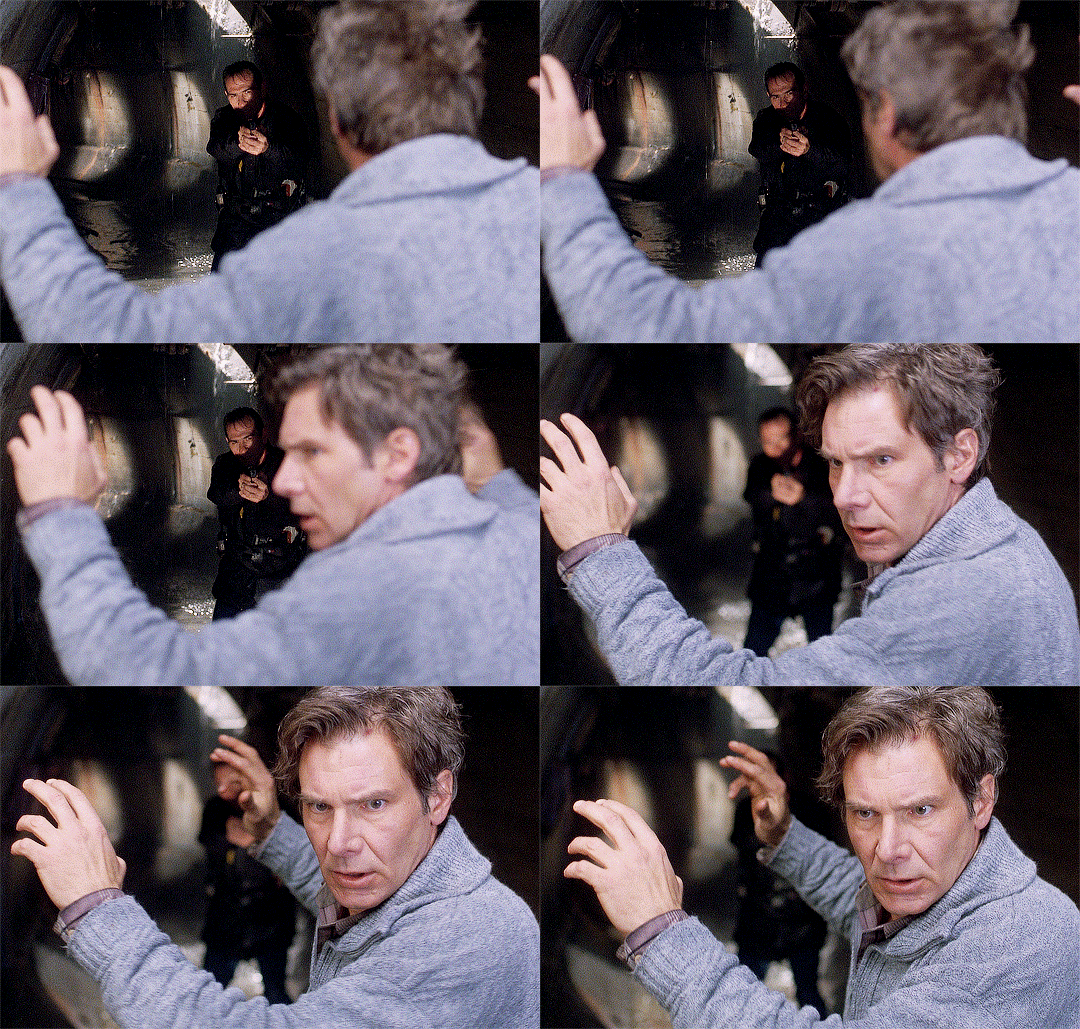
The guard is able to report that he saw Kimble and this gets back to the U.S. Marshalls team, who are getting the phones of anybody Kimble might call, starting with his lawyer first, tapped. There's also a report that an ambulance is missing. After the ambulance is spotted, Gerard rides in a helicopter, directing the police cars where to go. They spot him heading towards an aqueduct and when he goes through a tunnel, the helicopter lands at the other end, along with two cop cars, blocking Kimble's exit. He also can't backtrack since there are more cop cars coming from that side. In the end, he finds a grate and climbs down there where he finds himself in a tunnel system. Gerard and the others follow him and at one point, Gerard slips and drops his gun which Kimble picks up and points at him, telling him, "I didn't kill my wife!" to which Gerard replies, "I don't care!" Kimble runs off, but he took the wrong turn because he's now overlooking a dam which is at least 1000 feet tall. Now that Gerard has him cornered, he tells Kimble to drop his gun, which he does. He then tells Kimble to put his arms behind his head and turn around, which he also does. But Kimble isn't going to give himself up! He then proceeds to jump off into the waterfall with a very scared look on his face. He should look scared because it's a long-ass fall down to the bottom and there's no way anybody could survive that, let alone walk away from it unhurt, but of course that is exactly what he will do! 

Well, at least the U.S. Marshalls (except for Gerard) agree with me that nobody could survive that. Gerard wants to start a search team and when the others tell him that Kimble is dead, he replies, "That ought to make him easy to catch." 

This is when we see Kimble stumbling out of the water (even if that fall didn't kill him, he should at least have several broken bones). He sleeps outside under a pile of leaves and he has a nightmare about his wife's murder and this time we see the face of the one-armed man who killed his wife, so I guess that's telling us that he remembers more details about him. (Though I think having one arm would be a pretty big detail!) 

The next morning we see him walking along the train tracks and he ends up in a truck station of where he dyes his hair a darker shade. Where did he even get that dye? Was it already just there? Did I miss it when he went to Wad-Mart and got some essentials? He hitches a ride from a woman who picks him up. Great way to get murdered, lady, just picking up random hitchhiker. Luckily she picked up an escaped convict who has morals. 

We get a fakeout when the U.S. Marshalls have gotten a lead that their escaped convict is with some woman in some shack in the woods. Well, it turns out they're talking about Copeland. You remember him? He's the other escaped convict. His girlfriend is harboring him. They sneak in, but Copeland has grabbed Noah and points a gun to his head. He wants to bargain with Gerard, but, as we'll soon learn, Gerard does not bargain. He ends up shooting Copeland. Well, at least they don't have to worry about him anymore. Noah isn't thrilled with Gerard's decision, saying that if Gerard had missed, he would have killed him. 

So where did Kimble end up, you ask? He's in Chicago where he calls his lawyer who tells him he needs to turn himself in. Kimble asks him for money and his lawyer replies, "You're asking me to harbor and aid a convicted felon. I can't help you that way." When he asks Kimble where he is, Richard lies and tells him he's in St Louis. 
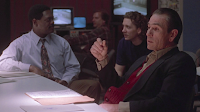
Since the lawyer's phone has been tapped, Gerard and his team are able to listen to it. Gerard looks like Mr. Rogers on Casual Friday. He's wearing jeans with a blue button up shirt, red sweater vest, and tie. They listen to the recorded call, trying to determine where Kimble is. They don't think he's in St. Louis because they hear a train that sounds like an el, but there are no elevated trains there. They try to come up with cities that have els which include New York, Philly, Milwaukee, and Chicago. I feel like it's so obvious he's in Chicago; that's the city he was the closest to and it's not like he could make it all the way to the East Coast. I supposed he could have gone to Milwaukee, but Chicago seems the most obvious to me. Once they realize they can hear a guy on the P.A. saying, "Next stop, Merchandise Mart", they know for certain he's in Chicago. 

We see his doctor friend who we saw earlier in the movie (the one at the fundraiser who thanked Kimble for loaning him his car) come out of his tennis club and get in his car. His name is Dr. Charles Nichols. When he stops at a red light, a bunch of homeless guys start cleaning his car and asking for money. Kimble, who must have known that Nichols would be going past there, comes up and knocks on his passenger window. Nichols is surprised to see him, but tells him to get in, but Kimble refuses and asks him for some money which Nichols hands over without any qualms. He asks Kimble if he has a place to stay or if there's anything he can do to help. At that moment, a police siren sounds and an officer tells Nichols he have a green light and to move on. (Would they really turn on a siren for that?) Kimble tells him he'll call him and strolls off. We next see him renting a spare room in a small house of a Polish woman who lives with her adult son.
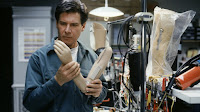
Kimble has come back to Chicago because he has unfinished business! He sneaks into Cook Country Hospital and when I say sneak, I mean he just walks right in without anyone giving him a second glance. He does hold up a towel to his forehead, feigning an injury (and probably trying to hide part of his face). However, he no longer bothers hiding his face when he takes the elevator to the floor where the prosthetics lab is. He just walks right in, seeing people getting fitted for limbs. He then sneaks into a storage area after a janitor comes out and he quickly goes in when the door is still open. It's just amazing that's he able to sneak anywhere without anyone noticing him and it's not like there's nobody around! In a locker room, he sees a janitor hanging up his uniform and when he's in the shower, Kimble sneak in and takes his uniform and ID badge.  

Gerard and Cosmo (that's the guy played by Pantoliano) start interviewing Kimble's friends and colleagues, starting with Nichols and we learn they went to medical school together. They are shocked when they ask him when was the last time he saw Kimble and he admits he saw him that morning and gave him money. He even confesses he offered to help him, but Kimble wouldn't accept it. Nichols doesn't want to help them catch him because he doesn't want his friend to go back to prison and claims, "Richard is innocent" and that they'll never find him because he's smart.

They continue their interviews and pretty much everyone vouches for Kimble, saying he's a good guy and a good doctor and none of the believe he is guilty of killing his wife. One of these doctors who vouches for Kimble is played by a young Jane Lynch.

In his rented room, Kimble is looking at documents and books about mechanical arms and trying to determine what kind the killer had...I guess. I'm not sure how he would even remember exactly what the mechanical arm looked like, but whatever. And I guess he got these when he pretended to be a janitor? The next day he is awakened by the sound of sirens and he thinks they have found out where he is, but it turns out they're busting the adult son for being a drug dealer. That guy will later tell the cops that Kimble has been staying at his house, but by that time Kimble will already be long gone. 

As a janitor, Kimble goes into the workshop of a woman working on a prosthetic limb under the pretense that he needs to clean the blinds in her office where her computer is located. He half-heartedly cleans the blinds (which he makes sure to shut), but also looks up information on the computer. There's a prosthetic arm database where he can type in information and every time he types in something new, the number of matches narrows until he has only five people who fit the description of what he's trying to find. For some reason, he seems to know when the one-armed murderer last got his mechanical arm adjusted. How the hell would he know that? Even though the woman is wearing headphones, I am surprised she doesn't hear the clickity-clack of the keyboard in her office. The computer Kimble is using is so archaic, it's hilarious. And I thought those candy-colored Mac computers they used on Felicity were old! He prints out the list of five people and puts it in his pocket.

There's been a bus crash and many children are in the hospital as a result of it. Kimble sees a kid on a gurney and he can tell there's something wrong with the kid, but the doctor looking at him thinks he's okay. A female doctor sees Kimble by the kid and, thinking he's the janitor, asks him if he can help them out and take the kid to observation room 2. This female doctor is played by Julianne Moore. I had seen her name in the credits and had no idea she was in this movie. This was before she was really famous. She's not in it very much, but I heard a big chunk of her role was cut. Originally, she was supposed to have a romance with Kimble, but they scratched that. Probably a good idea since basically the whole movie is about Kimble trying to find the guy who, you know, murdered his wife and proving his innocence. Anyway, Dr. Eastman (Moore's character) notices Kimble looking at the kid's X-ray. Kimble takes the kid in the elevator. They're the only people in there, so he's able to cross out what the previous doctor had written on the kid's charts and he writes his own diagnosis, delivering it to the right department. Doing this will save the kid's life. 

Back in the lobby, Dr. Eastman is suspicious and asks Kimble why a janitor would be looking at an X-ray and Kimble replies it's a hobby. She doesn't believe him and grabs his ID badge, telling him to stay where he is while she gets it checked out. Of course, he's not staying put! He scrams! 
The U.S. Marshalls are called and Dr. Eastman gives them her statement. Gerard and Cosmo wonder why a fugitive like Kimble would come to a public place such as a hospital and that's when they see a man with a prosthetic arm and follow him to the myoelectric lab. They come up with their own list of 47 males in the age range that Kimble described with one arm and start cross referencing them for criminal records.

At a payphone, Kimble makes calls pretending to be a doctor checking in on the patients from the list he printed. Being that this is 1993, payphone are pretty prominent in this movie, mostly used by Kimble. I think he probably uses one five or six times. You really couldn't make this movie today because it would be so much easier for him if he had a Smartphone. There was a sign on one of the payphone that made me laugh: "Please limit phone calls to five minutes." You know, because other people may need to use the phone! 

Kimble is able to narrow down the list even more and breaks into the home of the last guy. Luckily, that guy isn't home at the moment so he's able to just rummage through his stuff and he finds pictures of the guy who he recognizes as being the one he got into a fight with and he finds a prosthetic arm in his drawer. He also finds pictures of the guy with Dr. Lentz who was at the fundraiser the night of his wife's murder. 

Back at U.S. Marshalls headquarters, Gerard is told he has a phone call from someone claiming to be Richard Kimble. He and his team are talking and joking, but once Gerard realizes he's actually talking to Kimble, he makes a very irritated signal with his hands, telling everybody to shut up. Kimble tells him he's trying to solve the puzzle of who killed his wife and that he "just found a big piece". He gets up and walks away, but leaves the phone off the hook because obviously he wants them to find the murderer's home, which of course they go to right away.

The one-armed man is named Fredrick Sykes and when he returns home, he wants to know what's going on. They tell him he had a break-in and that a fugitive named Richard Kimble made a phone call from his apartment. Sykes denies knowing somebody by that name, but once they show him Kimble's photo, he recognizes him as the man who blamed a one-armed man for killing his wife and asks if he's coming after him. Gerard asks if he has a reason to come after him. This is when we found out that the police have already talked to Sykes and he was cleared because he had an alibi: he was on a business trip with fifteen people. We find out he works in security for the pharmacuetical company, Devlin MacGregor. 

Gerard's team leave because they don't have any hard evidence on this guy yet, but Gerard tasks Noah with finding out who the guy in the picture next to Sykes is. They will soon find out the man is Dr. Lentz. 

That evening, the Hilton is hosting the International Association of Cardiologists where Dr. Nichols will be the keynote speaker. We see him at the hotel in the afternoon, getting his speech prepared, when his assistant tells him he has a phone call and it's an emergency. Of course, it's Kimble who tells him he found the man who killed Helen. He believes they were after him, not Helen, because "Lentz was supervising the protocol for RDU-90" and he knew Kimble found out it was causing liver damage. Nichols drops a bombshell on Richard and tells him that Lentz is dead, that he died in a car accident last summer. He asks Richard if he can prove this about the drug and Kimble says he can, but he will need his help and tells him to call "Bones" (is that a nickname, I hope) and give him whatever he needs. It's at this scene where I get the feeling that Nichols is behind this, that he's not on Kimble's side, but he's pretending to be. 

Soon after, Gerard and Cosmo arrive at the hotel to talk to Nichols and they show him the picture of Sykes, telling him that Kimble broke into his apartment. When they ask him if he knows either Sykes or the man standing next to him, Nichols says he doesn't but of course we know that's a big fat lie!  

At the same time the U.S. Marshalls find out that the man next to Sykes in the photo is Dr. Lentz and that he has since passed away AND that Nichols lied about knowing him, Kimble makes a visit to Bones at the hospital and takes a liver sample he asked for. He takes it to Jane Lynch who looks at it under a microscope and declares, "Not only did they all come from healthy livers, they all came from the same liver." Lentz was one of the original patent holder on RDU-90 and Kimble was sending him his tissue samples and "he was replacing them with healthy samples, issuing the path reports on them, and sh*t-canning [Kimble's] stuff." Jane Lynch points out that Lentz died on August 21st and "half of the samples he approved were signed the day he died." She believes someone else must have been manipulating this, but who else would have access? It's at this point I believe Kimble knows exactly who it is, but I figured it out before he did, so ha, ha! He's got an enraged look on his face and he tells Jane Lynch he's going "to see a friend."

We get confirmation that it is indeed Nichols when Noah calls Gerard (he had just spoken to Bones) and tells him the release was approved by Dr. Nichols. There's a bunch of cross referencing with phone numbers going on and they find out that Kimble's car phone was used to cal Sykes at 7:30, the night of Helen's murder. Of course, we'll find out it was Nichols who made that call. I'm still a little confused as to why Kimble loaned him his car, but I guess he's just a good friend for him. Unfortunately for him, that was a ploy for Nicholas to get the keys and let Sykes into the Kimble home. But why would Kimble also give him his house keys? If (and that's a pretty big if because it would never happen) I lent my car to a friend, I would only give them my spare car keys, not my house keys. 
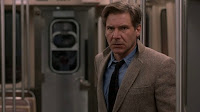
They want to talk to Sykes, but he has fled. Both he and Kimble have ended up on the same el train. There's a comical moment where Kimble is siting across the aisle from a man who's reading the paper and on the front page is a picture of Kimble and how he's an escaped fugitive. When the man flips to the front page and sees the picture, he looks up at Kimble, then slowly gets up and walks to the next train where he alerts a police officer about Kimble. This is when it is revealed that Sykes is on the train and he tries to shoot Kimble, but he ends up shooting the officer and they get in a scuffle, but Kimble manages to handcuff Sykes to a seat and gets off the train, but not before telling Sykes, "You missed your stop." Ha, nice zinger, Kimble. 

So now it's time for Dr. Nichols to give his big speech at the Hilton and he is introduced as being appointed director of Devlin MacGregor Pharmaceuticals. While he is talking about the wonder of the new drug, Provasic, he looks up to see Kimble in the back of the room with his arms crossed and glaring at him. Nichols knows now that he's been caught and starts to get nervous and has a Freudian slip when he says "dishonest" instead of "honest" and quickly fixes his mistake. Richard is getting closer to him, so he stops to acknowledge him and tells him he's in the middle of a speech. Richard doesn't care about that and tells Nichols that he thought he got away with it, but he (Richard) knows all about it and that he can prove it. I wonder just how much the audience can hear him? Probably just the people in the front. Nichols asks him to step aside so they can talk. The audience gasps when Kimble accuses Nichols of switching the samples so that RDU-90 could be approved. Basically, at this point, it's obvious that Sykes was hired by Nichols to murder Kimble to cover up that the drug was no good, but obviously Richard wasn't home that night because he was at work and I guess his wife was just collateral damage. Or maybe they went with the intention of killing his wife, then framing the murder on Richard so he would be locked away forever. I'm not really quite sure what the plan was. You would think they would just want to kill him so there would be no chance of something like this happening! Also, with framing someone, you would have to make sure that everything went to plan and it's not like they knew Helen's last actions would accidentally convict her husband of killing her; that certainly wasn't in their plans! 

So, anyway, Kimble and Nichols ends up fighting in the presidential suite that Nichols is staying in and their fight is taken outside where they crash through a glass roof and they both end up in (Nichols) or on top (Kimble) of a service elevator which takes them to the laundry room. At this time, Gerard and his team are on the scene and they also follow them to the laundry room. Nichols knocks out Cosmo with a big lead beam and takes his gun. He sees Gerard and is about to shoot him, but Kimble, who has picked up a metal pipe, knocks out Nichols before he can shoot the U.S. Marshall, so he has saved Gerard's life. By now they all know that Richard is innocent and that's the end of the movie. 

Sometimes I like to guess how old an actor is when I watch a movie and that's what I did with this one. I guessed Tommy Lee Jones to be in the 54-58 range, maybe 52 at the youngest. I thought he would be a good decade older than Harrison Ford, who I guessed was 45-48. Uh....how wrong I was! Tommy Lee Jones was around 46 when he filmed this and Harrison Ford is actually OLDER! Not by very much, just by four years, but still. 

Saturday, October 31, 2015

Second Murder

Double Jeopardy
Director: Bruce Beresford
Cast: Ashely Judd, Tommy Lee Jones, Bruce Greenwood, Annabeth Gish
Released: September 24, 1999
Viewed in theaters: September 26, 1999


This is one of those movies that are so bad, they're awesome and enjoyable to watch. I don't know what it is about this movie. I know it's not a particularly great movie, but I've seen it a handful of times and always love watching it. Maybe I just love it when a-holes get their comeuppance.

I don't know whose husband is worst: Jennifer Lopez's in Enough or Ashley Judd's in this movie. One of them was an abusive and cheating jerk and the other faked his own death and made it looks like his wife did it so she would rot in prison! Yes, in this movie, Ashley Judd's husband stages his own death and frames his wife. But she is out for revenge when she is told of a little something called....double jeopardy! Dun dun dun!

Libby and Nick Parsons (Ashley Judd and Bruce Greenwood) appear to have the perfect marriage...at least to Libby and everybody else! They have an adorable five year old son named Matty, they live in a beautiful home in Whidbey Island, Washington (which I've been to...shout out!), Nick has a successful career. However, Nick is having an affair...with Angie (Annabeth Gish), Libby's best friend of all people. One night, while on a weekend boat trip, Libby wakes up in the middle of the night after a passionate night with her husband to find blood everywhere and her husband missing. She is stopped by the Coast Guard where she is arrested for the murder of her husband. It doesn't seem to cross her mind until much later how weird it is that her husband was "murdered" and yet she was alive and fine. And wouldn't she hear her husband being stabbed to death? It's a boat...how big can it be? Exactly, Cal from Titanic. How BIG can it be? I mean, of course people are going to think she was the one who killed him! And that's why she is sent to prison. Although, I say, no body...no death! And they didn't find the body...of course they were out in the middle of the ocean, so they figured she dumped his body in it.

I don't think Nick framed his wife because he wanted to get out of their marriage and be with Angie. That seems a little extreme. Don't get me wrong, the whole thing is extreme, regardless. Rather, he has a nice little life insurance policy that will, should he die, and his wife so happen to be the cause of his death, will go to his son. Libby (not knowing anything about the affair) gives Angie custody of her son. I don't remember if they said anything about her having any parents or siblings she could leave her son with (although there is a scene later where she's visiting her mom in the South). It seems weird that you would leave your child with a close friend rather than a family member. It's just like that movie Life As We Know It....don't even get me started on the stupidity of those parents! I guess the hefty life insurance money went to Angie since she became Matty's guardian, although I always thought when money is for a kid, it stays in the bank where it cannot be touched by anyone until the kid turns 18. But I don't know anything about banking and finances, so I could be totally wrong. Now that Nick has his new girlfriend and a crapload of money (I mean, he had a bunch of money before, so I really don't know why he needed this money so bad...he must have really hated his wife even though we never saw anything to support that), he is able to take Angie and Matty to San Francisco.

This is around the time when Libby is starting to think something is up. I don't remember how long she was sentenced for but at least a year has passed when she notices that Angie and Matty don't come around to visit as much as they used to and soon it gets to the point where Libby can't even contact Angie anymore. Through trickery she obtains Angie's new phone number and address and is beyond pissed to discover she has moved to San Francisco and didn't even tell Libby. Well, yeah, I would be pretty furious too if I was in jail and my friend was watching my kid and they moved to another city without telling me. She calls Angie to give her a piece of her mind, but Angie says she meant to call and tell her, but she's been so busy. Matty is there and wants to talk to his mom so Angie lets him, but her hand is still on the receiver, ready to snatch that sucker away.

Okay, I don't remember anything about being five years old, nor do I know any five year olds, so I don't know how a five-year-old interprets the concept of death or prison. Does he know his dad "died"? Does he understand his mom is in prison because she "killed" Daddy? But SURPRISE! Nick isn't dead. Bet you didn't see that one coming! I thought for sure Matty was going to blurt out, "Mommy! Daddy isn't dead anymore!" But he just talks to her and says he misses her and when is he going to see her again. It isn't until a few minutes later when Nick walks in that he exclaims, "Daddy" and that phone is quickly hung up by Angie.

It all suddenly starts to click together for Libby. It's her "a-ha!" moment. Not only has her husband framed her for his so-called murder, but he was having an affair with her best friend...who basically kidnapped her son and took him to another city so they could live off Nick's life insurance money. Well, lucky for Libby, one of her fellow inmates used to be a lawyer and she informs her of a little thing called double jeopardy. It is a clause that states that a person cannot be tried for the same crime twice. That means that since Libby was already convicted for murdering her husband, then she can really murder him and not be sentenced for it. So of course she is all ready to get her vengeance. And if you're asking why didn't she just tell the police, she did, but Nick and Angie changed numbers and moved or did something where they couldn't be traced.

With good behavior, Libby gets out six years later where she lives in a halfway house and is under the supervision of her parole office, Travis (Tommy Lee Jones). There is an amusing scene where she's at the library trying to find if she can locate Nick's or Angie's address. The guy helps her find the info she needs (remember the present day is 1999 and she was in jail when the whole Internet craze of the '90s broke out so she doesn't know anything about how to get around the 'net). However he is a creeper who blatantly hits on her and asks her out. She tells him she'll have to check with her parole officer and when he asks her what she did, he is out of there in a flash when she replies, "Oh, I killed my husband." That's a good line to get rid of unwanted attention from the opposite sex!

In order to find Nick, she escapes from Travis while they're on a ferry in Puget Sound and her travels take her to Colorado where Nick and Angie lived and Angie died in a fire (but Libby knows the fire was not an accident! I'm not really sure why Nick killed Angie) and then she goes on to New Orleans where Nick has been living under the alias of Jonathan Devereaux. Do you think he took that surname because he's a fan of The Golden Girls? "I'm Jonathan Devereux, no relation to Blanche."

She confronts Nick at a fancy auction he's holding that she snuck into and threatens to expose who he is if he doesn't let her see their son. He tells her they will meet tomorrow at this huge-ass cemetery and for some stupid reason, she agrees to it. I'd be like, "Hell, no, we're not going to some big open space where there are plenty places to hide...we're going to meet at the Starbucks around the corner!" Unbeknownst to Libby (and the audience at this time), Matty, who would be around 12 at this time, isn't even in the same state. He is at boarding school in Georgia. Nick has paid some random kid to take Libby on a wild goose chase and keep running from her until she ends up in a mausoleum where Nick is there to greet her with a knock over the head and puts her unconscious body in a coffin...with another body! Ewwww! Luckily she has a gun (which she stole from Travis) to shoot her way out and luckily she wasn't underground so she can just walk out the door.

Meanwhile, on his quest to find Libby, Travis does his own research on Nick and finds out he's still alive and Libby never killed him. They both confront Nick where Libby tells him she can shoot him in the middle of Mardi Gras and nobody will even blink and Travis confirms that this is true. We-ell, this is not exactly true. I did a little research (and I do mean little!) and double jeopardy doesn't exactly work this way. She would still be convicted if she actually killed Nick. Luckily the movie doesn't have to deal with that because she doesn't kill Nick...at least not in cold-blooded murder. She decides he's not worth it and he grabs her gun and tries to kill her, but after a struggle, Libby kills him in self-defense.

She goes to see her son and he is played by Spencer Treat Clark who I totally forgot about. I remember seeing him everywhere around the early '00s (like Gladiator and and Unbreakable and Mystic River) and I was like, "Oh, yeah, that kid!" He was a really cute kid and I looked up some recent pics (he's 28 now) and he's really good-looking. He definitely was a winner in the genetic pool. Mother and son have a teary, heartfelt reunion.

Thursday, December 3, 2009

A Very Long Review

Um spoilers...and please ignore how crappy this looks (especially towards the end)! I have not mastered Blogspot yet; why can't it be simple to use like LiveJournal?

Batman
Director: Tim Burton
Cast: Michael Keaton, Jack Nicholson, Kim Basinger
Released: 6/23/89

Oscar nominations:
Best Art Direction (won)


Batman Forever
Director: Joel Schumacher
Cast: Val Kilmer, Jim Carrey, Tommy Lee Jones, Nicole Kidman, Chris O'Donnell
Released: 6/16/95
Viewed in theaters: 6-7/?/95

Oscar nominations:
Best Cinematography (lost to Braveheart)
Best Sound (lost to Apollo 13)
Best Sound Effects (lost to Braveheart)


The Dark Knight
Director: Christopher Nolan
Cast: Christian Bale, Heath Ledger, Aaron Eckhart, Maggie Gyllenhaal, Gary Oldman
Released: 7/18/08
Viewed in theaters: 7/20/08 (Um, my first viewing)

Oscar nominations:
Best Supporting Actor - Heath Ledger (won)
Best Sound Editing (won)
Best Art Direction (lost to The Curious Case of Benjamin Button)
Best Cinematography (lost to Slumdog Millionaire)
Best Editing (lost to Slumdog Millionaire)
Best Makeup (lost to The Curious Case of Benjamin Button)
Best Visual Effects (lost to The Curious Case of Benjamin Button)
Best Sound (lost to Slumdog Millionaire)


As you can see, I watched three different Batman films. Three different decades, three different directors, three different Batmans (sorry, Clooney, you didn't make the cut - there's no way you can make me watch that dreck!). Now I should preface this by saying that I'm not a Batman fan in the least; I know nothing when it comes to the world of Batman. In fact, for the longest time, I had no idea he was referred to as the Dark Knight. When I first heard of Nolan's title, I thought he was the one who came up with it (I'm being serious, people) and thought it was a catchy title and could totally see Batman being called the Dark Knight. Little did I know... Actually, they refer to him as the Dark Knight twice in Batman Forever, but I didn't remember that since it's been at least ten years since I've seen that movie. I also didn't know that Harvey Dent and Two Face were the same person. I remember Eckhart doing press before TDK was released and didn't understand why all the interviewers kept bringing up the character of Two Face and then I put two and two together. Aha! So in this review I'm going to compare and contrast the different elements of these three movies. I totally won't discriminate - oh, who am I kidding? I so have a clear favorite and you might be surprised by which one it is. Or not. Probably not.

Director: Burton v. Schumacher v. Nolan
All three movies are very different in style. Burton's has a certain athestic where you definitely feel like you're watching one of his films. There's a very gritty and almost nostalgic feel to '89. It kind of reminds me of an old mafia movie, especially with the way the men dress: trenchcoats, bowties, vests, fedoras. Watching it is almost the equivalent of watching a comic book come to life.

Then there's Schumacher who took over when Burton's movies were deemed too dark. (While I didn't find '89 scary, Batman Returns is pretty twisted and dark.) Forever is a flashy summer blockbuster. It's almost like watching a live-action cartoon. Most of the characters are caricatures with over the top performances and it's clear Schumacher chose the actors based on their attractiveness or popularity at the time. Watching this is like eating a bag filled with fun-sized candy bars: enjoyable at first, but the more you have, you start to get sick of it and want to stop and make it go away. It gets very tiring very fast.

Nolan's version is the most realistic and I mean this as a compliment when I say it's like I wasn't even watching a Batman movie (except when Bale showed up in costume). All the characters felt real, not as though they were taken from Saturday morning cartoons and there was no dialogue that sounded like it came from a balloon bubble. It's insane how well this movie did. Look at it this way: according to IMDb.com, it made more money in the first six days of its release than Batman Begins made in its ENTIRE run. As Brian Fellows would say, That's crazy! Oh yeah, you should know Begins made $205 million. Crazy! (By the way, TDK made over a billion dollars around the world.)

Gotham:
Obviously, the look and feel of Batman's hometown differs in all three films. There's a very 1930s New York vibe to it in '89. It doesn't look like a place I'd visit because of its dark and gritty appearance. I read a review that said the exterior shots of the city looks like "a diagram of an artificial city" and yeah, I have to agree. Of course, this film came out twenty years ago, so of course the special effects are going to be outdated and crappy. I'm sure twenty years from now we'll all have a good laugh over how big the cell phones are in TDK.

If Burton's Gotham looks like a place I wouldn't want to visit, then Schumacher's vision is a city I would avoid at all costs. Good Lord. His Gotham makes Las Vegas look like the small Iowa town where my mom grew up. There are neon lights everywhere and the GCI exterior just looks cheap. Forever's Gotham gave me a huge headache and can you imagine living there? Ugh! Nolan's Gotham is a real place where real people live. Of course, that's because it's Chicago, but they film it so it's not obviously Chicago and it works. No stupid and cheap made-up Gotham.

Batman/Bruce Wayne: Keaton v. Kilmer v. Bale:
In all three movies, I prefer Bruce Wayne to Batman because I cannot take a grown man in a bat costume seriously and all three actors are way better when playing Wayne. Keaton is charismatic as Wayne but it bugs me he didn't alter his voice as Batman and the delivery of the line about "dancing with the devil in the pale moonlight" to the Joker is just awful. Another thing that bugs me is the scene where he's sleeping hanging upside down. There are so many things wrong with that. First of all, Batman is human, not a bat, so WTF? And if he was a bat-human, wouldn't he be sleeping during the day? Duh! And second of all, Vicki Vale was there and saw him; wouldn't she be suspicious? It was just stupid.

Kilmer at least attempts to change his voice as Batman, but he gives off a very metrosexual vibe (perhaps it's the nipples on the Batsuit?) as Bruce Wayne as in he wouldn't want to break a nail. With Bale, you could totally see him taking some names and not afraid to pull a punch. Now his Batman voice is unintentionally funny but you have to give the guy credit for at least trying. Maybe he should've used his natural accent as Batman, though people would all be "why the f--- does Batman have a British accent?"

The Women: Basinger v. Kidman V. Gyllenhaal:
The love story in the Batman films always seem like filler to me and they're just thrown in there to fill a quota. As photographer Vicki Vale in '89, I thought Kim Basinger looked better with her hair pulled back and wearing glasses then when she was "glammed up" in those ugly pouffy dresses. She has so much hair that it's almost her supporting co-star.


As Chase Meridian, Kidman's role in Forever is pretty much only to seduce Batman and make booty calls and come off as desperate. See, she's in love with Batman, but Bruce is in love with her (she's his psychiatrist - and whose therapist looks like that anyway? Please!) and she doesn't know her patient is the Caped Crusader. Hijinks! So of course everyone knows Katie Holmes played Rachel Dawes, Bruce's childhood friend and love interest in Batman Begins, but due to "schedule conflicts" (please, Joey Potter, we weren't born yesterday!), Maggie Gyllenhaal stepped in for her in its sequel. So here are my thoughts about TomKatGate:


I like Maggie, but I found her to be the weakest link in TDK only because I didn't really care for the character of Rachel and found any scenes with her to be boring. While I was semi-spoiled about her death (when I was walking into the theater, I walked past these guys who said, "I can't believe they did that to Batman's girlfriend!" So yeah, it wasn't that hard to figure out something terrible was going to happen to her), and while I felt bad for Bruce, I was kinda glad she was gone from the movie at that point. Oh, well, at least a certain someone's sister played her so I can write hilarious captions like this:


"Hey, didn't I make out with your brother once?"

The Joker: Nicholson v. Ledger
It's the age-old question that's been going on for decades (okay, under two years): who was the better Joker? Who do I prefer? I was a teenager when 10 Things I Hate About You came out, so who do you think? Hey, I don't discriminate...against hot Australians. Okay, I may be a bit biased with my decision. I've always been a Ledger fan (and yes, that was an awful day for me). Plus I heard that Nicholson said that he would only be cast as the Joker if only Burton billed him first? Uh, shouldn't the guy playing the MAIN TITLE CHARACTER be billed first? Dude, get over yourself!

But actor preference aside, let's just focus on the acting aspect. Now I have no idea whose Joker is more like the original one (probably Jack's since his is more like a comic-book character), but if I watched a clip from '89 without knowing who played the Joker, I would have said Nicholson in a second. His schtick is he falls in a vat of chemicals and his skin turns white (not burned as you might think) and he has a permanent smile. He kills people by using a cute array of deadly gags like hand buzzers that electrocute and acid-squirting flower pens. He's a happy clown! He likes to twirl his cane and dance to Prince. (WTF, I know). Creepy, yes. Scary, um, not really. He plays it very campy. Now I'm going to get a lot of flack for this, but I really don't see what the big deal about his Joker is and I remember when it was announced Heath was playing the new Joker and everybody was saying he would never do Jack justice and how he was going to suck and ruin the movie. I'm sorry, but if John Lithgow (who was actually considered for the part; I bet he wouldn't have demanded to be filled first!) had played the Joker the EXACT same way as Jack did, nobody would be saying anything about his performance. And now it's funny that people are saying Heath was the better Joker (except for the stubborn Burton fanboys). Now if I saw TDK and didn't know who played the Joker, I would have never guessed in a million years who it was. (Well, except for the three second he's not wearing make-up, then it's pretty obvious). I think the voice he used (which Entertainment Weekly described as "Al Franken mixed with a nerdish pedophile" - thank you, EW, I couldn't have said it better myself) was the big reason that made Ledger almost unrecognizable. In real life, Heath's voice was like buttah, but his Joker voice is so damn creepy! Now, undoubtedly, he is scarier than '89 Joker, but I would dare say that he is funnier too...and he didn't even have all those cutesy gags. I laughed when he overheard one of his goons describe him as "the crazy clown in the cheap purple suit" and tells him "Oh, by the way, my suit wasn't cheap. You should know; you paid for it." And by the fourth time he asked somebody if they wanted to know how he got his scars, all I could think of was '08 Joker at some dinner party, asking guests that same question and people thinking, Oh, God, not this schmuck again!" Also, did anyone else think he rigged those detonators on the boats so they would blow up their own boat instead of the other one?
Two Face: Jones v. Eckhart:
In Forever, Two Face is every bit the comic book caricature with his 
"normal" side and his 
"wild" side. Not only is his appearance and suit divided into
two, but also his headquarters and he has two, uh,
concubines, I guess: Sugar and Spice. We never see him as D.A.
Harvey Dent, although there is a quick explanation of how he
turned evil, but I didn't really understood what happened to him 
physically. 
In TDK, Eckhart doesn't actually become Two
Face until the third act; we see him as good guy Dent for the
first two. His Two Face makeup is definitely more gruesome
than Jones'. In
fact, the only thing I would say is not very realistic about TDK (well, besides, some of the Joker's 24-style terrorist activities; seriously, you would need to know some serious access codes to pull off what he does in that movie), is the fact that this man is walking around with half of his FACE burned off right in the open. Even if you lived to survive that, there's no way anybody could go out in the open like that and not get infected. But that said, it is still a Batman movie. I have to give Eckhart props, because even though Heath Ledger steals the movie, he definitely held his own. Harvey Dent is also featured (in a very small role) in '89 and played by Billy Dee Williams. Burton never got to use him as Two Face, but there was some serious foreshadowing when he reads a letter from Batman at the end of the film and states, "If the forces of evil should rise again, call me." Hmmmmm....he was talking about himself! And speaking of foreshadowing, there was some of that in TDK when Fox tells Bruce that his newest weapon of choice "should do well against cats". Whoever could he be referring to?

The Riddler and Robin:
To get a good sense of Jim Carrey as the Riddler in Forever, take Ace Ventura and the Grinch and smash them together, multiply that by ten and you have the Riddler. Carrey is ridiculously over the top and I have a feeling that Schumacher was encouraging him to be as obnoxious as possible. Unlike '89 and TDK where the villains are feared, I never got that sense with the Riddler or Two Face. They were used more for comic relief, and honestly, they weren't that funny. While I wanted more scenes with the Joker when I watched TDK, the Riddler couldn't get off my screen soon enough when I watched Forever. Now I've seen Eternal Sunshine of the Spotless Mind, so I know Carrey is a capable actor, but man, he is awful in this. There's even a scene where he says something to Batman, then asks, "What that over the top?" YES! Yes, it was! The real person we should feel sorry for, though, in
this movie (after all, Carrey laughed his way to the bank), is Chris O'Donnell. Not 
only did he have to play the useless Robin (who is Batman's answer to Scrappy-Doo), 
but he is the only one from this film who went on to be in the even worse Batman and Robin - which I've never seen and never want to judging from the few clips of it I have seen.


Okay, to wrap things up, because I'm sure nobody is reading
this anymore, I actually preferred
Michael Gough's Alfred in '89 and Forever to Michael Caine's in TDK because with the former
that's the only character I've ever seen him play, so he is
Alfred to me. With the latter, I've seen
Caine in other movies and at award shows, so I just saw
Michael Caine. (Though he did have
some funny lines). Commissioner Gordon is hardly used in
'89 and Forever, but is very much
used in a great storyline in TDK and Gary Oldman is right
behind Ledger and Echkart in terms
of performance.

Why so...Sirius?

Somehow my font keeps changing and and I have no idea why and this review is going to look really messed up and I'm about to go all Christian Bale on this stupid site, so I better wrap this up. Anyway, here is my final evaluation of the movies:
Batman: See it if only for it's a classic and it did jump start the whole franchise (which is a good and bad thing). And if you don't compare Nicholson's Joker to Ledger's, he's not entirely that bad. I still think Lithgow would have make a better '89 Joker, though.
Batman Forever: This movie sucks. Don't see it if you haven't already.
The Dark Knight: This movie is awesome and if you haven't already seen it, you must live under a rock. There's a reason this movie made a boatload of money: because everyone and their grandma went to see it...multiple times!