Showing posts with label william h macy. Show all posts

Thursday, April 22, 2021

Check

Searching for Bobby Fischer
Director: Steven Zaillian
Cast: Joan Allen, Ben Kingsley, Laurence Fishbourne, Joe Mantegna, Max Pomeranc
Released: August 11, 1993

Oscar nominations:
Best Cinematography - lost to Schindler's List 


In case you weren't sure, the title is NOT referring to trying to find the actual Bobby Fischer, but rather the NEXT Bobby Fischer. Good, glad we cleared that up! 

So I should probably preface this by saying I know nothing about chess. I have never played it, I don't know the rules (I probably wouldn't understand the rules!). Much like one Jon Snow, I know nothing (about chess)! That said, I quite enjoyed this movie (even though I had no idea what was going on when chess was being played). You'd think watching people play chess would be one of the most boring things (and I'm sure it is in real life!), but the movie does a good job of keeping it cinematic.

This movie sort of reminded me of The Wizard. You know, that movie was about a young boy who is a video game prodigy and this movie is about a young boy who is a chess prodigy. I will say that this movie is better, but let's be honest, pretty much any movie (within reason!) is better than that one! 

The chess prodigy in question is a seven-year-old boy named Josh Waitzkin (played by Max Pomeranc). I had no clue Josh was a real person and that this movie was based on a book of the same name written by Josh's dad, Fred Waitzkin. But to be fair, I don't follow the chess scene, so I'm not familiar with any big name chess players (and to be honest, I'm not sure how big a name Waitzkin was as he was really a child chess prodigy). Yeah, I've heard of Bobby Fischer, but I feel like he's one of those big names everybody's heard of. I didn't know anything about him except he was really good at chess. We get some small Bobby Fischer history lessons sprinkled into the movie and he seemed kind of like a jerk. I did a quick skim through his Wikipedia page and yikes! He allegedly idolized Hitler and was glad that the 9/11 attacks happened. I'm not sure why you would want to be compared to him! Yes, I realize that they're only comparing Josh's chess skills to Fischer's chess skills and they make it a point to say that personality wise, Josh is nothing like Bobby. At this point in time (1992/93), I'm not sure how much is known about Fischer's truly problematic view of the world. If we really were searching for Bobby Fischer, I don't think I'd want him to be found! We don't need to search for him anymore, though, because he died in 2008. 

Heh, one of my notes I wrote was, "Bobby Fischer seemed like a whiny baby". I can't remember exactly why I wrote that, but it seemed like he was always complaining about something as young Josh tells us in voice over. (BTW, this kid was not the best enunciator of words so it was sometimes difficult to understand what he was saying in voiceover). I swear he told us that he complained about his view of his hotel in Iceland was too nice. WTF? 

So when we meet Josh, he's a kid who's just turned seven and he lives in New York with his parents, Fred and Bonnie (Joe Mantegna and Joan Allen) and his little sister. He enjoys watching Vinnie, a presumed homeless man (played by Laurence Fishbourne) play chess in Washington Square with other men. This movie never states what year it's supposed to be, but the real Josh Waitzkin was born in late 1976, so it would have been 1984 around the time he got into chess. Funnily enough, that was the year his portrayer, Max Pomeranc, was born, so there is only an eight year difference between them. I did wonder if they got a kid who was a chess player to play Waitzskin since they'd probably want to cast somebody who knew what they were doing and sure enough, according to the Wiki, Pomeranc was was one of the country's top 20 chess players in his age group at that time. Like I said, this came from Wiki, so who knows how reliable it is. 

So I haven't read the book (obviously, or otherwise I would have known Josh Waitzkin is a real person), so I'm not exactly sure how Josh learned how to play chess. His parents didn't teach him and he didn't learn at a friend's house. The movie makes it seem like he learned just from watching Vinnie and the other men in the park. Can you just self-teach yourself to play chess? I would think you would need to know the rules. Bonnie notices that her son has been fascinated with the chess players in the park, so she takes Josh to one old man in the park who's supposedly some great chess player from the past. His table has a sign that says you can play a game with him or have your picture taken with him for five dollars. (We will later learn that you don't make a lot if you're a world renowned chess player). Josh plays the man and loses, but Vinnie is watching him play and is impressed with the young boy's chess skills. He tells Josh's mother, "Your boy used pieces in combination to attack." Whatever that means, but it certainly impressed Vinnie. He asks Josh his name and Josh tells him. When he asks him, "Josh what?" his mother tells him not to give out his last name, but of course he does and Vinnie writes it down. 

When Bonnie reveals to her husband that Josh played chess in the park, her husband replies with, "Josh doesn't know how to play chess." She answers with, "Yes, he does. Don't ask me how, but he does." Yeah...the movie really never explains HOW he learned how to play chess and the parents seem to accept it. I'm sure it's more expanded on in the book. Josh's dad works as a baseball analyst/sports writer (something like that!) and likes to bond with his son over baseball; Josh is even on a Little League team. This has nothing to do with the movie, but the actor who played him sounded so much like Ray Romano, that I kept expecting Doris Roberts to come out and exclaim, "Raymond!" 

After hearing this revelation that his son knows how to play chess, Fred decides to bring out the chessboard to play a game with Josh. The game ends fairly quickly and Fred wins. He confesses to his wife that he should have let Josh win and was even giving him an opportunity to win. Bonnie tells him that Josh wasn't trying to win. Fred decides to play again with Josh and this time he tells him to "really try."

This time they play seriously and it takes so long for Fred to decide how to move his pieces that each time it's his turn, we see Josh playing with his sister during one of his dad's turns, talking on the phone to his friend (who he tells that he'll be right back when his dad calls to him that it's his turn, he runs to the living room, moves his piece, then runs back to the phone), and most humorously, Josh is taking a bath after his dad his finished thinking over a move and when he tells Josh it's his turn, Josh tells him exactly what he wants moved and he ends up winning the game. While it seemingly takes his dad several minutes to make a move, it only takes Josh a few seconds and he knows exactly how to move the pieces to win the game. 

Fred takes Josh to the Metropolitan Chess Club that he knows about from a guy that writes the Chess Column at the same newspaper he also writes for. Um, excuse me, Chess Column?? What? Is this only found in big city papers? I have never heard of a Chess Column in a paper before; granted I've never actively looked for one before. I also don't read the newspaper, I mean, how archaic.  

Anyway, Fred is there to look for a man named Bruce Pandolfini (played by Ben Kingsley). Obviously, he is a real person and I looked up his stats on Wiki:
-He is still alive at the time of this review; he is 73.
-Wiki tells me "he is considered to be America's most experienced chess teacher."
-I thought this little tidbit was interesting; I haven't seen The Queen's Gambit; but now I'm interested to check it out:
In 1983, Pandolfini was the chess consultant to author Walter Tevis for the novel The Queen's Gambit, for which Pandolfini had also suggested the title. Decades later, Pandolfini returned as consultant for the 2020 Netflix miniseries of the same name.

- He looks nothing like Ben Kingsley. Okay, that wasn't in his Wikipedia page, but just thought I would throw it out there. 

Before Bruce accepts tutoring Josh in chess, he invites Fred to an adult chess tournament where all the national chess champs are gathered. This is where we find out that one of the great chess champs, Asa Hoffman (again, somebody I've never heard of), who grew up in a wealthy family and went to prestigious schools, plays 200 games a year and only makes $2,000 from doing it. I suppose if you come from a wealthy family, you can afford to immerse yourself in chess! Fred tells Bruce, "Clearly, you had me come here so I could see all this. But if you really wanted me to say no to letting my son play, you wouldn't have bothered. You want me to think you want me to say no, but you actually want me to say yes." Bruce just replies with, "I want back what Bobby Fischer took with him when he disappeared." I don't know if I was clear when I was talking about Fischer, but supposedly he would just disappear and nobody had any idea where he was. But then he would pop back up to play a game, then disappear again. 

Bruce has agreed to tutor Josh and during their first session they don't even talk about chess, let alone play it. Josh has a large selection of board games in his room and they play Clue. I did notice he had Stratego which is a game my brother also had. We used to play it and he would always beat me because I sucked so bad. That's probably the closest game to chess I've ever played. 

At their next session, Josh is at the Metropolitan Chess Club and Bruce has set up the board for him. He tells his new pupil, "The mate is four moves from the position in front of you." This absolutely means nothing to me! He wants Josh to figure out the moves in his head; Josh tells him he can't do it without moving the pieces. This prompts Bruce to knock the pieces off the board and they clatter onto the floor. A bit overdramatic if you ask me. But after staring at the board for several minutes he gives him the answer, "knight to C8" which pleases Bruce. It pleases him so much that he gives Josh a certificate that he deems is "very rare." It says "Master Chess Certificate awarded to ______ for highest achievement on ______ (date)." Bruce continues to oversell the certificate. He tells him it's only been given out a few times in history and "only to those who achieve a lot of master-class points." This is just a piece of paper; it can't be that significant, but he wants to encourage Josh to earn master class points because it will show that he's learning chess the way Bruce wants him to learn it. 

Speaking of which, Bruce tells Josh's parents that Josh shouldn't be playing chess with Vinnie and the other men in Washington Park. He tells them, "What I'm trying to teach him and what he's learning there are two very different things. Park hustlers play tactics, not position. They rely on wild, unpredictable moves meant to intimidate their opponents. ...It'll cost Josh dearly in real games." Fred was willing to agree to Bruce's terms, but Bonnie refuses because she knows how much it means to Josh and how much he loves playing chess there. Bruce tells her it will make his job harder and she just replies, "So your job's harder." This is the first hint we get where the mother has the kid's interest at heart while the father is more about honing the kid on his skill. 

Fred takes Josh to his first chess tournament (I missed where it was held) and while Josh was swimming at the hotel pool with the other kids who were also there for the tournament, another father asks Fred what his kid's rating is. I guess Fred has no idea what this means (I certainly have no idea what it means!) because he sees a sign that has the number 15 on it and tells him "fifteen" which the other father is amazed by the 1500 rating and tells him he doubts their sons will play against each other because his son, Morgan, isn't even rated 1000 yet. I looked up what a chess player with a rating of 1500 would look like. They would be an intermediate player with 5-6 years of playing the game under their belt. It said a bunch of things that didn't mean anything to me and added that they "will probably need a chess coach to improve further." I'd be curious to know what the rating he really was at that time; he certainly could have been close to 1500! I would definitely be rated a 0! 

At the actual competition, which takes place at a high school gym, the director of the tournament seems to be more concerned about the parents than the kids. He tells the parents they can watch, but he doesn't want any funny business - no throat noises, no comments, no eye contact, nothing where they might be giving a hint or a sign to their child on what to do.  

There's a funny moment where Fred is standing behind Josh, watching him play. Josh's opponent's dad is behind him and he's this big burly guy with his arms crossed, just glaring at Fred. I guess he's trying to intimidate him? Elsewhere, a fight breaks out when a father is accuses of pulling his ear and giving his kid a hint. The man claims he was just scratching it, but like the tournament director told them all, "Nobody cares if you're guilty or not" so all the parents are kicked out of the room and sent downstairs to the locker room (and locked in until the end of the tournament!) All the kids start clapping once the adults are gone and they can finally concentrate. I'm surprised they let the parents stay in the room in the first place. 

This movie is full of big name actors: Joan Allen, Laurence Fishbourne, Ben Kingsley....and we get another one when William H. Macy shows up as the father of the kid who is playing Josh in the final game. (A young Laura Linney will also show up later as Josh's teacher). A random kid keeps running back and forth to tell the parents what's going on in the game. When he finally comes to tell them the game is over, he just walks away and doesn't say who won (um, that's what they're waiting to hear, kid!) It is revealed that Josh won (of course) when he and Fred are on the train traveling back home and a sleeping Josh is clutching a trophy. This leads us to a montage where we see Josh collecting a bunch of trophies as he wins game after game. Their mantle is getting quite full! We also see him building a tower with all the chess pieces which seems kind of impossible. 

Trouble comes in the form of a new kid named Jonathan Poe who is deemed the new Bobby Fischer. Josh sees him playing the old man in the park and it appears that he's an even better player than Josh. I would hope he would be because he's been trained by his chess master, a stuffy elderly man with a beard, since he was four. It seems his parents just gave their son to this chess master (WTF?!) and he does nothing but play chess; he doesn't even go to school. (Again, WTF?!) Good Lord, I can't imagine anything more tedious than having to play chess all the time. All. The. Time! This kid is a chess robot; at least Josh is a normal kid who goes to school and as other interests like baseball and astronomy and building things out of Legos. Poe seems to have a uniform AND a catchphrase. In the three scenes or so we see him (all on different days, mind you) he's always wearing a white polo. He also says "Trick or treat" after he wins a game. I mean, he can't come up with a better or more relevant catchphrase? There's already one built in the game with "Check mate"! 

Seeing that he's not the best anymore and not wanting to disappoint his dad, Josh tells Fred he doesn't want to go to the State Finals. He reasons that if he wins, everyone will be expecting it since he's a top ranked player. And if he loses, he's afraid of what other people will think, especially his dad. (Though he doesn't tell his dad that part). He tells Fred, "Maybe it's better not to be the best. Then you can lose and it's okay." I totally get what he's saying. Being ranked the best at something has to put a lot of pressure on that person. But if nobody is expecting you to win, if you lose, nobody will care and if you DO happen to win, people will probably make a bigger deal because they weren't expecting it! If you're already the best at something, does anybody really care THAT much? Thank God I'm so mediocre so I don't have to worry about this! Josh does go to the State Finals but ends up losing in seven moves; he clearly lost on purpose. 

Bruce sets some new rules for Josh including no more speed chess or games in the park. He knows Josh likes it, but it isn't good for him. He tells Josh they're teaching him all the wrong things. He also asks Josh if he knows what "contempt" means and tells him, "You have to have contempt for your opponents". Josh says he doesn't even when Bruce insists that his opponents hate him, which I seriously doubt since there are seven/eight-year-olds. Josh has the best response when Bruce says, "Bobby Fischer held the world in contempt." (What a shock). He simply replies, "I'm not him." This is pretty much the thesis of the movie: This kid is NOT Bobby Fischer.
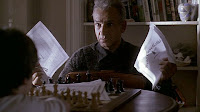
At another lesson (this one at Josh's home; I'm confused, sometimes they had lessons at the Waitzkin household and sometimes they had the at the Chess Club; they seemed to be wherever was more convenient for the scene), Josh wants to know how close he is to getting his so-called "very rare" certificate. A frustrated Bruce pulls one out of his briefcase and tells him it doesn't mean anything and starts pulling out many more copies he has and asks him if he wants those too. Geeze, what an a**! Bonnie thinks so too because she tells Bruce to get out of her house. On his way out, he tells her, "To put a child in a position to care about winning and not to prepare him is wrong."

Later that night, Bonnie and Fred get into a fight. Fred agrees with the chess coach and says Josh is in a slump and is afraid of losing. Bonnie retaliates with, "He's not afraid of losing; he's afraid of losing your love." Fred finally sees the light and tells Josh it's okay if he wants to stop playing chess, but Josh tells him he wants to play at the National Finals in Chicago, where, to become the champion, a player must win all seven games.

Even though Bruce was a total jerk to Josh, Fred still invites him to go to Chicago with them. He says he can't go so they end up taking Vinnie instead. It's kind of amusing they take a presumed homeless man with them. But it is kind of sweet and Vinnie was a much better coach to Josh than Bruce ever was. Bruce does end up coming to Chicago and he patches everything up between him and Josh when he gives Josh a framed certificate saying that he "obtained the rank of Grand Master in the eyes of his teacher". He tells Josh he's proud of him and is honored to be his teacher. Aww. 

So it shouldn't surprise anyone that Josh makes it to the seventh and final game and his opponent is Jonathan "Trick or Treat" Poe. Josh's parents, Vinnie, Bruce, and Poe's chess master are all watching the game on a monitor. Right away, Vinnie and Bruce have a disagreement when Bruce doesn't want Josh to bring out his Queen, but Vinnie thinks he should. As usually, I have no idea what's going on. Josh ends up getting Poe's Queen and tells him, "Trick or Treat." I'm sure Poe loved that! 

On the monitor, Bruce sees that Josh can win in 12 steps. (How?!?!  I mean, I guess it is possible to see your moves in advance). We see Josh concentrating on the chess board as we're hearing voiceover from Ben Kingsley telling us the moves he should make as though Josh is hearing what his teacher is telling him the moves he needs to make. Even before he makes a move, Bruce can tell that "he's got it". Being the nice and decent kid he is, Josh offers Poe a draw so they can share the championship. Poe just scoffs at this and Josh tells him, "You've lost; you just don't know it." Poe still doesn't believe him and tells him to look at the board and Josh replies, "I have." He insists on them sharing the title, but Poe still refuse to take his deal and tells him to move. He does and he wins. Yay. 

The movie ends and a few title cards show up, telling us that Josh "still" plays chess and he is "currently" the highest-ranked player in the U.S. under 18. Remember, this movie came out in 1993 so those key words are no longer relevant! And since Bobby Fischer's name is in the title, we get a title card with an "update" on him: "In September 1992, Fischer emerged from secession to challenge his old rival Boris Spassky. After winning, he promptly disappeared again." I guess Bobby Fischer was not a fan of this movie. What a shock.

Thursday, January 12, 2017

No 'Room' for Error

Room
Director: Lenny Abrahamson
Cast: Brie Larson, Jacob Tremblay, Joan Allen, William H. Macy, Sean Bridgers, Wendy Crewson
Released: October 16, 2015

Oscar nominations:

Best Picture - (lost to Spotlight)
Best Director - Lenny Abrahamson (lost to Alejandro Inarritu for The Revenant)
Best Actress - Brie Larson (won)
Best Adapted Screenplay - Emma Donoghue (lost to Charles Randolph and Adam McKay for The Big Short)


I should probably start out with saying that there will be spoilers, MAJOR spoilers, in this review.

I was aware of the book this movie is based on by Emma Donoghue when it was released in 2010 from reading blurbs about it in Entertainment Weekly and Marie Claire, two magazines I subscribed to at the time. I knew it was about a young woman and her five-year-old son who are being held captive in a small room (hence the title). It wasn't really the subject matter of the story that turned me off from the story, no, it was the fact that the story is told from the perspective of the five-year-old. When I read that, I was like, "I'm out!" That just did not appeal to me at all. However, while there are voiceovers from the young boy in the movie, movies are different from books in that you are not always being narrated by someone so it was much easier to take. Now maybe I'm wrong about the book and it could be wonderful, but I really do not want to read something from the perspective of a five-year-old even though this certain five-year-old is (sadly) like no other child his age.

If one went into this movie without knowing what it was about or having read the book, they might be a little confused at first about what is going on. We see a young woman, Joy (Brie Larson), celebrating her son Jack's (Jacob Tremblay) fifth birthday. Jack wakes up and goes around the small room they're in, saying hello to the different pieces of furniture and appliances. Despite living in cramped corners, they seem to be happy. We soon realize that they aren't just living there, but are being held prisoner there (well, I already knew that since I was aware of the story!) The 'room' they are living in is a small shed outside the home of Joy's abductor, a man she calls "Old Nick" (Sean Bridgers) - she doesn't know his real name. It consists of a bed, a wardrobe, a toilet, a bath, a small TV, and a small kitchen/dining area. The only window is a skylight. Joy has Jack do small laps around the room and push ups to get exercise. Her abductor has a passcode to get in and out and brings them food and sleeps there at night so he can rape the twenty-four year old girl. We learn that Joy has been held captive in this room for seven years and obviously Jack is a product of her abductor. To be honest, I'm surprised she didn't have any more kids. When he spends the night, Joy makes Jack sleep in the wardrobe. There is a moment in the movie when Jack sneaks up on Old Nick when he's sleeping and Joy wakes up and starts freaking out and tells Old Nick to get away from him. One thing is for sure: even though Jack is his son, Old Nick obviously doesn't care about him. He doesn't even know how old he is. Of course, this is a guy who abducted a girl when she was seventeen, raped her repeatedly, and kept her prisoner in a small room for seven years. Remember in my review of The Silence of the Lambs when I said I will never help anyone move a couch into a van because that's how the young girl was abducted in that movie? Well, if someone asks me to look for their dog, I'm not helping them because that was how Joy was abducted in this movie. 

Since Jack has only known "room" (and he refers to it as though it's a town he lives in) his entire (albeit short) life, he is not aware that anything else outside of "room" exists. Everything in "room" is real while everything he sees on the TV, is not. Because Jack has seen spiders and mosquitoes in "room", they are real, but the squirrels and dogs he's seen on TV, are not. The plant (that badly needs to be watered) in "room" is real, but the trees he's seen on TV are not. There's a moment in the film when Jack sees a mouse and gives it crumbs, but Joy throws something at it to scare it and it goes back though the tiny hole it came through. (If you know anything about mice, they can squeeze through the tiniest of holes). Jack accuses his mother of killing the mouse, but Joy tells him the mouse is in the backyard, which confuses the poor child and thinks his mother is talking about a backyard on the TV. 

Since Jack is now five, Joy believes he is old enough to understand what is going on. She tells him how the mouse is on the other side of the wall to which Jack responds with, "What other side?" and his mom tells him there's two sides to every wall...the inside which they are in, and the outside, which they can't see. She explains to him how there is an entire world outside "room" and the things they see on TV are pictures of real things and the people they see on TV are real humans called actors. Jack, being a petulant five-year-old, accuses her of lying to him and you can just see the desperation on Joy's face as she's trying hard to figure out how to make him aware of the truth. 

She comes up with an idea to make Jack's face flushed so he feels like he has a fever and even gags into his hair so he smells sick. (Eww, poor kid). She's hoping this will make Old Nick take him to the emergency room where Jack can give a note to someone explaining their situation. This does not prove to work because Old Nick just tells her that he'll get "stronger stuff" for him next time. 

Joy has been reading "The Count of Monte Cristo" to Jack and if you know anything about that story, it shouldn't surprise you that it will play a big part in this story. Joy tells Jack that she wants him to play dead, much like the main character of the Dumas classic when he escapes from his prison, and she will roll him up in a large rug where then Old Nick will have to take him out in his truck and drive him somewhere to be buried. She carefully explains to Jack that she wants him to stay perfectly still while Old Nick is putting him in the truck, but once they are driving and he's come to a stop, she wants him to unroll from the blanket, jump out of the truck, and run, screaming for help, to the nearest person where he will then give said person the piece of paper explaining his situation with his mother's name. They practice, many times, having him roll and maneuver out of the heavy rug. The whole thing is very traumatizing for Jack and he screams, "I HATE YOU!" at his mother. It is a VERY scary situation for both parties involved. It's scary for Jack because it will be his first time in his life without his mother and in a new environment where he has to perform a difficult physical task (which he does end up achieving while they practice it, but practicing and actually doing it are two totally different things). Also, if he fails, Old Nick will kill both of them. It's scary for Joy because she's relying on a five-year-old child. She has to place all her trust and faith in this child who has never experienced the world and didn't even know the world existed until a couple days ago. 

When Old Nick comes in, Joy has Jack all rolled up and starts crying to him that Jack has died and she wants him to take him somewhere nice to be buried and not the backyard. Luckily, Old Nick abides to her wishes. The moment he takes the boy rolled up in the carpet and shuts the door behind him had to be a scary one for Joy, not knowing if she would see her son again or if she would be rescued. 

The scene with Jack rolled up in the rug in the back of the truck made me so anxious, especially when he begins to roll out. I was literally on the edge of my seat. When Jack starts wiggling out of the rug, I was worried that the abductor was going to notice a movement in his rearview mirror. We see a bunch of train tracks and I was worried that he was taking Jack to a place way out of the way where there would be no people around. A now freed, very visible Jack is out of the rug and standing up in the truck, looking out over the side and I was so worried that the abductor was definitely going to notice him then! As you can see, I was just so worried during this whole ordeal! It's only when he comes to a quick stop, then starts again when Jack falls over and makes a sound that he notices and stops the car. Jack jumps out, disoriented, and runs right into a man walking his dog. Because Jack has long hair, the man mistakes him for a girl. Old Nick grabs Jack and the guy knows there's something wrong, especially when Jack starts saying, "Help!" and reaches to give him the piece of paper that Old Nick takes and crumbles. He also tells the man to mind his own business. When the guy tells him he's going to call the police, Old Nick shoves Jack away and gets back in the car and you think this can't be good news for Joy.

We next see Jack with two police officers who are trying to get answers from him, but he's too confused and upset to even remember his mom's name and since he no longer has the note, they don't have that lead. There was a moment earlier in the film where Joy bites into an apple and a bad tooth comes out (well, she hadn't been to the dentist in seven years...) and she gives it to Jack so he would always have a piece of him with her and he shows it to the police woman. I thought for sure this was how they were going to identify Joy, through her dental records. But it wasn't. He just describes how long they were driving and the police woman seems to know the area he came from and they find and rescue Joy, who miraculously, was still alive. We never find out what happened to Old Nick, but he is presumably sent to jail.

All of this takes place within the first hour and I will admit I was a little surprised at how quickly Joy was rescued. Most movies would have the whole story be about them trying to escape, but that is resolved within the first hour. In the second hour, it deals with Joy getting back to the real world. She is reunited with her parents (played by Joan Allen and William H. Macy), who are divorced. She and Jack move in with her mother. It's very interesting to see Jack acclimatize to his new surroundings. Joy has to show him how to use the steps in her mother's house because he's never had to use steps before and didn't know what they were. (I guess he never saw anyone use them on TV?) There's a very sweet moment when he gets to play with a dog for the first time. And another very sweet moment when he tells his grandma, "I love you."

But just because Joy and her son have been rescued, doesn't mean everything is hunky-dory. The first night the family has dinner together, Joy accuses her father of not being able to look at Jack and after that we never see that character again. I was confused by this, but I guess it was too hard for him to see this child that was also part his daughter's rapist and abductor. She also gets very angry with her mother and accuses her she's the reason she was abducted because her mother always told her to be nice to people and that was the reason why she helped the man with the "lost dog". 

Joy does a TV interview with a talk show host (Wendy Crewson) and it is such a contrast to see how she looked when she was in "room" (no make up, dull, dry hair) to when she does the interview at her mom's house (all made up, nice clothes, shiny hair). She's being asked questions like, "Why didn't you just kill yourself?" She's thrown through a loop when the hosts asks her why she didn't just ask her captor to take Jack to a hospital when he was born so someone else could raise him. I don't think Joy should be punished for this because how would she know he would even take the baby to a safe place and not just get rid of it? And, really, Jack is the whole reason she was rescued in the first place. I have a feeling that interviewer got a lot of angry tweets the next day!

There's a very interesting scene at the end where Joy and Jack go back to "room" because Jack insists on it. I suppose it makes sense he wants to have closure with it because it's the only home he's known. Who knows? Maybe I will check out the book.

Monday, August 11, 2014

Music Class

Mr. Holland's Opus
Director: Stephen Herek
Cast: Richard Dreyfuss, Glenne Headly, William H. Macy, Olympia Dukakis, Jay Thomas, Terrance Howard, Alicia Witt
Released: December 29, 1995

Oscar nominations:
Best Actor - Richard Dreyfuss (lost to Nicolas Cage for Leaving Las Vegas)


This film, about a music teacher, expands a time span of 30 years. Richard Dreyfuss plays Glenn Holland, an aspiring composer, who takes a job as a high school music teacher to make ends meet while he writes his composition in his spare time. He teaches at John F. Kennedy high school in Portland, Oregon. Okay, follow along with me here for a second: the first class he teaches is the class of '63, which means that he started in the autumn of 1962...JFK didn't die until November 1963 so they kind of jumped the gun on that! And I suppose they could have named the school after him while he was in office, but does that ever happen? I'm certainly not aware of any Barack Obama High School that may be lurking out there! And even if they did, the school would have to have been brand new since Kennedy began his Presidency in 1960. All I'm saying is that they should have chosen another president to name their fictional school after. The timeline just didn't match. 

He is not thrilled about being a teacher and is exasperated with his students because they fail the tests and are horrible at playing their instruments. His teaching method is just to have the students read the text book and give them a quiz at the end of each lesson, but soon realizes that's not working for them. He starts playing records for them and tells them that rock and roll music and classical music aren't so different from each other and plays cords from famous songs of both genres on the piano. His wife, Iris (Glenne Headly) tells him to hang in there for four years and then they'll assess their situation to see if he can work on his compositions full time so he can become rich and famous, except it doesn't exactly happen like that. 

Iris becomes pregnant and gives birth to their son, Cole (his full name is Coltrane as he's named after John Coltrane and he's lucky they could shorten it to Cole because Coltrane is a horrible first name!) who is deaf. It's not until he's well into his first year that they don't notice there's something off about him when they're at a parade where a loud siren goes off and everyone is covering their ears and babies are crying, but young Cole remains oblivious in his stroller, asleep. Unless Cole became deaf right that second, I'm a little confused. Didn't they notice there was something wrong with his hearing within the first week of his life? Even though babies can't communicate, they usually look at you if you're talking to them. My cat looks at me when I make a noise! They take Cole to a specialist who tells them not to use hand gestures with him. Obviously this was a time when sign language was uncouth and that specialist was an idiot because Iris finds it very difficult and frustrating to try to communicate with Cole while her husband spends most of his time busy with his work and students. 

We see a few of the connections he makes with his students. The first ever was with a student from the first class he taught, the class of '63. Gertrude (speaking of horrible names...) is a redhead (played by Alicia Witt) who needs help with the clarinet. I think he gives her good advice and bad advice. The good advice is when he tells her to just have fun when she's playing the clarinet after he plays her a record of "Louie Louie" and asks her what's the first thing that comes to her mind and she says, "They're having fun." The bad advice (and bad screen writing) was when he asked her what her favorite thing about herself was and she replied her hair because her dad told her it reminded him of the sunset and he said, "Play the sunset." What does that even mean? That doesn't make any sense. But maybe it wasn't bad advice because as soon as he said that, she nailed her solo. It was still cheesy, though. 

Another one of the students he mentors is a football player who has trouble keeping the beat played by a very young Terrance Howard...who would later star in August Rush, another movie about love and appreciation for music. 

When the '80s roll around, his son is now a teenager (and attends a school for the hearing impaired) and there are hints that he and his wife are having marital problems. Rowena is a girl from the class of '80 who is part of the spring musical production. She has aspirations of going to New York after she graduates (like, literally right after) to make it big there and she and Mr. Holland develop a near bordering creepy relationship. She invites Holland to run away with her and while he does meet her at the bus stop and give her an incredibly awkward kiss, he declines the invitation. He is working on a new composition that he has named "Rowena" and when his wife sees it and asks who Rowena is he makes up something about her being a mythical goddess and when Iris is at the school's production she sees the name of the main singer is Rowena and how many people are named Rowena? Plus Rowena is looking right at Holland when she's singing "Someone to Watch Over Me" so it doesn't take much for Iris to put two and two together, but she never mentions it to her husband. The movie is 2 hours and 25 minutes and if they had dropped this entirely pointless plot line, it would have been two hours. 

The death of John Lennon brings Holland and his son closer together. I was listening to a podcast review of this movie...one guy had seen it before and the other hadn't. The guy who had never seen it made me laugh when he commented, "Did people really treat John Lennon's death like it was 9/11?" Obviously he was exaggerating a tad, but I do see where he was coming from. It was all over the news, which was understandable...I remember the next morning after Michael Jackson died, the radio was playing a tribute to him, but the characters in the movie acted like it was one of their own family members who had died. Cole wants to show his dad something when he comes home from work, but Holland tells him he's not in the mood because somebody died and that Cole wouldn't understand and then Cole tells him he knows who John Lennon and the Beatles are and Holland realizes that despite his son being deaf, he can still understand and know about music. At a music function Holland puts on for his son's school, he sings a John Lennon and Yoko Ono song for Cole called Beautiful Boy. I had never heard of it until I listened to it on the soundtrack. Holland apologizes in advance for his singing ability and let's just say this song sounds better when John Lennon is singing it. It's a sweet sentiment, but I can't think of too many teenaged boys who would be thrilled to have their dad singing such a sappy song to them! At least Cole couldn't hear his dad's awful singing!

The make-up department did a great job with aging Richard Dreyfuss. He was 48 when he made the film. At the end of the film, Mr. Holland was 60, so they aged him down and up for the role. They didn't do such a great job with aging William H. Macy (or W.H. Macy as the opening credits has his name) who plays the assistant principal to Olympia Dukakis's principal, then the principal when she retired - he has the same buzz cut and glasses throughout the entire movie. It's as though the entire movie's make-up budget went into aging only Dreyfuss! When the movie wants to skip a few years, it will show clips of famous events that happened in those years. The only jarring part is when it skips from 1980 to 1995 without any clips. This is the biggest gap that the movie passes through and apparently nothing happened in the entire decade of the '80s! Nothing at all! I also have to laugh at how hard they're trying to make the 1995 class look so cool. Oh, look, there's two boys holding hands - we have gay students at our school now! It just felt like they were trying to hard to try to be cool with the times. At least in '95 it makes sense to have a school called John F. Kennedy High School! 

Mr. Holland is forced to retire because the school is taking away the budget for the music and drama classes. The school has put on a warm reception for him where many of his students from pass classes - including Gertrude, who is now the mayor, have come to perform one of his musical oeuvres. 

While a bit saccharine at times, it's an uplifting story. I would recommend watching it, but feel free to fast forward through all the scenes with Rowena! 

Monday, October 28, 2013

You Betcha!

Fargo
Directors: Joel and Ethan Cohen
Cast: Frances McDormand, William H. Macy, Steve Buscemi, Peter Stomare
Released: April 5, 1996

Oscar nominations:
Best Picture (lost to The English Patient)
Best Director - Joel Cohen (lost to Anthony Mingella for The English Patient)
Best Actress - Frances McDormand (won)
Best Supporting Actor - William H. Macy (lost to Cuba Gooding Jr. for Jerry Maguire)
Best Original Screenplay - Joel and Ethan Cohen (won)
Best Film Editing (lost to The English Patient)
Best Cinematography (lost to The English Patient)


I have never seen The English Patient, so I can't knock it, but I'm willing to bet that if I did see it, I would like Fargo better. Fargo was my first introduction to the Cohen brothers and probably my favorite movie of theirs (although I really liked No Country For Old Men).

Even though the film is called Fargo, it mostly takes place in Minnesota. I have been to Minnesota several times and they really do talk with that accent like they do in the movie. I remember one particular time I was at the Mall of America in 2000 and when I was in the dressing room of Wet Seal or The Limited or one of those clothing stores and I heard a saleswoman say, "You betcha!" to somebody. I almost started laughing out loud right there because all I could think of was this movie and how true they captured the accents and language of the northern Mid-west.

The film takes place in 1987 Minneapolis and used car salesman Jerry Lundergaard (William H. Macy) needs a way to get money fast due to his financial problems. Instead of asking his rich father-in-law for a loan, he hires two criminals (Steve Buscemi and Peter Stomare) from Fargo to kidnap his wife, Jean, and ask for a ransom from his wife's father. Carl (Buscemi) is a small, mouthy guy described as an "odd fellow" by witnesses and Gaear (Stomare) is a tall, silent guy who doesn't much care for Carl and his excessive chattering. The plan is for Carl and Gaear to ask for $80,000 from Jean's dad and in exchange they will get a new car and half the money although Jerry plans to tell his father-in-law that the ransom is a million so he will get more money.

The kidnapping scene is played for laughs at first. Jean is at home watching TV and it's broad daylight outside when she sees the two men with crowbars approach the back door and are obviously trying to break in. They're not even trying to be discreet about it. Once they do get it, the scene turns more scary when you realize she really is in trouble when they chase her around the house and she nearly breaks her neck when she's wrapped around the shower curtain (from hiding in the shower) and trips and falls down the stairs. The two men keep her wrapped up in the backseat of their new car and while driving though Brainerd (home of Paul Bunyon!), they are stopped by a highway patrol man because their new car does not have plates. Carl says he will get rid of him but when Jean starts whimpering in the backseat, Gaear kills the patrol man. While Carl is trying to move his body from the road, one lone car passes them and obviously sees the dead man being dragged by Carl. Gaear goes after them and runs the driver and his passenger off the road.

All three bodies are discovered the next day and the very pregnant local police chief, Marg Gunderson (Frances MacDormand) is on the case. I felt for her having to get up early and go out in that cold snow! I have never lived in Minnesota or anywhere up north, but I know how brutal the winters can get!

One thing leads to another and things only get worse for Jerry. His plan may have seemed simple on paper, but after the three people were killed, things changed, and more people end up being murdered from this whole ordeal. This includes Carl, who after being killed by his partner who can't take him anymore, throws his body in a wood chipper, which is probably one of the most iconic moments of the movie. It's certainly the one I remember the most!

It's a dark movie, but with lots of laughs (more "Oh my God, did they really do that?" type laughs, not belly laughs) and highly recommended