Showing posts with label 1974. Show all posts

Friday, July 3, 2020

The Great Train Hijacking

The Taking of Pelham One Two Three
Director: Joseph Sargent
Cast: Walter Matthau, Robert Shaw, Hector Elizondo, Jerry Stiller, Martin Baslam
Released: November 14, 1974


The Taking of Pelham 123
Director: Tony Scott
Cast: Denzel Washington, John Travolta, James Gandolfini, Luiz Guzman, John Turturro
Released: June 12, 2009
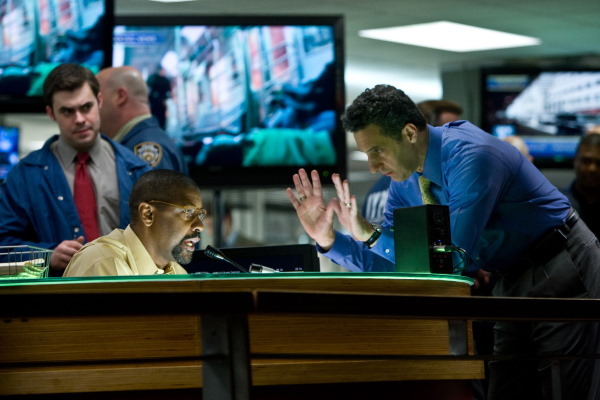

This is one of those instances where I not only saw the remake before the original, but I did not even know that the 2009 film was even based on another movie (which is based on a book). While both movies have their flaws, I think the original is the superior film. I thought it was going to be slow and boring (and yes, it is a bit slower than the remake), but I can see people in the '70s having a lot of fun watching this movie. Plus, the fashion is outrageously hideous. The whole color palette of this movie is brown, red, and orange. Seriously, why did the '70s love those colors?

The plot of the movies is simple: a subway car is hijacked and the perpetrators won't release the hostages until their ransom is paid by the transit police. The train is called Pelham 123 because it comes out of Pelham Bay at 1:23 pm.

Let's meet our main players: leading the heist in the '74 movie is an Englishman who calls himself "Mr. Blue" (Robert Shaw). He is joined by three other men who also have colors as code names. There's Mr. Green (Martin Balsam), Mr. Brown (Earl Hindman...you probably know him best as Wilson from Home Improvement), and Mr. Grey (a young Hector Elizondo). I'm guessing this movie inspired Quentin Tarantino when he made Reservoir Dogs! All the men are disguised in trench coats, fake mustaches, hats, and glasses. Mr. Green, who appears to be the oldest of the four men by at least a decade, is sneezing and sniffling right off the bat (and being really disgusting about it...he sneezes right into his hand; doesn't he know he's supposed to sneeze into his elbow?) and I'm thinking that this is going to be an essential part of the movie. I'll give you a little hint: it is. While Mr. Blue is calculating and cold and is able to remain calm under pressure, his successor is...not. In the remake, the perpetrator who hijacks the train is a man who calls himself Ryder (John Travolta). Very clever movie! Ryder is the complete opposite of Mr. Blue. First of all, he's wearing a black leather jacket with a ski hat and has a handle bar mustache and a neck tattoo, so their images are totally different too. There's a lot of screaming and cursing and threats and instability coming from him. He plays this very similar to the way when he turns into Nicolas Cage's character in Face/Off. In fact, I'm pretty sure there's a scene later in the movie where he tells Denzel's character, "Woo wee, you good lookin'" or at least it's very close to that. I have to wonder if the movie would have been a twee bit better if Denzel and Travolta had switched places. I think Denzel would have played it more cool and calculating like Shaw. I had to laugh when I was reading the IMDb trivia for this movie and one of the entries was "Ryder is calmer in the novel and the original film, but angrier in the remake." Yeah, no kidding! Ryder has his henchmen as well but they don't play as significant a role as they do in the original.

Both men and their minions are able to separate the first car from the rest of the train and I believe there are 17 hostages in the original and 19 in the remake, but I could be wrong. When Mr. Blue and the others take out their guns, nobody hardly even blinks an eye except for one woman who gasps. The other passengers are either reading or talking amongst themselves, or in one woman's case, is dead asleep. In fact, I thought she WAS dead for the longest time, but she was just actually really drunk (we see a bottle fall out of her bag at one point) and spends the majority of the movie asleep on the subway bench. Then, when Mr. Blue announces, "Your attention please. Anyone who tries to rise is going to get shot", it is met with laughter. The only one who seems to be concerned is the woman who gasped (and she gasps again here). What is wrong with these people? Do they not see the four men with guns? Do they not realize the severity of their situation? Didn't hijacks happen all the time in the '70s? Shouldn't they be taking this a little more seriously? Someone even makes a crack about how it's usually a plane that get hijacked. I did a bit of research over at the scholarly website known as Wikipedia and it appears that there were more hijackings in the '70s than there were in the '90s, '00s, and '10s combined. So it's not like these people are strangers to hijackings...I guess they just weren't used to one on a subway! An old man asks, "Shouldn't we be let in on what's happening?" and Mr. Blue replies with, "What's happening is that you're being held by four very dangerous men with machine guns." Talk about stating the obvious!

On the other side of the coin, our are heroes. In the '74 film, Walter Matthau plays a transit cop named Zachary Garber and in the '09 film, Denzel Washington plays a subway dispatcher named Walter Garber, so a nice nod to the actor of the original film. Through the majority of the movie, Denzel is just sitting at a desk, looking a bit disheveled at times. He's very pedestrian in this. I guess they wanted to make sure this is just your ordinary guy who's not used to being a hero. It drove me crazy when he referred to the train as "one twenty-three" instead of "one two three", but once Ryder takes over the train, he refers to it by the right name.

Matthau's Garber has a couple of supporting players who help him. There's Operations Lieutenant Rico Patrone (the late, great Jerry Stiller, you probably know him best as Frank Costanza) and a man named Frank Correll who I didn't catch what his title is, but he's someone who doesn't think they should pay the money. When he hears Mr. Blue's demands, he declares, "You're out of your skull!"
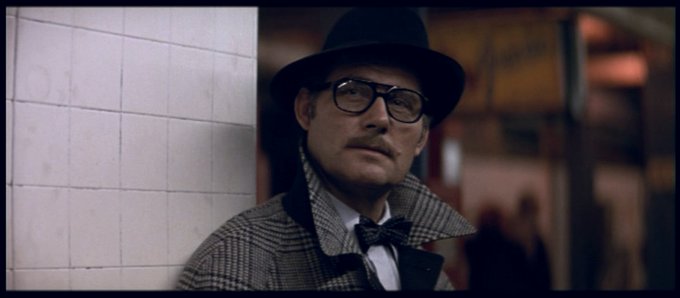
Mr. Blue gets in contact with Garber at the control center and tells him he has seventeen passengers and the conductor held hostage and is prepared to kill any or all of them if they don't obey his demands which is he wants them to tell the mayor that they demand one million dollars (pretend I'm saying that in a Dr. Evil voice) in cash for the release of the car and the passengers. He wants the money by 3:13, which is an hour from now and they will kill one hostage for every minute it's late and if anyone intervenes in any way, they will start killing hostages immediately. He tells them there are three things that they should know:
1. Pelham 123 is completely in their control.
2. There are four of them and they are all armed with automatic weapons.
3. They have "no scruples whatsoever about killing."

In the remake, it's basically the same deal, except it appears the going rate for 18 hostages (there were 19 originally, but somebody has already been killed) in 2009 is ten million dollars. Inflation, am I right? He also wants his money within the hour and will also kill one passenger every minute the money is late. I did like the exchange between the two lead actor when Ryder asks Garber when he thinks a fair time limit would be and Garber replies, "Thursday?" and Ryder tells him, "I was thinking more like an hour." Now, it would have been nice to know what day it is (if they said, then I missed it) because it would be one thing if it was Friday and Garber wanted a whole week, but it was Tuesday or Wednesday, I think 24 or 48 hours would be a much more fair time limit than a freaking hour!

The very limited time limit is pointed out in the '74 movie. After Garber tells Mr. Blue that the mayor has agreed to pay the ransom, he is given very precise instructions on how the money (of which he wants all the bills to be old so the serial numbers will be random) should be sorted and prepared. He tells him he has 26 minutes remaining, but Garber says he should turn off his clock since they agreed to pay the money. As he tells Mr. Blue, "Your instructions were complicated. The money has to be counted, stacked, tied, transported, - it just isn't physically possible." While I definitely see Garber's point, I understand why Mr. Blue still has a time limit. If he turns off the clock, it could give the police the excuse to think of another way to try to stop them or not pay the ransom or something. However, 26 minutes is a ridiculous short time to prepare a million dollars in a very specific way even if there were a lot of people helping them. Ha, wasn't there a task on a season of The Amazing Race where the last three teams are at a casino in Vegas and they have to count a million dollars worth of chips and they were having a tough time with that. Of course, there are only two people to a team.

There's one particular tiny change I really loved how they handled in the remake. So in the original it is revealed to the control center that there is an off duty cop on the train as one of the hostages. They know this because there were two cops and one of them got off and reported it when the news got out. They have no idea who the cop is, but whoever it is, they can't do anything anyway. Being set in the '70s, this movie is quite cringe-y with its sexism and racism. Correll says if he was running things, he would just go in and start blasting them (this guy is a real piece of work) and wonders about the cop: "When is he going to start shooting?" Garber replies that they don't even know if the cop is a man to which Correll scoffs, "A woman cop? What the hell good are they?" Then he mumbles something about "her goddamn purse" which I didn't quite catch, but it was clearly sexist and offensive. Then, later, Garber himself dismisses the idea of a female cop when they're talking about the cop again and he says, "There's a bunch of heavily armed men down there. What chance does one lousy cop got? Especially if it's a dame." Ugh, I mean, honestly, I would think if the cop were a man or a woman, they wouldn't have a great chance. Of course the cop turns out to be a man. This is the '70s, after all. But they keep this joke going for a payoff that's quite lame. I'm jumping a bit ahead of myself, but the cop will jump off the train to pursue the perpetrators and gets shot (he's still alive, though) and is laying facedown on the tracks. When Garber sees him, he thinks it's a woman because he has long hair and says, "Everything will be okay, ma'am" or something like that. You know what they did with the cop who was on the train in the remake? They kill him off first thing. The cop tries to stop the men and is immediately taken out. Perfect. Now you don't have to deal with a lame ongoing joke with a lame payoff. Of course the original is a little more comedic than the remake, so I can't see the new one doing that so I think they handled that just right. 

The '09 movie focuses a bit more on the Garber/Ryder relationship than the '74 one does. We get more backstory on both these characters. In the original, while Mr. Blue mainly speaks with Garber, we also see him speaking with Correll and Patrone and he doesn't really care who he's talking to as long as he's getting his money. In the remake, Garber is the first person to talk to Ryder and once a hostage team is assembled with a lead negotiator who takes over (John Turturro), they send Garber home. I guess his shift was over or something. When Ryder realizes Garber is no longer there, he gets very upset and irrational and he kills Jerry, the motorman, who was also a friend of Garber's. He tells them they have sixty seconds to bring Garber back or he will kill someone else. Garber is just exiting the building when they hustle him back in and gets back to the communication center with second to spare. He asks Ryder why he killed Jerry and Ryder tells him the city of New York killed Jerry. Don't think it quite works that way, Ryder. 
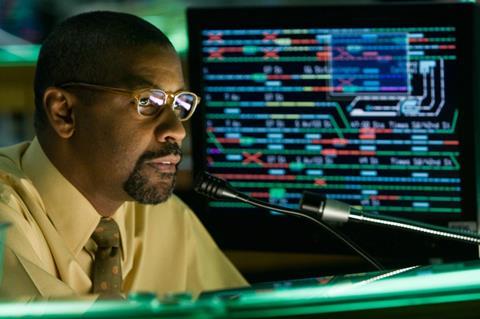
Ryder has looked up Garber on the Internet and finds out he is being investigated for allegedly taking a bribe. He brings it up and wants Garber to basically confess with everybody standing around and hearing every word. Garber keeps insisting that he didn't take a bribe. He tells Ryder that he was the assistant chief transportation officer and part of his job was to go to the people who built the trains, the manufacturers, and bid on contracts for the train. He was accused of taking a $35,000 bid when he went to Tokyo to look at two different trains and chose what he thought was the best train and said it would be the train he would pick anyway. It hadn't yet been decided if he was guilty or not, but he was demoted to answering phones while they waited for the outcome. Ryder, the ever so rational person that he is, threatens to kill a passenger unless Garber admits he did it. He grabs a teenage boy who he has speak to Garber, then tells him, "You've got five second to save this kids life." What else can Garber do than confess to taking a bribe? Whether or not it's true, you have to at that point. He tells Ryder he did take the bribe and when Ryder asks him what he did with the money, he says he used it for his kids' college tuition. Now the movie never lets us know if he did take the bribe or not. Yes, he did confess, and yes, he did have a quick answer to how he spent the money, but saying you used the money for your kids education seems like fast thinking and makes you appear a little sympathetic...it's not like he said he used the money for a vacation or a big screen TV. But he had no other choice but to confess to save that kid's life. When someone wants you to confess to something, even if you didn't do it, and they're holding a gun to someone's head and tells you you've got five seconds to confess, YOU ALWAYS CONFESS YOU DID IT! I did laugh when Ryder tells the kid to say, "Thank you, Garber, for saving my life." Just the way Travolta delivers that line is really funny. 

The bribe storyline isn't in the original, but the fact that it was a Tokyo business trip is clearly a homage to the original when Garber is showing four Japanese men who are directors of the Tokyo metropolitan subway system around. There's really no reason for this except that it provides exposition so Garber can introduce the audience, through these men, to other characters and explain how certain things work. When he introduces them (and the audience) to Rico, he wants him to tell them something exciting. Patrone tells them there was a bomb scare yesterday, but it just turned out to be a cantaloupe. (How do you confuse a cantaloupe with a bomb?) They try to make a joke (a very cringe-worthy one, at that) that Garber thinks they can't understand English and calls them "dummies" and "monkeys" in front of their faces, but turns out they understand English just fine. Why they still remain polite when Garber is being quite rude in front of them, I'm not sure. 
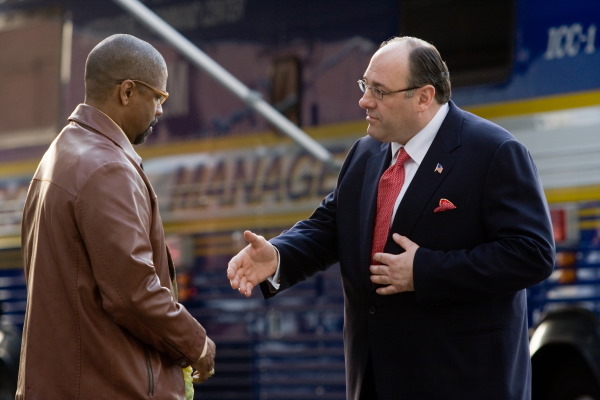
The mayor of New York plays a role in both films. In the '74 movie, the mayor is played by Lee Wallace and in the '09 movie, the mayor is played by James Gandolfini. There is a meeting about whether or not the ransom should be paid; there are people who think it shouldn't, but the mayor decides to pay the ransom because at the very least, he is guaranteed eighteen votes (although two passengers on that train are children, so therefore aren't able to vote...also, at one point I heard a baby crying, but there was no baby on that train!). Here's a fun fact: Doris Roberts plays his wife. I didn't know it was her until I read her name in the credits, then had to go back and watch that scene and I was like, Oh, yeah, that is the mom from Everybody Loves Raymond

In the remake, the mayor is brought to the Control Center where he talks with Ryder who makes a deal with him: he will trade all the passengers for him and he could save the life of seventeen New Yorkers. (The number of hostages to start was nineteen, but after the death of the cop and Jerry, the motorman, the toll went down to seventeen.) The Mayor doesn't take his offer and Ryder screams at him that he didn't want him anyway.

Okay, remember the teen boy that Ryder almost kills but doesn't because of Garber's confession? (Or, should I say, "confession".) Well, he has a laptop he's using to communicate with his girlfriend (heh, if they ever did a remake of the remake, they would change that to an iPhone!). In the chaos of the takeover of the train, the laptop gets tossed underneath a seat and the connection is lost. Later, when the power is turned back on, the laptop, which is open and oh so conveniently pointed in the right direction, the girl sees what is going on and streams it live. This allows everyone at the command center to see what is going on inside the train and Garber recognizes one of the hijackers as Phil Ramos (Luis Guzman), a former motorman who killed a few passengers ten years ago when he was high on cough syrup and ran into the platform. He went to jail for manslaughter. 

Ryder has more of a backstory than Mr. Blue does. Pretty much all we know of Mr. Blue is that he was a mercenary in Africa. With Ryder, we learn that he's a Wall Street Guy. He doesn't seem like the Wall Street type with his neck tattoo, but I guess doing hard time in a white collar prison will do that to a guy. It is discovered that his real name is Dennis Ford (but I'll still refer to as Ryder for the purpose of this review) and he was released from prison two weeks ago where he served a sentence of nine years, and, -get this- he spent the last four of those years on the same cell block as...dun, dun, dun....Phil Ramos, the disgraced motorman. Why a Wall Street guy and a motorman would be at the same prison is beyond me. 

Ryder was sent to prison for insurance fraud; he stole $20 million. He tried to take a plea bargain for three years, but the judge gave him ten because they didn't recover all the city's money. Honestly, they try to make sure he has a backstory that it becomes convoluted and confusing (seriously, this guy is a Wall Street guy, seriously?).

Now it's time for the money to be delivered. In both movies, they cut it very close to the wire. In the '74 film, Garber asks Mr. Blue for more time, but he says no, not even fifteen or ten minutes more. Once the money is sorted, they have about seven minutes to make it to their location. Garber doesn't think it will be enough time and they still have to carry the money down to the track on foot. Once again, Mr. Blue has strict and precise instructions on how he wants the money delivered: two unarmed policemen will walk down the track. One will have the money and the other will have a torch which he will flash continuously from side to side. Okay, real talk here: when he said "torch", I thought he meant a literal torch and I was thinking, Now I know there were flashlights in the '70s, but once he said "flash" I knew he meant a flashlight. Calling a flashlight a torch is either a British thing or a '70s thing. Perhaps both. Anyway, back to the instructions. When the policemen reach the car, the rear door will be open and the one with the money will throw the bag under the floor of the train and they will both walk back to 28th Street Station. Mr. Blue warns him, "Any wrong moves by anyone, I will kill a hostage" and ends the conversation by telling him that he has five minutes to deliver the money. When Garber realizes the money won't reach its targeted destination by 3:13, he asks Mr. Blue if they can at least get the money to the entrance by that time and Mr. Blue agrees. At least this movie is dealing with a more reasonable villain! When there is a minute left remaining, Mr. Blue is getting ready to shoot someone unless the money is there. Garber makes an executive decision and tells him the money has arrived even though it hasn't (it's been a bit delayed because a cop car has flipped over) and Mr. Blue tells him, "You made it just in time, didn't you?" Oh, if only he knew. An astonished Garber asks him,"If we were a few seconds late, you would have knocked off an innocent person?" Yeah, I have to agree with him. I think most criminals would want to avoid killing people. If you're there to get a ransom, collect your money and go. Why add murder to your conscious? But I suppose threatening to kill someone is a good way to instill fear. Not that I would know or anything. 

During the exchange, things don't go as planned when a gun is fired by a sniper who the police have positioned in the tunnel. In return, Mr. Grey retaliates and ends up killing the conductor. What a shock; once the money is delivered, Mr. Blue calls back with more strict and precise instructions: he wants Garber to restore the power to the entire sector, then clear the local track from 28th Street to the South Ferry. He wants all the signals set to green. As always, he promises threats: if there are any red lights, he will shoot a hostage; if he sees another policeman, he will shoot another hostage; any deviation, he will shoot anther hostage. I almost wanted Garber to ask him, "What will you do if things don't go your way?", but better not goad the man with a gun and a greed for a million bucks. However, Garber does get a good shot in when he says,  "Listen, fellow, I hope you take this in the right spirit, but after this is over, you should seek out psychiatric help." Yeah, no kidding. Although Ryder needs way more psychiatric help than this guy does. 

Speaking of Ryder, in his movie, the money is late (surprise, surprise) because of an overturned car and Ryder is about to kill a young boy (he likes to go for the young passengers on his train; I guess he wants to make a statement), but another passenger, an Armed Forced guy who has somewhat made a connection with the kid and his mother, steps in front of the kid and takes the bullet for him. There is also accidental fire shot in this movie and Ramos is killed. There movie differentiates from the original when Ryder wants Garber to bring the money because then the cops won't bother him. That and because his motorman is dead and he knows that Garber was a motorman for over six years. There is talk among others on the command center side if Garber is in on this and I'm thinking, Oh, wouldn't that be a great twist if he was part of this whole setup the whole time? Spoiler warning: he's not. I guess they didn't want to veer too far from the original as the only people who are part of the plot are the four men in trench coats and hats and mustaches and spectacles. 
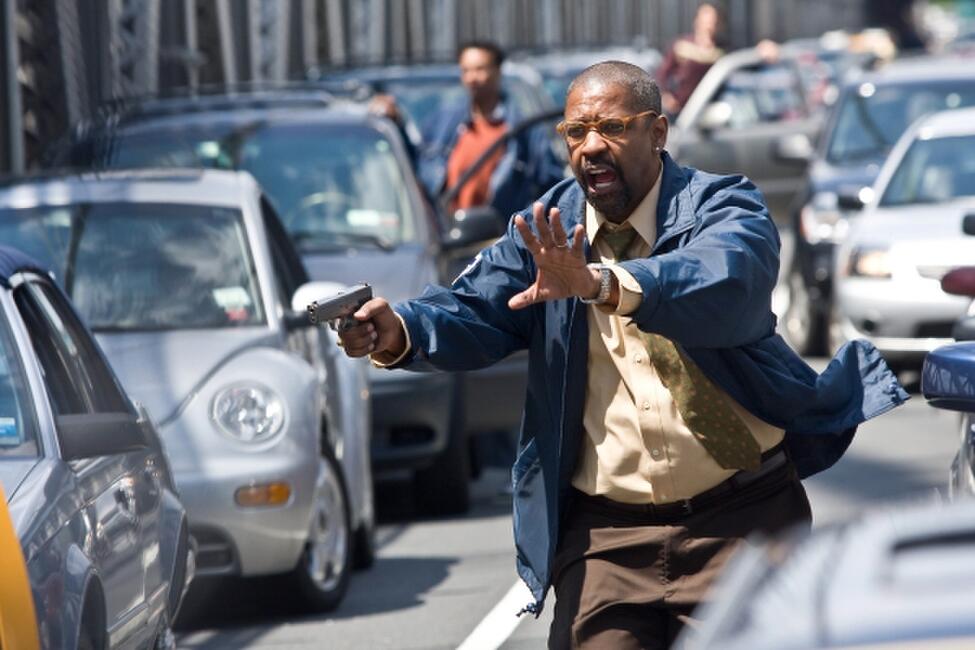
Ryder has instructions for the FBI agent similar to the ones Mr. Blue had for his Garber: he wants the power restored to the whole sector and the local tracks to be cleared from 68th to Coney Island with all green lights and no cops. With a gun pointed to him, Garber is forced to drive the train to the next station, then Ryder and the two remaining hijackers jump off after rigging the train to keep going...and it will because all the green lights have been ordered by him to stay on. I can't remember how, but Garber also manages to separate from the group and also manages to snag a gun. All the passengers are freaking out because the train won't stop and they realize nobody is driving it, but it manages to stop with no serious injuries. The other two hijackers are killed so Ryder is the only remaining one. Garber has followed him and confronts him on the Manhattan bridge where the police are running towards them. Ryder wants Garber to shoot him before the police reach them or he will kill Garber himself. He gives Garber a countdown of ten. Garber keeps turning his head to yell at the police who are nowhere near him and every time he kept turning his head, I kept shouting at the screen, "Don't turn your head, Denzel!" because I was worried that Ryder was going to grab the gun out of his hand. Of course the police don't reach them at the end of his countdown and Ryder goads Garber into shooting him which he does. Garber is able to pick up the gallon of milk he promised his wife he would get (in other words, he promised he would bring himself home) and most likely his bribery charges have been dropped.

So, yeah, if you're familiar with the original then you know the remake's ending is quite different. Sure, there are a few things they keep the same (like the train speeding down the tracks without a driver), but it goes a different direction, no pun intended. For one thing, Mr. Blue does not want Garber to bring him the money. He already has his motorman who's very much alive (besides, I don't think this Garber was ever a motorman.) Garber and Patrone are wondering why they want to go to the South Ferry. Is there a boat or a sea plane waiting for them? They are following the train's moves on the board at Grand Central Tower so if they stop anywhere before the South Ferry, they'll know about it. 

Without any notice the train starts moving and there's a bit of comedy when people ask "what train is moving?" and Garber says, "What's the matter with everyone? How many hijacked trains we got around here anyway?" Mr. Blue tells Garber they're moving because they're trying to put some distance between them and all the cops that are situated in the tunnel.

A cop named Detective Daniels who is keeping in communication with Garber and has an eye on everything from the streets asks Garber if perhaps the hijackers jumped off the train after setting the throttle and while they're chasing the train, the bad guys are sneaking out of an emergency exit behind them. Garber dismisses this and tells him it's impossible because of "a little gizmo called 'dead man's feature'" which is a handle that has to have a hand pressing down hard on it at all time or else the train "stops cold". It was created in the event a motorman ever "drops dead". 

They notice the train stop again and Garber tells Daniels to put detectives on every platform from 14th to the South Ferry. He also decides to join Detective Daniels so it's Patrone who gets in contact with Mr. Blue. While he wonders where Garber is, he doesn't threaten to kill anyone if he doesn't get to talk to him like Ryder did. When Mr. Blue questions where Garber is, Patrone tells him, "Even great men have to pee." And after Mr. Blue tells him to give his regards to Garber, Patrons tells him, "You can do it yourself at the arraignment." Ooh, snap, Frank Constanza! 
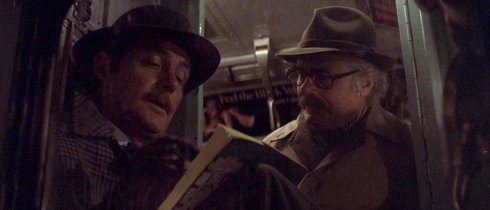
Turns out Detective Daniels was right and the four hijackers have managed to override the dead man's feature so the train is able to keep on running without them. This is when the policeman who is one of the hostages jumps off the train after them in the dark and crouches in the shadows to not be detected. One of them thinks they heard something, but the others just shrug it off. Meanwhile, the train is going fast, about 70 mph and the drunk woman is still passed out while everyone else is screaming. I think this woman needs help; somebody get her to an AA meeting, stat! Garber has a realization that the men must have jumped off the train, so he wants to go back to where the train was stopped for a few minutes. We probably get the most '70s line from the whole movie when Detective Daniels tells another officer, "Turn this thing around and burn rubber!"

We see the four men take off their disguises and put on different hats. I love the way Robert Shaw pronounced "moo-stash-es". You know, it's too bad we don't see a scene of Ryder in the remake peeling off his tattoo to reveal it was a fake one. That would have made a lot more sense because no way a Wall Street guy has a neck tattoo. Mr. Blue instructs them to toss their guns, but Mr. Grey wants to keep his with him in case "something goes wrong". He wants to make sure he has "some heavy artillery" with him. Mr. Blue coldly tells him, "I won't ask you again" to which Mr. Grey retorts with the worst reply he can think of: "Blow it out of your ass, Mr. Blue" and thus gets a handful of bullets in his chest. I mean, he did ask for it. 

The cop who jumped off the train after them and is hiding in the tracks takes his shot at Mr. Brown who comes out from the door and is peering around the wall on the small stoop of steps he's standing on. It is absolutely ridiculous that the cop kills him on his first try. He is laying down so already he doesn't have great aim, but the shot he has for Mr. Brown is narrow, but yet, despite all that, he kills him. It apparently takes a lot out of him because he's lying in the tracks, moaning, and Mr. Blue comes out and is about to shoot him, but this is when Garber shows up and tells him to drop the gun. Knowing the gig is up, Mr. Blue touches the live rail with his foot and electrocutes himself. Dude, if you wanted to kill yourself, why not just reach for the gun you dropped and just have Garber shoot you? I feel like getting shot would be a more desirable death than being electrocuted! Garber is cringing hardcore and I'm like, dude, I'm right there with you. Ouch. 

So the transit police know for a fact that three out of the four hijackers are dead, but where is the fourth guy, known as Mr. Green? They also know the three dead men were not the motormen, so that must leave the fugitive because somebody had to know how to drive the train. They go through a list of motormen who were recently discharged and find they have nine people to look into. We see Garber and Patrone pay a visit to a couple of them before they make their way to the apartment of Mr. Green, who they know as Harold Longman. Before they knock on the door we see the old man doing a Scrooge McDuck and literally rolling around on his bed covered in bills. When the transit police knock on his door and announce themselves, he tells them to wait a minute and hurriedly throws all of his money in the oven. Obviously this guy has never seen Breaking Bad or El Camino or else he would think of some better hiding spots for his money than a freaking oven! I did think it was a nice touch that he flushed the toilet right before he answered the door to make it look like that was the reason it took him a few minutes to answer the door. The cops have some questions for him and he tells them he works nights at Kennedy Airport as a forklift operator and had been home the whole afternoon, taking a nap. Longman is facing his bed when he's talking to the cops and sees a stack of money peeking out under the bed so he walks over and discreetly kicks it under his bed. When Garber asks him if he heard about the subway hijacking, he plays dumb and tells him he doesn't know about it and thinks he's kidding. I love Garber's deadpan reply: "Do I look like I'm kidding? Would I be here if I were kidding?" He does make a good point. 

Right before they're about to leave and come back with a warrant (as Mr. Longman points out, they need a warrant to search his place), Patrone wants to light his cigarette but doesn't have his match, so Longman invites him to use the stove. Now even though the money is in the oven and Patrone was using one of the burners, I thought for sure the money was going to be found or accidentally set on fire. Actually, what I really thought was that when Longman was busy talking to the detectives, his wife was going to come in the kitchen and turn on the oven to start dinner and by then it would be too late to save the money, but he didn't appear to be married. But nothing happens and the two cops leave, telling him they'll be back with a warrant which will give Mr. Green (gotta love that the guy who wound up with the money got the "green" name) plenty of time to hide his money somewhere else.
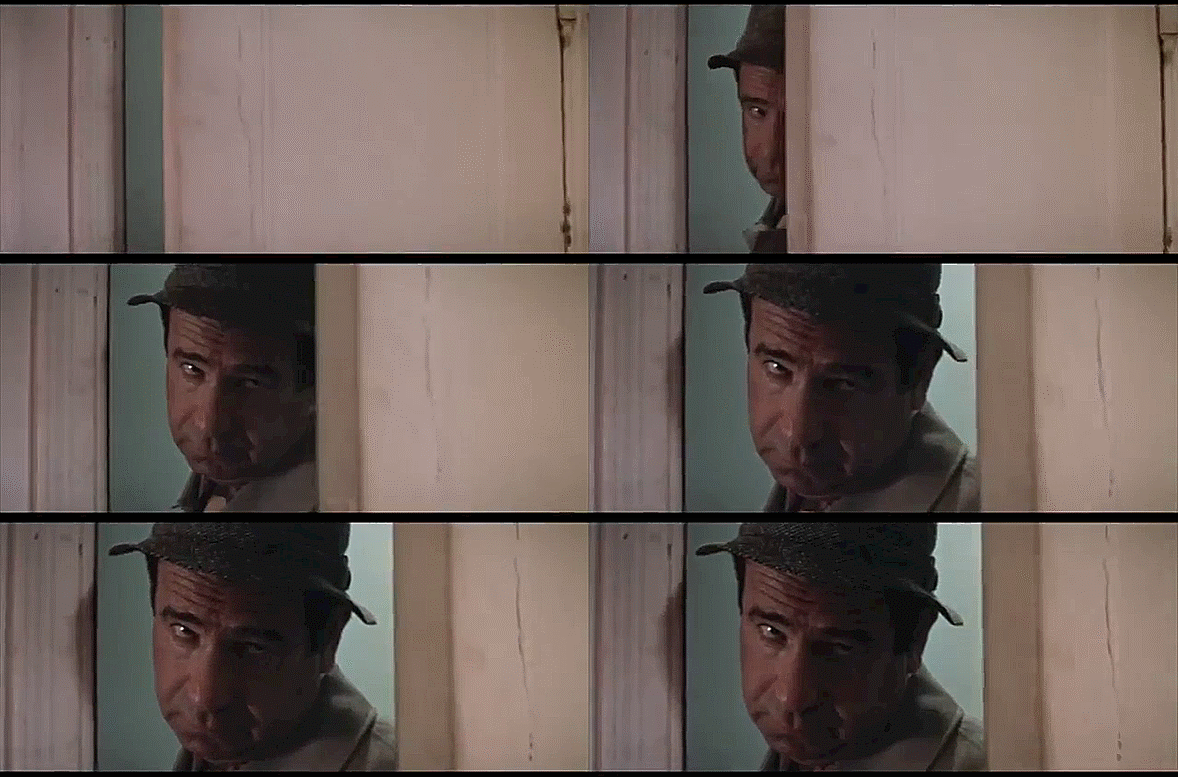
Busted! 

But then...something happens. Remember how I said all his sneezing was going to come back and play an important part? Well, throughout his phone calls with Mr. Blue, Garber kept hearing a sneeze in the background and at the very moment he and Patrone are about to leave, he hears that exact same sneeze and knows they caught their man. We get a freeze shot frame of Walter Matthau poking his head through the door and giving the man a "Gotcha!" look. The whole thing feels like something you would see at the end of a cheesy old sitcom complete with a "Wah-wah-wah" sound effect. Hey, I just said I preferred the original to the remake; I never said it was a perfect film!

Tuesday, July 17, 2018

An Offer You Can't Refuse

The Godfather
Director: Francis Ford Coppola
Cast: Marlon Brando, Al Pacino, James Caan, Diane Keaton, Robert Duvall, Talia Shire
Released: March 24, 1972

Oscar nominations:

Best Picture (won)
Best Director - Francis Ford Coppola (lost to Bob Fosse for Cabaret)
Best Actor - Marlon Brando (won)
Best Supporting Actor - Al Pacino (lost to Joel Grey for Cabaret)
Best Supporting Actor - Robert Duvall
Best Supporting Actor - James Caan
Best Adapted Screenplay - Mario Puzo and Francis Ford Coppola (won)
Best Costume Design (lost to Travels With My Aunt)
Best Editing (lost to Cabaret)
Best Sound (lost to Cabaret)

*It should be mentioned that the score by Nino Rota was originally nominated, but was deemed ineligible and was replaced by the score from Sleuth. This was because Rota had already used portions of this score for a 1958 movie called Fortunella. *


The Godfather Part II
Director: Francis Ford Coppola
Cast: Al Pacino, Robert De Niro, Diane Keaton, Robert Duvall, Talia Shire, John Cazale, Lee Strasberg
Released: December 20, 1974

Oscar nominations:

Best Picture (won)
Best Director - Francis Ford Coppola (won)
Best Actor - Al Pacino (lost to Art Carney for Harry and Tonto)
Best Supporting Actor - Robert De Niro (won)
Best Supporting Actor - Lee Strasberg
Best Supporting Actor - Michael V. Gazzo
Best Supporting Actress - Talia Shire (lost to Ingrid Bergman for Murder On the Orient Express)
Best Adapted Screenplay - Mario Puzo and Francis Ford Coppola (won)
Best Art Direction/Set Decoration (won)
Best Costume Design (lost to The Great Gatsby)
Best Score - Nino Rota and Carmine Coppola (won)


The Godfather Part III
Director: Francis Ford Coppola
Cast: Al Pacino, Diane Keaton, Talia Shire, Andy Garcia, Sofia Coppola
Released: December 25, 1990

Oscar nominations:

Best Picture (lost to Dances With Wolves)
Best Director - Francis Ford Coppola (lost to Kevin Costner for Dances With Wolves)
Best Supporting Actor - Andy Garcia (lost to Joe Pesci for Goodfellas)
Best Art Direction/Set Decoration (lost to Dick Tracy)
Best Cinematography (lost to Dances With Wolves)
Best Editing (lost to Dances With Wolves)
Best Original Song - "Promise Me You'll Remember" by Carmine Coppola and John Bettis (lost to "Sooner or Later (I Always Get My Man") by Stephen Sondheim for Dick Tracy)


***Spoiler warning for all three movies***

I'm going to say something that might anger a lot of movie aficionados: I don't care for most movies from a certain era. This "era" includes from the inception of film making to the sixties. Now I'll be the first to admit that I haven't seen many movies from these decades (you may notice that many of the movies I review are from the eighties, nineties, aughties, and whatever the heck you call this decade), so perhaps it's not fair for me to make that judgement. But every time I watch (or try to watch!) a movie from the distant past, I have such a hard time getting into it. There are a few exceptions to this. I really liked Bonnie and Clyde (1967) and 12 Angry Men (1957). And even though I'm not gaga over Breakfast at Tiffany's (1961) and Citizen Kane (1941), I can appreciate their places in pop culture relevancy. I actually came to appreciate Tiffany's a lot more when I tried watching My Fair Lady (1964). I couldn't even finish that one! All About Eve (1950) is another one I couldn't finish. I've seen Casablanca (1942) and eh. I wasn't impressed. Yeah, it gives us that great line, but I really didn't see the big deal. (I'm just really asking to be murdered by a cinephile, aren't I?) And there are other movies from this era that I've seen that I don't care for. Oh! How could I forget? I really don't like one of the most beloved movies of our time, The Wizard of Oz (1939). It's been more than a minute (or a decade or two!) since I've seen it, but I think my dislike for this film is inherited from my mom who hilariously hates this movie (she said she had to watch it a lot when she was a kid and in turned started to hate it) and also, I lived in Kansas when I was a kid/teenager so I have heard many of the stupid jokes about "I don't think you're in Kansas anymore."Ugh! Everyone who ever said that to me thought they were being SO CLEVER! So yeah, now I've probably pissed off a lot of people....but don't worry, you'll be getting some good news in a bit.

You're probably wondering where the '70s fits into this (actually, you're probably wondering when I'm going to start the damn review!) as I don't count it among the decades of filmmaking I don't care for and I also haven't reviewed too many movies from that decade. Well, I hope to change that soon. As much as I hate '70s fashion (bell bottoms? ugh!), '70s music (disco? It's the WORST!), and '70s decor (orange shag carpet? Whoever thought that was a good idea?), I think the '70s has some great films and to me, that's the first decade where I truly love the majority of the films (and even though I haven't seen as many movies from the '70s than from the '80s til the present, I have seen many more films from the '70s than from any before it). Obviously you have the rise of Steven Spielberg and Jaws (1975) which is considered the first blockbuster and you have Star Wars (1977) which, while I don't really care about those movies, has been one of the biggest franchises of all time, if not the biggest. Already I've just named two movies and already this decade is way more impressive in terms of filmmaking than any decade before it. Oh, and let's just add The Godfather and it's sequel (1972, 1974) and it pretty much cements the '70s as the first truly great decade in film history. That's okay if you don't agree with me, but rejoice, film aficionados and cinephiles! You don't have to kill me! I love The Godfather movies! (Well, the first two...the third was okay, but we'll get to that later). 

Seeing as all three movies are either almost three hours long or over three hours, it took me about four days to get through all of them, but it was an engrossing experience as I knew I was in the thralls of what is considered to be two of the best movies ever made in the history of film (and the third one was still pretty enjoyable for what it is). It was like finding the Holy Grail of movies. I'm not saying this is my new favorite movie, but wow! It was so good! I was just in awe watching them. I get why people love these movies and rave about them. I get why they've won so many accolades. I get why the first one is ranked #1 (or 2 or 3) on many Best Movies Of All Time lists. The only movies that ever seem to get ahead of it on these lists are Citizen Kane and/or Casablanca, and like I've mentioned before, I don't much care for those films. The American Film Institute ranked it the second greatest movie of all time behind Citizen Kane.

Yes, believe it or not I had never seen The Godfather trilogy. I admit, the length was a big factor in that. I just never had time to really sit down and watch all of them and knowing they were all around three hours just seemed like a huge chore, but I was able to find time to set aside a couple hours each day to watch them. I also wasn't sure if I would like them. I'm not the biggest fan of the mafia/mob genre. Besides Goodfellas (which I really love), I really haven't seen many films depicting it. I watched The Sopranos (and I could tell it was very influenced by The Godfather), but it was never a favorite show of mine. Hell, I still haven't seen the last season to this day! I was very aware of The Godfather in pop culture history, how could you not be? It has been parodied countless times in other movies and TV shows. (Zootopia comes to mind). I was very aware of the horse head scene and I knew "I'm going to make him an offer he can't refuse" (which is the second most iconic movie line after "Frankly, my dear, I don't give a damn" from Gone With the Wind according to AFI's 100 Greatest Movie Quotes). It also gives us the well-known mantras "It's not personal, it's business" and "Keep your friends close, but your enemies closer", although I don't think they originated from the films or the 1969 novel by Mario Puza the first film is based on, but I'm sure it helped make them popular. It also helped popularize the phase, "sleeping with the fishes."

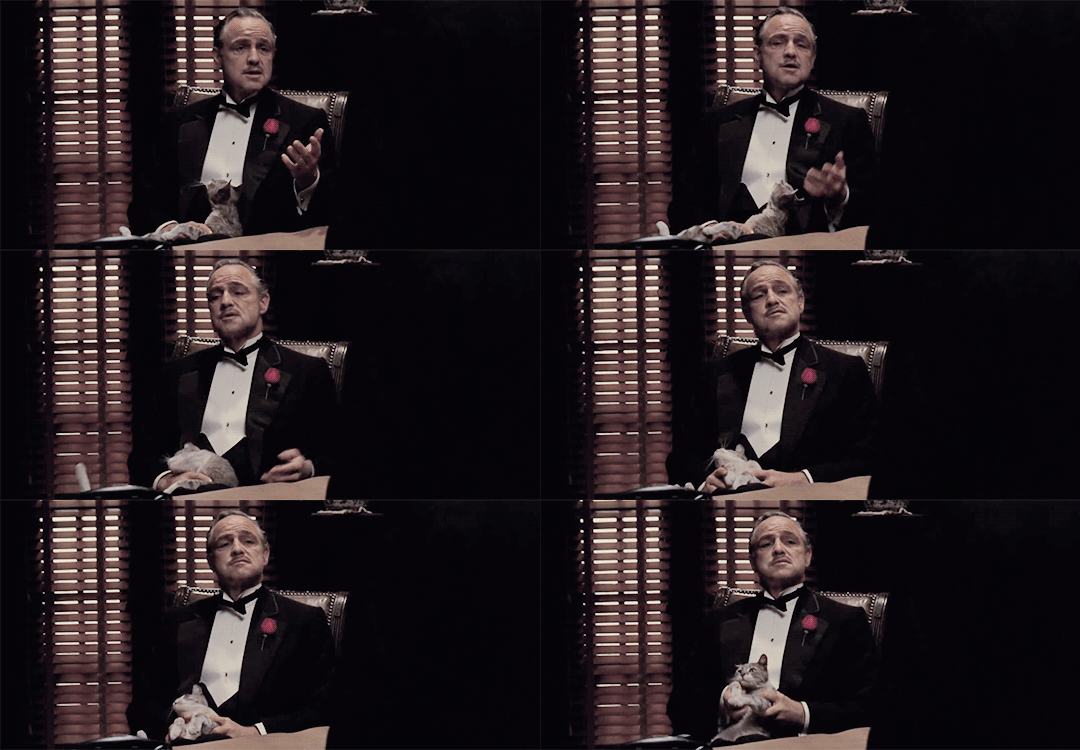
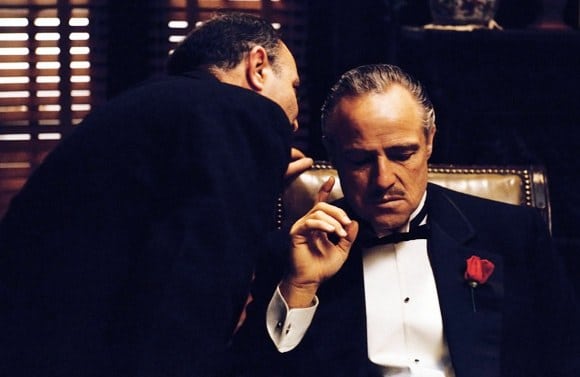
The first movie opens with Don Vito Corleone (Marlon Brando), the head of one of the Five Families, a powerful New York mob family granting requests on this, the day of his daughter's wedding. He has a cat in his lap who is just loving the pats and scratches and belly rubs it's getting from the Godfather. We meet the Corleone family. There's oldest son, Santino, who goes by Sonny (James Caan); second oldest son, Fredo (John Cazale); youngest son, Michael (Al Pacino); and youngest, his daughter, Connie (Talia Shire). Oh, and he's also married to a woman named Carmela, but she's pretty much a non-factor. In fact, I had to look up her name. She has a couple scenes in the movie. We also meet Vito's lawyer and adopted son, Tom Hagen (Robert Duvall). I did not recognize Duvall at all...I knew he was in this movie and kept looking for him and just figured he had a small part and I just missed it, but no, he's a major character and it wasn't until after I looked him up that I realized who he was!

Michael brings his girlfriend, Kay (Diane Keaton), to the wedding. I knew Diane Keaton was in this movie, but I did not recognize her at all! Yeah, this movie came out 46 years ago, but I have seen Annie Hall and that was released a few years after this one and she looks like Diane Keaton in that. I'm used to Diane Keaton looking like...Diane Keaton and I did not recognize her at all! It wasn't until I was well into the movie and had already seen the other two women in the movie who clearly weren't her as they were both Italian and dark-haired, that I realized the young fair-haired woman we were introduced to early in the movie was indeed her! 

So I already mentioned the infamous horse head scene but I was NOT expecting it to happen so soon! Something like that, I thought for sure there would be a build-up to it, but no, it happens just a little over half an hour into this nearly three hour saga! The poor horse was killed because of some Frank Sinatra wannabe named Johnny Fontane who sings at Connie's wedding and who all the girls and older women fawn over him like he's the Beatles or Elvis or One Direction. He wants out of his recording contract and his Godfather is able to make that happen. When a movie executive refuses to put Fontane in one of his movies, he wakes up to find his beloved $600,000 racehorse's head in his bed. I had always assumed the head was on the pillow next to his, but he wakes up to find himself in a pool of blood (a LOT of blood) and follows the trail to the foot of his bed where the head is and has the reaction I think anyone in his situation would have: he screams in horror and anguish. As horrible as this scene is in the context of the movie, I think the behind-the-scenes story is almost worse. First of all, it's a real horse's head. Ugh. Now I understand why the actor screamed like that! I would need years of therapy! I did not know about this until after I saw the movie. I just figured the horse head was donated to them after a horse died of old age or natural causes, but no...it's much worse than that. It's pretty horrific, actually. Probably just as horrific as you know, decapitating a horse after you kill it. Coppola got the horse head from a dog food company. Yes, there was once upon a time when they slaughtered horses for dog food. What the f*** kind of s*** it that? Not cool, Frank. As far as I know, that no longer happens, but you can bet I marched over to my cat's cat food to read the ingredients and was relieved to see the only protein listed was chicken. There is no way in hell you could film this scene in today with a real head, even if the animal had died of old age or natural causes. So yeah, pretty disturbing.

Despite playing the titular character, Marlon Brando wasn't in the movie very much. He's only in it for less than an hour. He gets shot early on in the movie by a drug trafficker named Sollozzo after he refuses to go into business with him. He survives the assassination attempt, but spends time in the hospital. After a corrupt cop named McClusky, who's on Sollozzo's pay roll, pops Michael in the jaw, Michael decides he's going to get revenge on them, and kill them. He also knows if they're not killed first, they're going to come after his father because they know he survived the assassination attempt. There is a meeting set up under the guise of a truce because after the assassination attempt on their father, hothead oldest son Sonny had a hit put out on one of Sollozzo's allies. (There was a lot of plot to follow!) The only way to do this is find a hiding spot for his gun at the restaurant they'll be at since he'll be frisked beforehand. He's given advice from Sonny and Clemenza, his father's right-hand man, on how the hit should go down. The advice he gets includes "two shots a piece in the head as soon as you come out" [of the restroom] and for him to drop the gun and "walk fast, but don't run." Clemenza is not amused when he asks Michael, "You shot them both, what do you do?" and Michael replies, "Sit down, finish my dinner." When he's at the restaurant, he's staring intently at the wine opener the waiter is using and I really thought it was going to come into play. Either he wasn't going to find the gun in the bathroom where they decided it would be hidden in a toilet tank and have to improvise with the wine opener or he was just going to snap and grab it from the waiter and puncture the men's necks with it. But that doesn't happen. When he goes into the bathroom, he finds the hidden gun, but instead of immediately shooting the men as he was directed, he sits back down at the table and I wondered if he had changed his mind. But no, as Sollozzo is talking to him, you can see the anger raging in him and he shoots them both in the head (and the police officer also gets it in the throat) and the table flips over. The waiter is standing right next to the table and blood gets all over his uniform and he just takes a step back, with his arms behind his back. It's very odd. He doesn't scream or look scared. The other extras in this scene just sort of slip out the back door while Michael briskly walks out the door.

The men he killed were connected to one of the other Five Families (and I'm sure somewhere out there, someone has a detailed family tree of these mafia families!) and he is taken somewhere he'll be (supposedly) safe. Picture it: Sicily, 1945. (How much do you want to bet Sophia Petrillo loves The Godfather?) He's staying there under the protection of his father's friend, Don Tammasino. He meets and falls in love with a beautiful young woman named Apollonia and they get married. This has to be the smallest village ever because after he sees her, he and a couple guys he was with go to an outdoor cafe and while they tell the guy who owns the cafe about the girl, we find out that she's his daughter and he's not happy they're talking about her like that! But through a translator, Michael wins him over and asks him if he can introduce him to his daughter. The marriage doesn't last very long as the bad guys have found out where Michael is and a car bomb that was intended for him, kills his first wife instead and he heads back to New York after being in Sicily for a couple of years. We never do see any fallout from her father. She could have easily been a forgotten character, but she is brought up in the third movie when Michael mentions her to his grown children. That's kind of a messed up thing to do. "Hey, kids, I was married to another woman before I married your mother, but she was killed. Otherwise, if she hadn't died, I would still be with her and you two would never exist." So yes, Michael ends up marrying Kay when returning to New York, but he doesn't approach her until he's been back for a year and they just sort of pick up where they left off, even though Kay had no idea where he was or that he was married. Their son, Anthony, is born a few years later.

Connie is married to an abusive man and Sonny beats him up. When it happens again (and there are dishes being smashed and belts being lashed and furniture being turned over), Sonny heads out to help his sister, but ends up being shot at when he tries to go through the toll, but his car is blocked and he's unable to get through as the men riddle his car (not to mention Sonny himself!) with bullets. This was all a plot by one of the heads from one of the Five Families who got Connie's husband to wile her up so she would call Sonny for help and then they could trap and kill him. Of course Connie's husband will later be killed in retribution, making Connie none too pleased with Michael, who ordered the hit.

Vito, who is now recovered, calls for an emergency meeting between the Five Families and wants a peace offering. Because of this, Michael is able to return to the United States without fear of retaliation. The film will jump forward in time a few years without telling us. (They're much better about that in the second movie). All of a sudden, Marlon Brando is in old man make-up and he's playing with his grandson in an orange grove where he will eventually keel over and die. Oranges play a pivotal role in these movies: whenever you see one, a character will die or almost get killed in that scene or maybe a few scenes later. I have to admit, I honestly didn't notice it until the second movie, but when I went back and revisited some scenes, then I definitely noticed. Just keep your eyes peeled for oranges whenever you watch any of The Godfather movies (although, I swear in the third movie, sometimes there are oranges in a scene and nothing significant happens). Because of the deaths of his father and older brother, Michael is now the head of the Corleone household.

While I don't know which scene in The Godfather is the most iconic, I would have to assume it's one of the last scenes where Michael is at the church baring witness to his sister's baby being baptized while a multitude of murders are going on. Pretty much Michael is making sure he's turning on his foes before they turn on him. While the baptism is going on, we see the other heads of the mafia families being killed. Probably the most memorable death is that of one Moe Greene, the bespectacled Las Vegas casino owner who refused to sell his shares to Michael. He is shot in the eye (through the lens of his glasses) as he's getting a massage and a lot of blood spurts out. Pretty impressive how they did that. Although I have to give major props for the guy who died on the steps and rolled down them. That got a chuckle out of me. That was some great acting there. The baby we see getting baptized is none other than future Oscar-nominated director Sofia Coppola (aka the director's daughter). She was only a couple weeks old when they filmed that scene and she was born in May of 1971, so that should give you a timeline of when the movie was filmed. I'm sure many people would agree that her performance in this movie is much better than her performance in the third movie...oh, we'll get to that in due time!

Time to move on to The Godfather Part II. Some people like the first movie the best, some people prefer the second to the first. Never is the third movie in this conversation. (Wonder if there's anyone out there who does like the third more than the first two?) While I think there are great scenes in the first movie, I think I may like the second a bit better because by this time I was more invested in the movie and I was more familiar with the characters. But then again, there are some great scenes in the first movie and you have that iconic performance by Marlon Brando. Yeah, this is tough. The second movie is the longest at three hours and twenty-two minutes. (The first one is three minutes shy of being three hours and the third one is ten minutes shy of being three hours. Dang, these are really long movies!) In a way, Part II is like watching two movies interwoven into each other: one starring Al Pacino and the other starring Robert De Niro. The movie is so long that there was actually an intermission break after two hours! Seriously, after the scene ended, this cue card came on that said "Intermission". I have never seen a movie have an intermission, not even Titanic which is the same amount of time (five minutes less!) and I saw that in the theaters three times! This movie is the first sequel to win an Oscar, something that won't happen again until 2004 when the third Lord of the Rings movie won.

It's 1958 and Michael and his family are living in a lake house near Lake Tahoe in Nevada and his children are grade school age, young Anthony just having celebrated his First Communion. Early on in the movie, an assassination attempt it made on Michael when bullets come flying through his bedroom window as he's talking to his wife, who is in bed. Nobody is hurt, but Michael will spend the rest of the movie trying to find out who put out a hit on him.

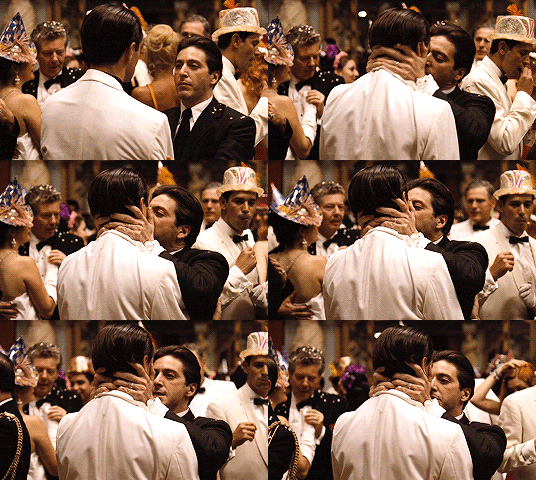
A new major character is that of Hyman Roth, a Jewish investor and business partner of Michael's. He plays into Michael's father's mentality of "Keep your friends close, but your enemies closer." He is played by Lee Strasberg, who, I'll admit, I didn't know who that was, but after listening to some podcasts and reading about him, discovered he was a famous acting coach who taught acting method and some of his famous clients included Marilyn Monroe, James Dean, Paul Newman, and his co-star, Al Pacino. When we first meet Hyman, he's lounging on a chair with one leg draped over the arm of the seat. I have never seen anyone sit like this in the movies or in real life, but now knowing his background as a method actor, it all makes sense that he would think outside the box. Needless to say, there's some shady stuff going down with Roth. Michael thinks that Roth put the hit out on him, but when Roth tells him that he was a friend of Moe Green's and heard he had been killed, he did not worry about who put the hit out on him, and let it go, insinuating that Michael should do the same. Hyman has a hit out for Michael, but Michael's men kill him first. It turns out that Michael's only surviving brother (for now!), Fredo was the one responsible for the attempted hit on him. "I knew it was you, Fredo...you broke my heart." In Fredo's defense, he says he didn't know about that, but it's too little, too late. Michael has one of his men kill Fredo (a shot to the back of the head while they're fishing in a boat), but not until after their mother has died so she doesn't have to be alive to know about it.

Kay, who is pregnant with what Michael hopes is a son (why does he care when he already has a son?), has lost the baby in a miscarriage, but later, she will reveal to Michael something I think she should have taken to the grave: she tells him she didn't have a miscarriage, but rather an abortion because she didn't want to bring any more children into this family. Well, this makes Michael furious and he slaps Kay in an intense scene. They get divorced, not surprisingly.

There's a lot more things going on during the Michael storyline, including a Senate hearing investigating the Corleone family. Plenty of oranges and murders! While all these scenes are going on, we get some reprieves with the flashbacks to a young Vito Corleone. Yes, we get the Vito Corleone origin story. And it starts at the very beginning with him. We see him as a nine-year-old boy named Vito Andolini who lives in Corleone, Sicily. His father has been murdered by Don Ciccio (pronounced chi-chi-oh!), the main mafia leader after Antonio Andolini insulted him. (Dang, don't insult Ciccio!) Vito's older brother vowed revenge, but also ended getting killed himself. Ciccio has his men fetch Vito because he wants him killed too. His mother begs for his life, telling the crime lord that the child never talks and isn't a threat, but Ciccio doesn't care. I have to say, that he's right. Sure, right now he's a weak nine-year-old kid, but as well know, he'll grow up to be one of the most powerful men in the mafia who will build an impressive empire. And, spoiler alert, he will get his vengeance on Ciccio. Just not right now. Cuz he's only nine. Mama Andolini distracts Ciccio and tells her son to run. He complies, but she is shot. With help, Vito gets on a ship and travels to New York. Because he doesn't talk, his last name becomes Corleone, the place of his birth.

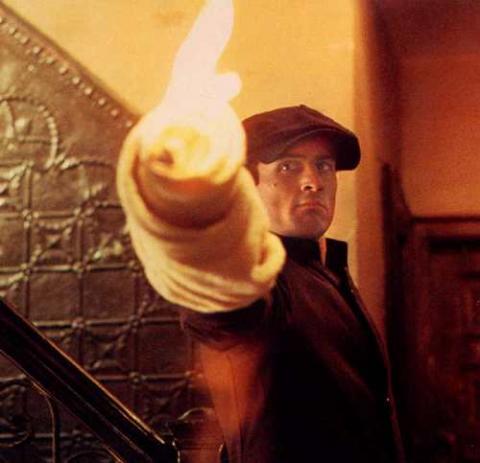
When we see Vito later, he will now be a young man and he's played by Robert De Niro. He was thirty when he filmed this and he looks so young! Even if I didn't know he was in this movie, I would have recognized him. I grew up with '90s and '00 Robert De Niro, so I'm used to him being fifty and older in his movies (think Meet the Parents or Silver Linings Playback De Niro). He does a good job of adopting Brando's mannerisms from the first movie. All the Vito scenes are subtitled in English because the characters are speaking Italian. Vito lives in Little Italy (where else?) with a family that are distant relatives of his. This is where he meets Genco, who he will eventually start an olive oil company with called Genco Pura. (Mmm, olive oil). He gets a job as a grocer at Genco's father store, but understands when he has to be fired because a man named Fanucci, who has a lot of power and is able to get his way, wants his son to have the job. We see how Vito meets Clemenza and Tessio who are both important figures in the first movie and become important allies for Vito. They start an illegal operation and Fanucci gets wind of this and demand that Vito and his men cut him in for a profit or he will go to the police. Vito will hide in a dark shadow of Fanucci's apartment and kill him with a towel. Well, a gun wrapped inside a towel. Before Fanucci will meet his demise, he will grab an orange from a market. Should've gotten an apple, Fanucci.

Speaking of people who Vito will get his revenge on, remember good old Ciccio? He's a much older man, but he's still alive (for now) when Vito goes back to Sicily twenty-two years later under the guise of selling his olive oil to him. When the hard-of-hearing Ciccio asks his name, Vito replies, "Vito Corleone" and when he asks who his father is, he has to tell him twice that it's Antonio Andolini because Ciccio didn't hear him the first time. As he leans closer to tell him, he knifes him in the stomach, cutting him diagonally as he say, "And this is for you!" Yep, Ciccio was smart in wanting to kill Vito when he was a young boy so this wouldn't happen to him!

Time to move on to The Godfather Part III which came out sixteen years after Part II and is set in 1979. I was kind of surprised to find out it was nominated for Best Picture (even though it didn't win like the first two did) because whenever The Godfather trilogy is brought up, people HATE this movie and talk about how awful it is and how it can't be counted as a perfect trilogy because this movie brings it down. I do agree it's not as good and doesn't have the same pedigree as its predecessors, but honestly, I didn't think it was that bad. Of course, I was expecting for something really awful, but it was still an enjoyable stand alone movie. I think it has my favorite Al Pacino line from any of The Godfather movies which is, "Just when I thought I was out, they pull me back in!" This movie came out the same year as fellow gangster flick, Goodfellas, also nominated for Best Picture. That movie was much better than this one.

While I didn't think the movie was as bad as everyone made it out to be, I did have to agree that Sofia Coppola was awful in it. This was something I often heard in regards to this movie, and hoo boy, they weren't lying. "Sofia Coppla was really good in Godfather 3," said no one ever. I totally blame this on the director, what was he thinking putting his eighteen (nineteen?) year old daughter in this? I guess Winona Ryder was originally supposed to have the part, but she dropped out to be in Edward Scissorhands. While there were other actresses who expressed interest in playing the role, they were on a tight schedule and Sofia was the only one available...or something. I'm not quite sure about the whole story. Maybe Francis Ford Coppola had his father glasses on and his children can do no wrong in his eyes, but did he not see how awful his daughter was in this movie? Her voice and delivery are flat, she has no emotion, just everything about her acting is terrible. Well, I thought she was good in one scene, but I'll get to that later. (And you'll think I'm so mean!) I have enjoyed Sofia's movies she's directed, so she does have talent...acting just isn't it! I do feel bad for Sofia because she was so young and she got a lot of flak for this. That's gotta be hard. FFC is no stranger to casting his family in his movies. Talia Shire, who plays Connie in all three movies, is his sister.

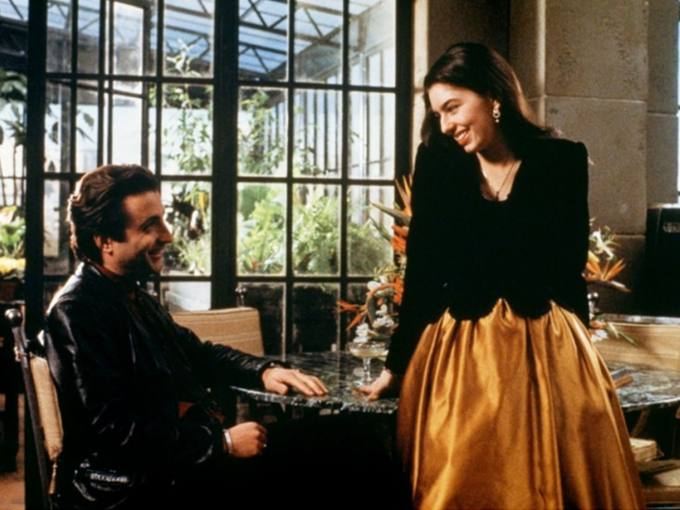
I should probably mention that Sofia plays Michael and Kay's daughter, Mary. Yes, Diane Keaton is back too and they're still divorced, but on more friendly terms. There's this really creepy and icky subplot involving Mary where she falls for her cousin, Vincent (Andy Garcia) who is the illegitimate son of Sonny and a woman he hooked up with at his sister's wedding. They are flirting with each other and when they start making out with each other after what is supposed to be a sensual scene of him guiding her hands to make gnocchi (think Ghost with the pottery), I thought I had misunderstood the scene of them earlier where they're talking about "the old days" with their fathers and something else entirely had come out of their mouths or when they called each other "cousin" or "cuz", that was a term of endearment in Italian. I was thinking, THEY CANNOT ACTUALLY BE FIRST COUSINS AND MAKING OUT! THAT IS DISGUSTING! Seriously, I almost threw up in my mouth a little when they say, "I love you cous" and start kissing. By the way, how embarrassing would that be to have your dad direct you in a make-out scene?  I totally thought I had misunderstood this whole business of them being cousins! But, no, they ARE first cousins as her father points out (thanks for clearing that up, Al) later on. When Michael says, "He's your first cousin," she replies, "Then I love him first." GROAN. And, ewwww. Was this acceptable back in the '70s? Is this an Italian thing? I don't get it! While he does say it's a no-no since they are cousins, he seems more concerned that it's too dangerous, you know, since Vincent has family connections. Vincent does agree to stop seeing Mary and when we see that scene, are we supposed to feel sad they're not going to be together? Cuz I sure as hell don't! I don't care that she's boo hoo hoo-ing and sad. Girl, go meet somebody who isn't related to you and shares your blood! Ewww! Seriously, if I were in a movie where my character was in love with her first cousin, I would tell the director (especially if it was my own dad!), "Uh, you sure about this?"

Anyway...as with any Godfather movie, there are one or two (or three or four) death scenes, but some of them are way over the top. One of the earlier ones feels like it came out of a Die Hard movie. Michael is in a fancy conference room with other mob bosses and a helicopter starts gunning them down from the ceiling...its quite ridiculous. One idiot dies cuz he's trying to get his lucky coat off a hook. Don't think that coat is lucky anymore. Of course the only people who get out alive are the two main characters. There's also an assassination attempt on Michael when the whole family (including Kay) are in Sicily to see Anthony (their son, remember) perform at an opera. Anthony has decided to be an opera singer for whatever reason. The opera is called Cavalleria Rusticana and it looks like the most boring opera ever. It looks very religious and long and weird and boring. Seriously, I wish someone would shoot me if I were watching that! It's not until after the opera when everyone is outside that Michael is shot at, but his shoulder is grazed and instead Mary gets hit in the chest and falls on the stairs. This is when Sofia has her best scene: when she's lying dead on the steps, not breathing. (Heh, I told you it was mean!) Michael gives a chilling reaction to his daughter's death. He later dies as an old man. Okay, the more I think about it, the more this movie isn't that great and I take back what I said about it being not as bad as I thought it was. It is pretty bad. Except for the one Al Pacino line I like.

So yes, while Part III brings the overall score of the Godfather movies down a peg, the first two movies are quite a cinematic achievement and I have to wonder what it would be like to see it in the theaters when it was released. 

Thursday, January 7, 2016

A Man and His Cat

Harry and Tonto
Director: Paul Mazursky
Cast: Art Carney, Ellen Burstyn, Larry Hagman, Geraldine Fitzgerald
Released: August 12, 1974

Oscar nominations:
Best Actor - Art Carney (won)
Best Original Screenplay - Paul Mazursky and Josh Greenfield (lost to Robert Towne for Chinatown)


I discovered this movie through a podcast I listen to called Battleship Pretension where two hosts in their early thirties discuss a topic involving movies. They both went to film school so they seem to be reputable in discussing film...much more than I am, anyway. On this particular episode, they were discussing movies with animals as the main focal point. As you can imagine, there were many movies with dogs brought up, but only a few with cats and Harry and Tonto was one of them. They both praised the movie so I typed it down on my "Notes" section of my iPod Touch under a list of movies to watch. (Otherwise if I didn't, I would probably forget about it!)

The movie is about a seventy something man, Harry (Art Carney) who travels from New York to Los Angeles with his cat, an orange tabby named Tonto. His building is being torn down so he is forced to move. At first he stays with his oldest son, but decides to travel cross country. At first, he plans to fly but when he learns that Tonto will have to be separated from him on the flight, he refuses and takes a taxi to a bus stop and will travel that way. But after he realizes that Tonto needs to use the bathroom (and won't use the toilet when Harry holds him over it...pretty sure NOBODY likes being touched when they need to use the restroom!) and asks the driver to pull over so his cat can relieve himself. Tonto ends up running away and Harry tells the bus driver to go on without him and the driver tells him he has to go so he won't be late to the next destination. He tells Harry there's another bus coming in another hour. Tonto does come back to Harry, but instead of getting on the next bus, he rents a car. Keep in mind this is 1974 and his license expired in 1958, haha!

Along the way, as you do while on a roadtrip, he meets new people and reconnects with some familiar ones. His daughter, Shirley (Ellen Burstyn) lives in Chicago and he finds out his old girlfriend, Jessie (Geraldine Fitzgerald) who he dated long before he married his wife is still alive and living in an assisted care facility with Alzheimer's. He picks up two hitchhikers, which is never a good idea, but it seems even worse considering it's the '70s! There were some shady people in the '70s! He picked up a teenaged girl and a guy in his twenties. The guy kept sprouting off verses from the Bible. He was a little freaky. I've no doubt Harry was relieved when the Bible-thumper said he was going to get a ride with someone else who was heading his way. Harry thought the girl, Ginger, was going with him but she told him they had just met on the car before his. Harry doesn't seemed concerned that a sixteen year old (and later we actually learned she's fifteen!) is running away and they stay in a hotel together and she's standing around in her underwear in front of him! I don't think she was trying to seduce him; I think she was just clueless. She later meets Harry's grandson and they seem to hit it off. 

Harry also meets a hooker on the way. He tells her she's too beautiful to be a hooker and she says she's a high-price one. She also says she's been with men older than him! I think it was implied that they had sex...I'm not sure though. Maybe this was why the movie was rated R even though we don't see anything. There is no nudity or violence and maybe there was a couple of curse words, but I don't really recall. There was some sex talk, so maybe that's why it was rated R? I feel like if this movie was made today, it would be rated PG. Speaking of the time it came out in, everything must have been cheap in the '70s...I know about inflation, but there's a scene where a homeless man asks Harry for thirty five cents so he can buy a coat. What the what? Did coats seriously costs 35 cents in the NINETEEN seventies? That cannot be right! 

Even though Tonto is with Harry throughout the movie, I wish there was more of him. Half the time, he feels just like a background character. I was wondering if we were ever going to get the story behind the name and we do when Harry is arrested for peeing in a potted plant on a street in L.A. (and in front of a window so I'm sure the people inside the building got a pleasant view!) His cell mate is a Native American man and he explains that Tonto is named after the character from The Lone Ranger, the radio show. I knew I was familiar with that name and when he said that I realized I knew it from the Johnny Depp remake (never saw it though, looked awful!) Interesting that it was a Native American man he told it to. Makes me wonder if he had a cat named Schindler, would his cell mate have been a Jewish man? I also wish we had gotten backstory on how Harry acquired Tonto. The one scene where Tonto is really a focal point is the one I mentioned earlier when Harry takes him off the bus to relieve himself and he gets lost and Harry is really worried that his cat has ran away. 

Harry walks Tonto on a leash and if you know anything about cats, they do NOT like to be on leashes. I know because I've had experience with a cat and a leash before. Let's just say he did not want to be led around by me and wanted to do his own thing and explore the shrubs and pounce on bugs. When he didn't have Tonto on a leash, Harry was carrying him around in the most awkward way: one hand under the front legs of the cat with his back legs dangling down. I felt bad for the cat cuz it didn't look too comfortable. I did love it when Tonto would curl up on the dashboard when Harry was driving his car...totally something a cat would do, though it seems dangerous to let a cat roam a car since they might get down by the gas and brake pedals. I also love the scene where Harry is on the bus next to a fat man eating a sandwich. He is holding Tonto and you can tell he's trying to hold him back because that cat wants that sandwich! He ain't acting! It cracked me up when he took his paw and swatted at the sandwich. That's something my own cat, Milo, would do. 

At the end of the movie, as you would expect, Tonto dies of "old age". I put that in quotes because Tonto, according to Harry in a voiceover, was eleven years old when he died. What the what? Since when is eleven old for a cat? That's more "mature", but not "senior". Unless, like people who are living longer these days than forty years ago, maybe that's true for animals too? Then he says in the voiceover that Tonto was 77 in people years. That is so wrong! Because I had a cat, McKenzie (the one who hated the leash....he was a very independent cat! (Well, that's all cats!)), who died when he was 18 and on the cat conversion chart I looked at, said he was 80 something in human years. Obviously, Harry must have been going by the dog chart where you multiply the age by 7. I don't even know if that dog conversion is even accurate anymore, but it most certainly isn't for a cat! McKenzie would have been 126 years old when he died if we went by his cat conversion chart. I checked a cat age conversion chart and it said an eleven year old cat is 61. My cat, at age 18, was 89! A little more believable than 126! Milo is 49 going on 54...poor thing! They age so fast. 

I do wish there was more backstory and interaction with Tonto, but I do understand that the latter probably wasn't alway the easiest. There's a scene where Harry puts down some water for Tonto after they come back from their walk and you know the director wants the cat to drink the water, but he just sniffs it and walks away. Ha! This is the reason there are tons more movies with dogs...you can train a dog, you can't train a cat. They're gonna do what they wanna do! 

Art Carney won Best Actor for this movie, which is a bit surprising considering he was against Jack Nicholson for Chinatown and Al Pacino for The Godfather Part II. I hoped at least he thanked the cat! Or cats, I should say since I read they had two playing Tonto. 

Thursday, October 14, 2010

The Towering Inferno

The Towering Inferno
Director: John Guillermin
Cast: Paul Newman, Steve McQueen, William Holden, Faye Dunaway, Jennifer Jones, Fred Astaire
Released: 12/14/74

Oscar nominations:
Best Picture (lost to The Godfather Part II)
Best Cinematography (won)
Best Editing (won)
Best Original Song - "We May Never Love Like This Again" (won)
Best Supporting Actor - Fred Astaire (lost to Robert De Niro for The GodFather Part II)
Best Art Direction (lost to The GodFather II)
Best Sound (lost to Earthquake)
Best Score - John Williams (lost to Nino Rota and Carmine Coppola for The Godfather II)


Watching a movie about hundreds of people being trapped inside the world's tallest building while a fire blazes below them, it's hard not to think of the World Trade Center, especially since the novel it was based on was based on the WTC and what would happen if a fire would ever occur in a building that high. The only differences are that this fictional building is located in San Francisco, is 130-something stories, and didn't collapse. I have to admit: I kept waiting for the building to crumble. There's a bit of a prophetic line in the movie when Steve McQueen's fire marshall told Paul Newman's architect, "We were lucky we only lost 200 people; the next time it could be 10,000." Okay, yeah, maybe not that many people died in the WTC, but still a little eerie considering it was uttered 27 years before 9/11.

The fire is started by faulty wiring which is discovered by none other than a technician played by O.J. Simpson. Hmm, who wants to bet that HE started the fire? Of course the building (which is an office and residential building) has just opened and everyone is attending the grand opening on the top floor. The fire starts on the 80th floor but the owner of the building isn't too concerned with it, thinking it's just a small flame that can be controlled by the fire department and doesn't want to disturb his party.

Being that this film is very reminiscent (aside from a few dashes of Hollywood ridiculousness) of what those people in the WTC went through on September 11, it was a little hard to watch it at times because it seemed too realistic. This wasn't one of those disaster movies like 2012 where everything is so over-the-top, that you can sit back and enjoy the ride and laugh at the absurdity of everything.

I will say that I was caught off guard when one of the characters played by someone in the cast I listed above has a sudden demise. Usually you can tell who's going to live and who's going to die in these types of movies, but this one totally shocked me; I wasn't expecting it at all.

This is what I learned from The Towering Inferno:
-When constructing the tallest building in the world, never be cheap. (The owner wanted to save a few bucks and that's what ultimately caused the fire).
-If you are having an affair with your secretary, both you and your mistress will die a horrible death if there's a fire in your building.
-NEVER get in an elevator when there's a blazing inferno. What the hell were you thinking, Newman?
-Always make sure you have tanks of water on top of your building so you can put out fires. (That may have been a bit of a spoiler).

I really liked Paul Newman and Steve McQueen in this; I might have to check out more of their films.