Showing posts with label Ray Liotta. Show all posts

Friday, October 4, 2024

The (super)Natural

Field of Dreams
Director: Phil Alden Robinson
Cast: Kevin Costner, Amy Madigan, James Earl Jones, Ray Liotta, Timothy Busfield, Gaby Hoffmann
Released: May 5, 1989

Oscar nominations:
Best Picture (lost to Driving Miss Daisy)
Best Original Score - James Horner (lost to Alen Menken for The Little Mermaid)
Best Adapted Screenplay - Phil Alden Robinson (lost to Alfred Uhry for Driving Miss Daisy)


Field of Dreams is a movie I watched many times when I was younger because it was a favorite of my family's. Both of my parents (and many of my relatives) are from Iowa, so you can probably see why it was such a staple for me growing up! This is just such a quintessential American movie; it's got baseball and takes place in the nation's heartland. As someone who has been to Iowa many times, I can confirm that it definitely captured the state.

An interesting side note about the movie's title: as you may already know, Field of Dreams is an adaptation of W.P. Kinsella's novel, Shoeless Joe (which I read when I was a freshman in high school, but don't remember anything about it), but the studio didn't want the movie to be the same title because they thought that the audience would think it's about a homeless guy or that Costner is supposed to be the title character. Somebody suggested Field of Dreams, but the director didn't like it (not sure why!). He talked to the author to tell him that although the screening was well received, they had to give it a different title. Kinsella told him the he didn't come up with the book's title and said he wanted to call it Field of Dreams instead, so the director took that as a sign and thus that's how the film became Field of Dreams. I'm guessing whoever suggested the movie be called that in the first place already knew Kinsella wanted that as the original title of his book or maybe it was just a huge coincidence. 

It's been almost fifteen years since I've seen the movie so there were a few things I forgot. One of those is the movie gets going really quickly. It takes less than five minutes before Ray Kinsella (Kevin Costner) hears the voice.

We get some quick backstory about Ray. Actually, we first start with some quick backstory about his father, John Kinsella. He was born in North Dakota in 1896, was in the war, settled in Chicago and became a fan of the White Sox and a lover of baseball. He played in the minors for a year or two, "but nothing ever came of it." He moved to Brooklyn where he married his wife and Ray was born in 1952. As he was going through the timeline, I mentally did the math in my head and was thinking his father was pretty old when Ray was born. He would have turned 56 in 1952. Ray does admit his father was "already an old man" when he was born, and yes, he certainly was! His mother (no idea how old she was) died when he was three so he was raised by a man old enough to be his grandfather. He grew up knowing about Babe Ruth, Lou Gehrig, and "the great Shoeless Joe Jackson." He and his dad fought a lot and when it was time for him to go to college, he "picked the farthest one from home" which turned out to be Berkeley. There he met his future wife Annie (Amy Madigan) and one of the things they had in common was that "she came from Iowa, and [he] had once heard of Iowa." After graduation, they moved there and got married in June of 1974 and his dad died the following fall. According to him, "a few years later" their daughter, Karin, was born. This does not track because Karin is played by a very young Gaby Hoffmann who was born in 1982. The movie takes place in 1988 and she can't be no older than six so saying she was born "a few years" after 1974 isn't quite correct. To me, a few years is maybe 3-5. But I suppose it's all semantics. 

Annie talked Ray into buying a farm and at 36, he tells us "Until I heard the voice, I'd never done a crazy thing in my whole life." 

So, yeah, all that backstory takes less than five minutes to tell. I assume it's much more fleshed out in the book. Like, I bet W.P. Kinsella devoted more than a paragraph to that! Probably even more than a chapter!

Of course, the voice he's talking about is the one that says, "If you build it, he will come." He's out in the cornfield when he hears it and his wife and daughter are sitting on the porch swing. When he asks Annie if they heard anything she says they didn't. When they're back inside, he tells Annie what the voice said and she seems to take it all in stride. She asks, "If you build what, who will come?" which is a good question. She even jokes about it the next day (he heard the voice again laying in bed) when he takes Karin to school and asks him, "What if the voice calls while you're gone?" He jokes back and tells her to "take a message."  

He hears the voice again and this time he sees a quick image of a baseball field, then he sees an image of Shoeless Joe Jackson. This seems to come out of nowhere and it makes me wonder how this was done in the book. Like, was he given more context clues? At dinner (where the family is eating freshly picked corn on the cob - yum!) he tells Annie he thinks he knows what the voice meant and if he builds a baseball field out there, then "Shoeless Joe Jackson will get to come back and play ball again." She replies, "You're kidding" and laughs. Even though she tells him that it's "the craziest thing I've ever heard", she's very supportive of him. Oh, did I mention that Shoeless Joe Jackson died in 1951? She asks him if he's actually thinking of doing this and he replies, "I can't think of one good reason why I should", then tells her he's scared of "turning into [his] father" and that he never "forgave him for getting old." The main reason he wants to build this baseball field is because his father never did one spontaneous thing and he's "afraid of that happening to [him]" and "something tells [him] that this may be [his] last chance to do something about it." As we already know, Annie thinks he's crazy, but she's very supportive. Perhaps a little too supportive. She tells him, "If you  really feel you should do this, then you should do it." I don't think most wives would be that encouraging and let their husbands just randomly build a baseball field (complete with stadium lights)!

We next get a montage of him building the field. A few people have come by in their cars to gawk and take pictures. I was wondering how he got the money for everything (especially the stadium lights; where did he get those anyway?), but we'll find out later that he used most of their savings to build this baseball field. I wonder how long it took for them to build this because it seems Ray and Annie are the only ones working on it! While he's plowing the cornfield, he tells his daughter (and the audience if they weren't privy) how Shoeless Joe got his nickname: "When he was still in the minors, he'd bought a new pairs of spikes and they hurt his feet. So, about the sixth inning, he took them off and played the rest of the game in just his socks. The other players kidded him and called him "Shoeless Joe" and the name stuck." 

He continues his exposition about the baseball legend when he tells Karin about how Jackson's team (the White Sox) threw the World Series in 1919. According to the Wikipedia article I read about this, "Jackson and seven other White Sox players were accused of accepting $5,000 each (equivalent to $88,000 in 2023) to throw the World Series." Ray says that he did take the money, but nobody could prove that "he did a single thing to lose those games." 

You know, this reminds me of on Survivor when some tribes purposely lose because they want to go to Tribal Council to get rid of dead weight or a teammate who is toxic or isn't contributing anything. I mean, I know it's not exactly the same thing because nobody's being bribed on Survivor and it's not, you know, illegal to throw a challenge (but some people think it's a terrible idea), but you usually need everybody who's in on it to throw the challenge. Perhaps Shoeless Joe played as best as he could because he knew his other teammates were going to really stink it up. The commissioner of baseball (I had no idea there was such a thing!) suspended the eight players for life and they were never allowed to play professional baseball again. 

Later, when the baseball field is complete, he and Annie are laying out on the grass and he tells her that his father claims he saw Joe years later "playing under a made-up name in some 10th-rate league in Carolina." He looks around smiling as he says, "I have created something totally illogical." He is very lucky to have such a supportive wife! I love this scene because you can feel the ambience of Iowa...a muggy summer night with the crickets chirping and perhaps the waft of cow manure in the distance (hopefully very far in the distance!). 

Annie gets up in the middle of the night to see Ray sitting by the window, just looking out at the field. Obviously, he's waiting for something to happen now that his field is complete. The next thing we know, there's snow on the ground and the house is decorated for Christmas. While he has family over, he's still looking out the window, but still, nothing has happened. This seems to be the only instance of time passing. I feel like there should have been more because the next scene is when he and Annie are discussing their finances (and how they spent most of their savings building the field) and Karin tells him, "There's a man out there on your lawn." Karin forgot to mention the important detail that the man in question is wearing a baseball uniform! 

So we have an interesting dialect scene when Annie tells Ray "I'll put up some coffee." Most people (if not all!) would say "I'll put on some coffee" (or they would just simply say "I'll make some coffee"). I would had just assumed this was an Iowa/Midwest thing, but most of my relatives are from Iowa and I've lived in the Midwest my whole life and I have NEVER heard anyone say it that way. It doesn't sound natural to me. I even listened to it again to make sure the subtitles weren't wrong, but she definitely says "up".

Ray turns on the stadium lights and starts swinging the ball to the ghost of Shoeless Joe Jackson (Ray Liotta) with the bat. At first, Joe doesn't say a word until he jogs up to Ray and after Ray says hi and introduces himself, he tells Ray that his name is Joe Jackson. He asks Ray if he (Ray) can pitch so he can swing the bat. 

After a few hits, Joe talks about how much he loves this game and even myself, who doesn't really care for baseball, starts to get nostalgic and sentimental for what he's talking about. And just wait until the James Earl Jones speech! He asks about the lights and Ray tells him that all the stadiums have them. He agrees with Joe that they "make them harder to see the ball", but tells him that "owners found that more people could attend night games." 
 
Annie and Karin have come out and head in their direction so they can meet Joe, but when he walks towards them and reaches the edge of the field, he stops. In a later scene, we will find out why he can't go any further. Karin, being a six-year-old, asks him if he's a ghost. He asks her, "What do you think?" and she replies, "You look real to me." Annie invites him inside (probably for that coffee!), but he says he doesn't think he can. He turns to go back towards the cornfield, but then turns back and asks Ray if he can come back again and Ray tells him yes, that he built this for him. Joe tells him there are others, meaning the other eight players that were also suspended and that "it would really mean a lot to them." Ray tells him they'll all welcome. Joe has one more question for Ray, probably one of the better known lines in a movie filled with famous quotes: "Is this heaven?" Ray replies, "No, it's Iowa." My aunt (who lives in Iowa) loves this line and often quotes it. 

Has that ever been a tourism slogan for Iowa? If not, it should be! You know when you enter a new state and you see the welcome sign with the state's name and then some slogan (usually some pun or something the state is known for)? Well, I went to look up the signs for each state and Iowa's says 

The People of Iowa Welcome You
Iowa
Fields of Opportunities

First of all, I feel like these are two different welcomes and they should have gone with just one. Obviously the "Fields of Opportunities" is a play on of Field of Dreams. I will give them credit for that, but honestly, they really missed the mark with not going with

Is this Heaven?
No, it's
IOWA!
C'mon, Iowa Tourism Board! 

The next morning, Annie's mother, brother, Mark (Timothy Busfield), and Mark's wife are at the house. Mark is telling Ray he's going to lose the farm and the baseball field is going to bankrupt him and if he sells the farm now, he can get a fair price. Karin comes in to tell her dad that "the baseball game is on" and Mark thinks there's one on TV even though Ray and Karin go outside. 

They sit on the bleachers, Karin with her popcorn (nothing seemingly to drink, though) as the eight players emerge from the cornfield and start to play ball. A few minutes later, Annie comes out with Mark and the others as they're getting ready to leave. We quickly learn that Mark, his wife, and his and Annie's mother cannot see the eight men out on the field. When Karin tell him they're watching "the baseball men", he turns around, looking confused. I'm honestly surprised that they didn't show a shot of an empty field so we could see it from Mark's perspective. During this whole scene, the ball players are always in the background. Both Ray and Annie are surprised Mark and the two women can't see anything, but should they really be that surprised? These are ghost, for a lack of a better word, out there. 

When it's time for the ball players to go back to where they came from, they walk into the cornfield and visual effects are used to show them vanishing. I think this would have been more effective if they kept on walking until we couldn't see them anymore because eventually they would have disappeared into the cornfield! 

As Ray is heading back inside, he hears the voice again and this time it says, "Ease his pain." He has no idea what that means and doesn't get any more instructions or details when he asks, "Whose pain?" When he tells his wife he heard the voice again, she makes a joke, asking him if he has to build a football field this time. 

That evening, there is a PTA meeting scheduled to talk about book banning which really has Annie irked. While there, a future Trump voter holds up a book called The Boat Rocker by Terrance Mann claiming that "smut and filth like this has no place in our school." I laughed when Annie leans over to Ray and whispers, "Fascist. I'd like to ease her pain." She'll have a couple more zingers for this woman before the evening is over! 

One of the school administrators who's running the meeting tells the woman, "That book is hardly smut" and is "considered by many to be the classic novel about the 1960s." Unfortunately, many of the attendees agree with Ms. Fascist. The administrator reminds them that the author is a Pulitzer Prize winner and "is widely regarded as the finest satirist of his time." Ms. Fascist continues her rant, saying the books of Mr. Mann "endorse promiscuity, godlessness, the mongrelization of the races..." Annie is getting very angry and her eyebrows are raised and she mouths "wow" in disbelief when the woman says that. 
 
During all this, Ray has been writing "ease his pain" over and over on the itinerary they were given for the meeting and has an epiphany that it may be referring to Terrance Mann. Annie stands up to confront Ms. Fascist (we actually do learn her name but I forgot what it was and it's more fun/accurate to call her that) and tells her and the rest of the attendees that Terrance Mann coined the phrase "make love, not war." She tells the woman that if she had experienced the '60s, she would think the same way too. The woman haughtily informs her that she "experienced the '60s" and Annie replies, "No, I think you had two '50s and moved right into the '70s" and sits down. Ooh, burn, Annie! The woman retorts by telling her, "Well, your husband plowed under his corn and built a baseball field." After telling Ray that she'll "be cool", Annie stands back up and replies, "At least he is not a book burner, you Nazi cow." Yeah, pretty sure Annie won with that one, but the woman still snaps back with "At least I'm not married to the biggest horses' ass in three counties." Yeah, no, Annie still won. She takes over the meeting when she wants to "put it to a vote" and asks the audience "Who's for Eva Braun here?" Sadly, at first, it seems she doesn't have any supporters, even after she asks them "Who wants to spit on the Constitution of the United States of America? " But when she asks "Who thinks freedom is a good thing?", they start raising their hands. There's a funny moment when Ray is still deep in thought and she smacks him on the shoulder and he raises his hand. 

As they're leaving, Annie is super excited that everyone is on her side now. Ray tells her he knows whose pain he's supposed to ease: Terrance Mann's. Annie asks how does he know that and he replies, "I don't know I just know. I was right about building the field wasn't I?" Hmmm, sorry, movie, but I'm not buying it. Seems like a bit of a lame answer. Here's a fun fact: in the book, it's J.D. Salinger whose pain he has to ease. Annie asks him, "What's Terrance Mann got to do with baseball?" He doesn't know that either and so we get a montage of him going to the library and looking up articles about Mann on the microfiche (the children of today would be horrified that Google or Wikipedia didn't exist back then!) and reading his works. Ray tells Annie that Mann stopped writing in the '70s and now "writes software for interactive children's videos" (does he mean computer games?). He found a short story Mann published in a magazine in 1962 called "This Is Not a Kite" where the hero of the story is named John Kinsella; Ray's father's name. The last interview he ever gave was in 1973 where he says his dream as a child "was to play at Ebbets Field with Jackie Robinson and the Brooklyn Dodgers." Ray says Mann was "a baseball fanatic" and in order to "ease his pain", he needs to take him to a game at Fenway Park. (Mann lives in Boston.) This time, Annie isn't too sure about this. Building a field on their farm? Totally fine! Traveling to Boston? Big no-no! She doesn't want him to travel all that way because they are having financial problems and he needs to stay at the farm. They have a bit of a dispute and Ray tells her he strongly thinks there's a reason he needs to go and he thinks "something is gonna happen at the game." Annie admits that she had a dream of Ray and Terrance Mann watching a game together at Fenway Park, and what do you know Ray had the exact same dream, so it must be a sign! Ray now has Annie's blessing to go to Boston.

I looked up how long it is from Dyersville, Iowa (that's the actual town where the baseball field is) to Boston and it's a little over 19 hours to drive there without any stops. Too bad Terrance didn't live a little closer, like Chicago or Minneapolis. 

When Ray arrives in Boston, he finds out where Terrance Mann (James Earl Jones) lives (surprisingly this reclusive writer wasn't in the phone book!), but when he knocks on his apartment door, Mann isn't too happy to see him and tells him he wants to be left alone after slamming the door in Ray's face. You could say that Mann is a bit of a grumpy old man. Ray tries again and asks him if he can have one minute of his time so Terrance agrees. Ray tells him, "You once wrote, 'There comes a time when all the cosmic tumblers have clicked into place and the universe opens itself up for a few seconds to show you what's possible.'" Terrance doesn't have time for this and pushes Ray out of his apartment. He notices that when Mann slammed the door, the door didn't quite latch, so he's able to go back inside. He puts one of his hands in his coat pocket and pretend it's a gun. Mann doesn't buy it at all and grabs a crowbar, telling Ray he's going to beat him until he leaves. Ray is able to evade the weapon when he tells Terrance he's a pacifist and the writer stops short of taking a swing at him. 

Ray tells him he has to take him to a baseball game later that evening and that "something is supposed to happen there tonight." When he brings up the interview Terrance gave years ago about him wanting to play baseball, Mann denies ever saying any of those things. Ray tells him if he comes to the game with him, he promises he'll never bother him again. 

Here are two fun facts when they go to watch the game at Fenway Park:

-We find out that two hot dogs and two beers cost $7 in 1988. What a deal! 
-Apparently, Ben Affleck and Matt Damon were extras during this scene. Makes sense since they are from Boston. They would have been about fifteen or sixteen at this time. I tried looking for them, but yeah, I did't see them. 

While watching the game, Ray hears the voice again and it has a new message for him: "Go the distance." At first, I was thinking that was the most vague message, but we'll quickly find out what the disembodied voice means when Ray sees a message on the Jumbotron. It says "Archibald 'Moonlight' Graham" and lists some stats about him including that he's from Chisholm, Minnesota and played for the New York Giants in 1922. So I'm guessing that "go the distance" means he's supposed to drive to Chisholm and find this guy. 

He asks Terrance if he heard or saw anything, but Mann doesn't know what he's referring to. Ray tells him that he didn't need to come after all and they can leave now. When he drops him off outside of his apartment, Mann asks Ray if he got another message. Ray doesn't want to take up too much more of his time, so he says the message was "The man's already done enough, leave him alone" and shakes Terrance's hand. As he turns the car around, he has to stop quickly because Terrance is standing right in front of him in the street. He says "Moonlight Graham" and Ray knows that Terrance heard the voice and saw the stats about Graham on the screen. 

Apparently Ray didn't know what "go the distance" meant (gee, I thought it was pretty obvious - the most obvious of all the messages the voice says to him!) so Terrance has to explain to him that they need to find Moonlight Graham in Minnesota. He hops back into the van without even packing first! Dude, you're literally right in front of your apartment! Go upstairs and pack a suitcase! 

They travel 1,539 miles from Boston to Chisholm (which is a little over 200 miles north of Minneapolis; I Google mapped their route). When they reach the small northern town, they try looking up Archibald Graham in the phone book, but can't find anything. They go to the office of the Chisholm Tribune Press where an old lady who's probably been working there for over fifty years recognizes the name as Dr. Graham or "Doc" Graham as he was known. He had given up his baseball career to become a doctor. She has to break the news to the two men that he died in 1972. Terrane wonders what made them travel all this way to try to find a man sixteen years after he died. They interview some old guys at a bar who knew Dr. Graham. One of them tells them he "wore an overcoat, had white hair, and always carried an umbrella." In a few short minutes, we'll see why this scene is here. Though, I have to ask, don't most old people have white hair? We get another little detail that Doc's wife always wore blue and that the shops in town stocked blue hats because they kew he would buy one. Now you know this is a small town if everyone knows that! And just how many blue hats does one woman need? How many hats does one woman need? I looked up the population of Chisholm and 4,711 people lived there in 2022. I imagine it was half that or even lower in 1922! (Although back in the '90s, they were up to over 5,000!) 

Later that evening, Ray goes for a stroll and it appears he has been transported to 1972. He sees posters for Nixon, the movie marquee is promoting The Godfather, "one of this year's ten best" and he sees that the year on a license plate is 1972. I totally forgot about this time travel scene. Probably because it only lasts less then a minute, then it's never really talked about ever again. Out of the mist he sees an older gentleman with - get this - white hair and wearing an overcoat and carrying an umbrella. He is indeed Archibald "Moonlight" "Doc" Graham (Burt Lancaster in his final role) and he invites Ray to his office. 

We learn that he only got to play half an inning, but then left to become a doctor because he "couldn't bear another year in the minors." When Ray asks him what his wish is, he tells him it's to play baseball again, more specifically that he would "have liked to bat in the major leagues." When Ray tells him he can make his wish come true, Doc says he believes him, but that he can't go with him because he can't leave this town and that his dream "will have to stay a wish." 

Later, Ray discusses it with Terrance and the writer thinks they were sent to Chisholm to "find out if one inning can change the world" and if Moonlight had "gotten a hit, he might have stayed in baseball." 
 
Ray calls back his wife who had called earlier and she tells him she talked to the bank and they told her that they had just sold the deed on the farm to Mark and his partners and they're going to foreclose. He tells her he'll be home soon, but first he needs to take Mr. Mann back to Boston. Lucky for him, Terrance tells him he's coming with him. Can you imagine how out of the way that would have been for him if he had to drive him back to Boston? He would have had to drive 1,530 miles east, then almost 1,220 miles back to Iowa. Now, since he's already in Minnesota and Terrance wants to go back with him he only has to travel 422 miles south. (Can you tell I like using Google Maps?) 

While driving to Iowa, Ray tells Terrance that not everybody can see the ballpark, but technically that's not true. They can see the field, they just can't see the players. They come across a young hitchhiker and he's carrying all his belongings all bundled up in a cloth with a pole attached to it. It's almost as though he's from another time! The boy tells them he plays baseball and he's looking for a place to play and that he's "heard that all through the Midwest, they have towns with teams." Ray tells him they're going to a place just like that and he hops in the van. After Ray and Terrance introduce themselves, he says his name is Archie Graham. Ooh! The plot thickens! 

While Archie is napping in the backseat, we get some backstory about Ray's relationship with his father as Terrance asks him about it. He tells him his father never made it as a baseball player, so he tried to get him (Ray) "to make it for him" and Ray ended up despising the game and refused to play when he was 14. That's when he read Mann's book The Boat Rocker. There's a funny moment when Terrance gets all indignant and says "It's not my fault that you wouldn't play catch with your father!" Ray continues, saying he said "something awful" to his father and left home at 17. It is implied he never saw his father again because he wanted to return, but didn't know how, but was able to make it for the funeral. The terrible thing he said to his father was that he could never respect a man whose hero was a criminal. He's referring to Shoeless Joe Jackson and when Terrance tells him he wan't a criminal, Ray replies he said it because he was seventeen. He has deep guilt about it and is sad that his father never got to meet Annie or Karin. 

When they return to the farm, there are now more players out on the field so now they will be able to play real games instead of just practices. It is established right away that Terrance can see the players and he is astonished that Shoeless Joe Jackson is there. Archie is amazed by how many players he recognizes (but I sure don't) - Smokey Joe Wood, Mel Ott, and Gil Hodges are the names he utters. Yeah, the only old-school baseball players I know are Babe Ruth, Jackie Robinson, and thanks to this movie, Shoeless Joe Jackson. Oh, and I've also heard of Lou Gehrig, but mostly because of the disease. 

The young Archie gets his older counterpart's dream of swinging the bat. He misses the first couple of times but after getting some advice from Joe, he smacks the ball and gets a home run....I think....I'm not really a sports person, so I really don't know how baseball works. 

The next day, while Ray is watching a game with his family and Terrance, Mark stops by. He walks right in the middle of the field, nearly getting hit by the ball the pitcher throws. It's funny when the players get really angry at him, but I'm not sure why they just didn't wait until he had passed by them. Also, if the ball had hit him, would he have felt it? Terrance quickly realizes that Mark can't see the players and when Mark sees Ray's got company, he asks "Who is this? Elvis?" He doesn't believe Ray when he tells him it's Terrance Mann and introduces himself as the Easter Bunny. Mark tells Ray that he has a deal to offer that will allow him to stay on the land. Karin interrupts them to tell her dad that they don't have to sell the farm; that people will come to watch the game and will pay for a ticket. I laughed when she says that people will decide to come to Iowa City for a vacation, but they'll think it's "really boring" (yeah, who would go there for vacation? And I can say that because I've been to Iowa many times and have relatives (including my parents) who are from/still live in Iowa), so they'll drive to the farm and pay to watch the games. I had to get out the old Google Maps again....Iowa City is about an hour and a half away from Dyersville. 

Mark isn't listening to her, but Terrance is! This is when we get James Earl Jones' "People will come" speech and he waxes poetic about baseball and how "the one constant through all the years has been baseball." As he's giving his speech, the music starts swelling and he walks out on the field and all the players stop what they're doing, but this time they're more in awe and not irritated like they were with Mark. They slowly walk closer to him. I did laugh when he said, "They'll come to Iowa for reasons they can't even fathom." That would be another great welcome sign for Iowa:

Welome to Iowa
You've come here for reasons you can't even fathom

Though the heaven line is much more iconic and synonymous with this movie. At one point he says, "Oh...people will definitely come." When he said "oh", he kinda held it for a few seconds and I thought he was going to break into "Oh, beautiful, for spacious skies..." James Earl Jones would appear as an ex-ballplayer (and the owner of Hercules) four years later in The Sandlot and I have no doubt the director/writer hired him for that role because of this movie. 

Mark tells Ray he'll lose everything and will be evicted, but Ray tells him he's not signing anything. Karin ends up falling off the top of the bleachers and hitting her head. This is because Mark had grabbed her after she tells him there are people out on the field and he accuses Ray of turning his daughter into a "space cadet", but when he puts her down, she ends up falling instead. I think it would have made more sense if she had just accidentally fallen. 

Annie starts running back to the house to call for help, but Ray sees young Archie Graham coming forward and he tells his wife to "wait". Please, like any mother would "wait" for some ghost doctor to help their child. But she does and he does. When he steps off the baseball field, he turns into the old man doctor and is able to save the young girl who was unconscious because she had a hot dog lodged in her throat. Mark is able to see him, so did he just see some random old guy materialize right in front of him? He is also now able to see the other ballplayers and asks when they got there. 

Everyone's had enough excitement for one day, so Joe tells Ray that they'll see him tomorrow, then asks, "Do you wanna come with with us?" Ray thinks he is talking to him, but he is asking Terrance who is standing next to Ray. Ray is a bit upset he wasn't the one invited. He says he built this field and asks, "What's in it for me?" Terrance tells him there's a reason they chose him, "just as there was a reason they chose you and this field." He then admits he did give the interview about Ebbets Field, the one that sent Ray to Boston to find him. He says there's something out there and he'll write about it because that's what he does. 

Terrance disappeared into the corn field and before Joe leaves, he says to Ray, "If you build it, he will come" and nods at the catcher who turns out to be John Kinsella, Rays' dad. I think he does actually have a line earlier in the movie (when the group is playing baseball), but nothing is ever given away about him being Ray's dad and since his face is always covered by a mask, Ray has never noticed until now. 

Ray and John introduce each other and I'm not sure if John knows Ray is his son. (Ray just says his first name.) Ray introduces him to Annie and Karin and almost tells Karin he's her grandfather, but instead introduces him as John. Annie says they're going to let the two of them talk and takes Karin back to the house. John asks Ray, "Is this heaven?" and Ray replies, "It's Iowa." John says, "I could have sworn it was heaven" and when Ray asks if there is a heaven, John tells him there is. They say goodnight and as John walks away, Ray calls out, "Hey Dad, you want to have a catch?" and John replies, "I'd like that." Considering that was his reply, he would have to know that Ray is his son or otherwise he'd be like "What did you call me?" 

The movie ends with a long line of cars lined up as far as the eye can see waiting to see the game. They're not even ready for all those people because they only have one set of bleachers! And what about all the food they're going to need?

I've been to the filming location in Dyerville and I just remember the baseball field being smaller than it looks in the movie. People were playing baseball, but I was more interested in the cornfield! 

Tuesday, June 30, 2020

How to Save a Life


John Q
Director: Nick Cassavettes
Cast: Denzel Washington, Robert DuVall, James Woods, Kimberly Elise, Anne Heche, Ray Liotta
Released: February 15, 2002


I assume this movie was overlooked by many because it came out during the middle of the Oscars campaign when Denzel was nominated (and won) for Training Day which came out in late 2001. While there are super cheesy moments that make me feel like I was watching a made for TV movie at times (the music, the slow motion), I thought this was pretty entertaining (but when has Denzel ever let us down?) and it has to be the most exciting movie I've ever seen about health insurance!

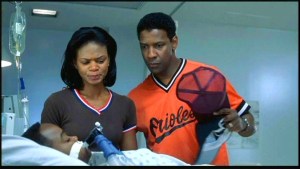
John Quincy Archibald (Denzel Washington) is a man who is trying to make ends meet, but it is hard for him and his wife, Denise (Kimberly Elise). He works at a factory where he's supposed to be full time but because they don't need him that much, his hours have been reduced to only twenty a week, and she works at a supermarket and has to wear the ugliest brown and yellow uniform. We are introduced to them on the morning their car is being repossessed, but despite that, they seem to be in good spirits. But the day is still young. While at their nine-year-old (??) son's baseball game, the young boy collapses while running from one base to the other. Michael's parents rush him to Hope Memorial Hospital in Chicago and are told by doctors that his heart is three times larger than what it should be (sounds like the opposite of the Grinch's heart!) and not enough blood is being pumped into it, thus making it work too hard. They have put him on a monitor for now where his blood pressure is at 88, when it should be above 90. If it goes below 70, that means heart failure. It's probably not a big surprise to hear that before this movie is over, it will go down to 68.

The hospital administrator supervisor, Rebecca Payne (Anne Heche), and Dr. Turner (James Woods), inform the Archibalds that their son's heart is useless and needs a transplant, otherwise he may only have weeks to live. The decision seems to be easy for the parents (by the way, stellar acting from Denzel here...tears are running down his face, while he's trying to remain composed as he's having the conversation): of course they want their son's name to be put on the donor list and get the transplant as soon as possible. Rebecca tells them that his insurance doesn't cover the procedure and if they do want the procedure, they have to treat it as a "cash account" which means it will cost $250,000 and will require a down payment of $75,000 before they can put Michael's name on the transplant list. This is horrifying news for parents of a dying child who only have a little over a thousand dollars in savings. As Payne coldly states, "It costs money to provide health care."

The next part of the movie focuses on the parents doing anything they can do to change the fate of their son. John talks to his boss about his insurance and is informed they recently changed carriers from a PPO to HMO (my eyes usually glaze over when any type of insurance is being discussed, so I really don't know the differences). As a non-management part time employee such as he is, John only qualifies for "second tier" catastrophic coverage, which only has a max payout of only $20,000. (Can you tell I was taking notes? No way I can remember all this! Though I actually take notes for all of my movie reviews). John argues that he was hired as full time, but is only getting part time hours because work is slow and his boss replies that the coverage is based on hours worked. He regretfully tells him there's nothing he can do, but John can file an appeal which will take seven working days to process. 

The parents talk to someone at State Services who tells them she can't help them because they already have medical insurance and that they should be on welfare, which surprises Denise because they both already have jobs. They next go somewhere for financial aid and they end up in the wrong line (which was already long to begin with) and had to enter another long line. I really felt for them in that moment. They're in a cramped, crowded room. They have other things they could be doing to progress things and standing in a line for hours probably makes them feel like they are not getting anything done. Worst of all, when they do finally talk to someone to see if they can get financial aid, the answer they get is, "No, you don't qualify." A defeated and angry John replies "My son is dying. I'm broke. If I don't qualify who the hell does?" 

The next week he gets back a reply to the appeal he filed and things are starting to look a little better until after he shows it to Payne and she tells him that he filed the wrong paperwork. The one he filed was an appeal for an already existing claim when he should have filed a grievance that will take a month to get. Oh, man, if I were him, I would have been so tempted to reach across the desk and slap her! Maybe tell these poor people what they need to do! 

We next see a montage of them raising money, and their church and neighbors, despite not having much money either, pitch in and raise money for them. (If ever there was a time for a Go Fund Me, this would be it, but unfortunately they were living in the archaic times of two thousand and two!) One of Denise's friends, who is a waitress, gives her tips to her. John goes to a pawn shop where he sells his wife's engagement ring and they have a garage sale where they sell their TV and car among other things. In the end, they come up with $22,000, which is pretty impressive, but still a long way off from the $75,000 they need.

Unfortunately, the hospital can't wait any more and decide they're going to release Michael. I wasn't quite sure how much time had elapsed since Michael was first admitted to the hospital, maybe a month? John isn't there when this decision is made, so his wife calls him from a pay phone (yes, they were still using pay phones in 2002!) to tell him what's going on and hisses at him to "Do something." Now I'm sure when she told him this, she didn't mean for her husband to take an emergency room hostage (spoiler alert!), but rather try to talk some sense in the doctors and see if they can show a little compassion. To be fair, he does try to talk to the doctor first before he takes a drastic turn. He tells Dr. Turner that he did some research and found out the hospital does 300 surgeries every year which are $250,000 each and that comes out to $75 million and he doesn't understand why they can't perform the surgery on his son in good faith and promises him he will pay the rest of the money back. When the doctor apologizes and tells him he can't do this, John pulls a gun out of his jacket and tells him, "I'm not asking anymore; I'm telling you, you are going to give my son a new heart, do you understand me?" You can tell he really hasn't thought this plan through (or has never done anything like this before!) because he is nervous and doesn't exactly know what to do. The doctor tells him, "If you do this you are on an irreversible course of action."

John ends up bringing him to an emergency room where he locks the doors, breaks the security camera and tells the security guard (played by Ethan Suplee) to shut down the elevators. We get the first great Denzel line of the movie: "Hospital's under new management now: from now on, free health care for everybody."

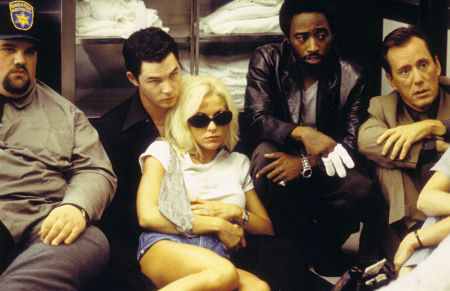
Along with the doctor and security guard, there's also another young doctor (played by Kevin Connelly), a guy with a bleeding hand, an abusive boyfriend and his girlfriend, a Spanish-speaking mother with her baby, and a pregnant woman and her husband. He also lets a gunshot victim in and lets the young doctor work on him.

Word quickly gets out what is happening at the hospital and a team is quickly assembled outside. Robert DuVall plays Frank Grimes, the hostage negotiator who gets in touch with John. When he asks him if anybody is hurt, John replies, "It's an emergency room; everyone's hurt." When Grimes asks him his name, this is when we get the movie's title as he tells him to call him "John Q". (Can't give away his full name, though, let's be honest, they're going to find out!) John tells Grimes to find Rebecca Payne and to tell her to put his son's name on the donor list. He adds that if his son's name isn't on that list by 4:15, somebody will die. I think that gives them an hour.

John agrees to let a few hostages go and releases the mother and her baby and the pregnant wife and her husband (honestly, I'm surprised he let the husband go, but as we will soon find out, John Q is a stand up guy). When they are released, they tell news crews (by this time there's a whole crowd outside the hospital) that John Q is a "very good man" and they praise him for letting in the man with the gunshot or else he would have died. 

Ray Liotta plays Gus Monroe, the Chief of Police, and he wants to take more drastic measures, despite the fact that John seems to be cooperating with them and Grimes doesn't agree with his tactics. He wants to put a sniper in through the air ducts so he can take a shot at John. Payne is also brought onto the scene and tells Grimes and Monroe, "If you give in to this guy, there's gonna be guns in every hospital." She decides that she's going to lie and tell John's wife that she has decided to put Michael's name on the list and the hospital will pay for everything. Then Denise will tell her husband and he'll let the hostages go.

Of course Denise (who is with her son) is thrilled to hear this (and I think this may be the first time she hears about what her husband is doing?), she calls him to tell him Michael's name is on the list. Somehow, the local news is able to get live video feed of John talking to his wife, then to his son. (And the swarmy news guy says, "This is my white Bronco.") Rebecca is so touched when she sees this that she changes her mind and gives permission for the young boy to actually have his name on the list. This kind of surprised me that she changed her mind as she was portrayed as a cold corporate bitch who wasn't budging one bit...until she was moved to tears. Meanwhile, while John is distracted talking on the phone, the sniper Monroe has sent through the vents takes his aim at an unarmed John, who see's he's on TV right before he gets shot in the arm. He pulls the sniper down and punches him several times. I'm not sure how long it's been since he first took the ER hostage, but I love that he started as a bumbling everyday guy who didn't know what he was doing and now he's this bad ass who's also quickly becoming a hero as we will soon see when he brings out the sniper who he has duct taped his hands behind his back.

Grimes tells him, "Nobody wants to kill you" and an angry John yells "What is this?" and throws the sniper's rifle towards the lieutenant. By this time an even bigger crowd has gathered and they are cheering for John. They cheer in the right spots and they boo in the right spots (like when John shows the gun after Grimes tells him they're not trying to kill him.) We get a little foreshadowing as Grimes tells hm, "There's only two ways out for you: jail or dead." Without spoiling too much (or maybe I'm spoiling a lot!), one of those two things will happen. We then get what is perhaps the most Denzeliest line from this film, which was in all the trailers: before he lets the sniper go, he declares, "I am NOT going to bury my son; my son is going to bury ME!" I mean, even if you've never seen this movie, I'm sure you can hear Denzel say it. That line reminds me when he says, "We didn't land on Plymouth Rock; Plymouth Rock landed on us!" in Malcolm X. Probably because it has a similar structure and it's another iconic Denzel line that's said in a very Denzel-ish way. (I mean, if anyone can say their lines in the most Denzel-ish way, it's Denzel Washington!)

John's demands are that he want his son brought to the ER and he will let the hostages go. This is agreed upon and they prepare to receive the young boy. When John said he wanted his son to bury him, he was thinking the next day, apparently, because his plan is to kill himself and have his heart be given to his son. Dude, that's very noble, but a TERRIBLE idea. As the two doctors tell him, there are too many risk factors like bloody type, chest cavity measurements, and both blood tissues must be compatible. John tells them that they're both B positive, their tissues match, and his heart should fit since his son's heart is three times the normal size. I still think this is a terrible idea and there's still the slight chance his heart won't be compatible for his son and then he will have died for nothing. This is when the hostages find out that John's gun only had one bullet in it and he was never planning on killing anyone except for himself (interesting he had that suicide plan all along, but I guess it makes sense because he had to make sure his son got a heart one way or the other).

So John is lying down (not sure why), ready to shoot himself, but he first decides he's thirsty and needs a drink of water. Really, what does it matter if he's thirsty if he's going to be dead in a few minutes? Obviously, they're trying to prolong the moment and make it as dramatic as possible because while this is going on, the doctor who was staying with Michael receives a fax that a brand new heart that fits the criteria for Michael perfectly has just been harvested from a young woman who died in a car accident. I should back up here and say this is how the movie opens: we see a young, well-to-do woman driving her fancy BMW in Montana, I think. She's driving super fast through the curvy, mountainous roads and at one point she passes a truck in an obvious no-passing zone and while she's passing him, surprise, surprise, another truck appears in the view. Now this moron had plenty of time to pass the truck and get back in her lane and hopefully learn her lesson that it's not a good idea to pass cars on roads like these. Oh, she will learn her lesson, all right, but just more in the deadly way. I think she is able to pass the truck, but barely and her car gets clipped and spins in the other lane and she is hit by the oncoming semi. I don't mean to be callous or anything, but the dumb bitch kinda deserved it. Also, where is she going that she's in a hurry to get to? And why is she so dressed up? She appears to be in the middle of Nowhere, USA. I was very confused when I was watching this scene; I had no idea how she was internal to the plot, but once she was hit, I figured it out. I don't think you need this scene; especially not as the opening to the movie!

When Denise is informed about the heart, she calls her husband on the walkie, telling him she needs to talk to him, but he doesn't want to respond because he doesn't want to change his mind. I'm yelling at the screen, "Tell him you found a heart!!!" I found it a little bit weird that nobody is trying to stop him while he's "preparing" to kill himself. While there are people who don't agree with what he's doing, nobody is actively trying to stop him. In a very, very tense moment, he pulls the trigger with the gun pointed to his head, but oops-a-daisy! The safety is on. I mean, whew, right?

We see his wife outside the building and she's screaming something (presumably they found a heart), then in the very next scene we see a bunch of doctors, including John who is dressed up in scrubs. It's a weird scene because we don't see his reaction when he learns that 1), a heart has been found for his son, and 2), he doesn't have to kill himself after all. I guess they wanted it to be a surprise for the audience to see if he had pulled the trigger before it was too late. I personally would have rather seen his reaction as I figured he wasn't going to die. It didn't seem like that kind of movie; this is a guy you're rooting for, after all, they're not going to kill off the hero in such a horrible way.

The surgery is performed and the organ fits Michael perfectly so he now has a healthy heart. The ending of the movie shows John in court. We see all his hostages who are there to support him and most most likely gave witness statements. He is found not guilty of attempted murder and armed criminal action, but is found guilty of kidnapping and false imprisonment. I'm not sure what the sentence is, but his lawyer tells him she will try to get it down to two years. I'm thinking since everyone is on his side, it will be even less than that. But I guess they gotta show that he needs to do the time as he did commit a crime cuz you just can't hold everyone at gunpoint in a hospital even if your intentions are noble.

I'm not sure how realistic this movie is (something tells me not very) and it definitely is very emotionally manipulative, but it's a fun throwback early 2000s Denzel movie to watch.

Speaking of 2000s Denzel movies, I will be reviewing a few more this week, so I hope you enjoy those! I guarantee you will like them! 


Monday, July 18, 2016

A Made Man

Goodfellas
Director: Martin Scorsese
Cast: Ray Liotta, Robert De Niro, Joe Pesci, Lorraine Bracco, Paul Sorvino
Released: September 21, 1990

Oscar nominations:
Best Picture (lost to Dances with Wolves)
Best Director - Martin Scorsese (lost to Kevin Costner for Dances with Wolves)
Best Supporting Actor - Joe Pesci (won)
Best Supporting Actress - Lorraine Bracco (lost to Whoopi Goldberg for Ghost)
Best Adapted Screenplay - Martin Scorsese and Nicholas Pileggi (lost to Michael Blake for Dances with Wolves)
Best Film Editing (lost to Dances with Wolves)


I need to watch Dances with Wolves in the near future to see if I agree with the Academy's decision of awarding that Best Picture over Goodfellas. I call BS on Kevin Costner winning Best Director over Marty Scorsese, though, ESPECIALLY since at this point in time Scorsese had never won an Oscar for directing (and wouldn't win one until 2007 for The Departed....personally, I liked Goodfellas better, though I will admit it's been awhile since I've seen The Departed.) If you remember, back in 2010, I posted several videos about a poll asking which was the biggest Best Picture upset in Oscar history. Dances with Wolves winning over Goodfellas was on the list, but it was not the one that won the poll and not the one I thought should have win....oh, trust me, there's a much bigger upset! You'll just have to go back and watch to find out, but if you know me, then you already know my answer!

Goodfellas is based on a book by Nicholas Pileggi called "Wiseguy" (damn, I can never remember if book titles are suppose to be italicized, underlined, or in parentheses which is why I just do all three!). Since there was already a show on TV called Wiseguy, Scorsese (smartly) changed the name. I think Goodfellas is a better title anyway. Wiseguy sounds like a comedy. "Ehhhh, Wiseguy!" The book and movie are based on the true story of Henry Hill (played by Ray Liotta), a man who got sucked into the mafia life at a very young age and would eventually turn on his mob family. The movie begins with him saying, in voiceover, "As far back as I can remember, I've always wanted to be a gangster." He tells the audience that as a young child and teen in the '50s, he was always awed by the power these Italian-American men in his Brooklyn community held. He was able to get part-time work from them by running errands for them and doing small jobs. This soon became a full-time job and he was part of their family.

His mentor is Jimmy Conway (Robert De Niro), who Henry is in awe of the first time he meets him at a club because Jimmy is just tipping everyone one hundred dollars, like he has money to blow through like it's no big deal. He gives the doorman $100 just for opening the door and the bartender $100 for keeping the drinks coming. When he meets Henry he gives him a couple hundreds, just for the hell of it, really. Jimmy likes to sell things on the black market, such as cigarettes, booze, shrimp and lobster. He gives Henry two important pieces of advice: "Never rat on your friends and always keep your mouth shut." Henry will NOT abide by these rules later on in the movie!

He meets Tommy DeVito (Joe Pesci), a very volatile man which makes him extremely scary and dangerous. One of the most well-known scenes in the movie is when Tommy is telling a story to a group of guys including Henry, and the punchline of the story is, "Yeah, I told this guy to go f*** his mother" and then he sees this guy again and he says, "Hey, I thought I told you to go f*** your mother!" All the guys are laughing hysterically, including Henry who says, "You're really funny." Tommy seems to take this more as an insult and asks him, "Funny how? Like I'm a clown? I amuse you? I make you laugh? I'm here to f***ing amuse you? What do you mean funny?" The whole table is silent and Henry has to try to backtrack what he meant so he's not insulting Tommy anymore than he (apparently!) already is. He tells him he thought the way he told the story was funny and Tommy gets even more angry and says, "How the f*** am I funny?" Henry gets a little freaked out then calls him out and says, "Get the f*** out of here!" and Tommy laughs and says, "I almost had him!" So he was just playing with him the entire time. Although, as it turns out, when he gets angry, sometimes he's not always playing around. This proves to be true in another scene when the guys are playing poker and and a young guy named Spider (played by Michael Imperioli aka Christopher (Christofuh!) from The Sopranos) is serving them drinks. He misunderstood Tommy wanted a drink after delivering the beverages to the table and Tommy says to him, "Where's my f***ing drink?" Spider tries to explain to him he thought he said he didn't need a drink, but this only makes matters worse. Spider asks him if he wants a drink and Tommy says, "Yeah, I want a f***ing drink! Move it, you f***ing bastard!" He thinks it would be hilarious if he made Spider "dance" and takes out his pistol and shoots him in the foot. The other guys are like, "What's the matter with you, Tommy?" and Henry goes over to help Spider. Tommy says, "So what? He got shot in the foot! Big f***ing deal!" Henry and another guy go take him to get his foot taken care of and Tommy says, "Let him crawl there like he crawls to get the drinks!" He is laughing and smiling and obviously does not feel bad he just shot someone in the foot. (Well, he does do worse things than shoot people in the foot and he never feels bad about those either!) He tells Spider, "Don't make a big f***ing thing out of this, you little prick!" and "It was an accident!" At a following game, we see Spider has a cast on his foot. Tommy makes fun of him and Spider tells him, "Why don't you go f*** yourself, Tommy." Big mistake. BIG. MISTAKE! The other guys (except for Tommy who is just sitting there looking mighty pissed!) are laughing and Jimmy jokes that he has respect for Spider for standing up to Tommy. The second he tells Tommy, "You gonna let him get away with that?", I KNEW Spider was a dead man. Because Tommy takes out his gun and just brutally blows him away. All the guys are shocked and Jimmy says, "I was f***ing kidding with you and you f***ing shoot the guy?" And I'm thinking, Well, maybe you shouldn't have egged him on! We all knew this was going to happen!

I wrote in my Breakfast Club review that I grew up knowing Emilio Estevez best as the coach from The Mighty Ducks because that was the generation I grew up with. Well, it probably won't surprise you when I say that Joe Pesci will always be one half of the Wet Bandits from Home Alone to me. I was a kid when that movie came out (and you know I'm a big Home Alone fan!), so I will always associate him with that movie. It only came out two months after this one, but I was too young to see Goodfellas! I don't even think I was even aware of it until several years later. Haha, can you imagine if Tommy DeVito was the character in that movie? First of all, I don't think Kevin would survive! Or Marv after that scene with the crowbar and the tarantula! Second of all, those f-bombs would be dropping every which way!

I heard somewhere that 27 people who were in this movie, would later go on to appear in The Sopranos, which is pretty much the TV version of Goodfellas. I already mentioned Michael Imperioli, but probably the most well-known one would be Lorraine Bracco, who plays Henry's wife, Karen Hill. They first meet on a double date they have with Tommy and a woman who is a friend of Karen's. While Tommy and his date are canoodling and having a great time, Henry and Karen aren't talking to each other and show no interest in each other. Another double date is set up, but this time Henry doesn't show up and Karen is pissed about that. We suddenly get voice over from her which was a little jarring at first because so far at this point, we've only heard voice overs from Henry. When she confronts Henry about standing her up, he is attracted to her fiery personality and they soon start dating. There's a great scene where Henry takes her to the Copacabana nightclub and instead of going through the front doors and waiting in line, he takes her through the back and there's this great one-take scene of them walking through the back halls and the kitchen. Here's the scene:


Man, I tell you, that Marty Scorsese is a great movie director. That is a brilliant scene. This is why I enjoy this movie so much; a lot of the scenes just suck you in like this one. Although I will say I mostly associate that song with Adventure in Baby-Sitting! (I have seen that movie a lot more than this one! This is only the second time I've seen Goodfellas.)

Needless to say, Karen is very seduced by Henry and becomes even more attractive to him when he beats up her neighbor with the handle of his gun when he tries to get too handsy with her. Henry hands Karen the bloodied gun and she says she knows this would have scared most woman, but it made her even more attracted to him. They eventually get married, but that won't stop Henry from having some fun with another woman on the side.

The movie begins with Henry, Jimmy, and Tommy driving at night when they hear a sound coming from the trunk. They stop the car and open the trunk to reveal to the audience a bloodied and beat up man who they thought was dead, but is still alive (but barely because he looks really bad). We see Tommy take out a huge knife and stab the poor guy several times and then the movie starts in chronological order. About an hour in the movie, we will find out about the man in the trunk. He is a mobster named Billy Batts and he did a very stupid thing by insulting Tommy. Do these people never learn. You don't f*** with Tommy DeVito! Not if you want to live! Billy is actually an old friend of Tommy who he hasn't seen in several years because they do hug and seem happy to see each other after all this time. But then Billy starts joking around with Tommy about his shoe shining days and this really ticks off Tommy. (Someone needs to go to anger management!) Billy tells him to calm down, that he's only kidding with him. Everything seems to be calm, but then Billy (who must be a real idiot), has to make another crack and this really sets Tommy off and he goes to attack Billy, but is stopped by Henry and Jimmy. Later, when Billy is alone, Jimmy distracts him so Tommy can sneak up on him and start beating the crap out of him with Jimmy's help. They put him in the trunk of the car and head to Tommy's mother's house because Tommy tells them there's a shovel at her house. Here's a fun fact: Tommy's mother is played by Scorsese's real-life mother, Catherine Scorsese. (Another fun fact about this movie is that Samuel L. Jackson has a small role. He plays a man who helps the guys with a big heist, but then after he carelessly leaves a trail for police, he is whacked.) He tells the guys to be quiet because he doesn't want to wake her up, but she's already up when the enter the house. She ends up making this big Italian meal for the three men in the middle of the night and Tommy takes this huge carving knife and asks her if he can take it because he hit a deer (he explains to her that's why he has blood on his shirt!) and he needs the knife to hack off the hoof of the animal! We then return to the very first scene of the movie and see him use the knife to stab Billy and kill for good this time. Since Billy was a made man, Tommy soon gets his comeuppance and I think we all saw that coming!


Towards the end of the movie, things start to spiral for Henry and he is forced to go into the Witness Protection Program and rat on Jimmy and mob boss leader, Paulie (Paul Sorvino). I just love the way this movie is shot; lots of brilliant camera work. Yes, the movie is very violent, but it IS a gangster movie, after all! It also makes me want to read the book it was based on. I am looking for something to read!