Contagion
Director: Steven Soderbergh
Cast: Matt Damon, Laurence Fishburne, Jude Law, Marion Cotillard, Kate Winslet, Gwyneth Paltrow
Released: September 9, 2011
Viewed in theaters: September 22, 2011
Warning: some spoilers
If you already hate Gwyneth Paltrow, like I do, then you will hate her even more after watching Contagion! Not only do we find out that she's cheating on her husband (Matt Damon) in the first ten seconds of the movie, but she's the reason this fast-killing virus spread to the United States after returning from a trip from Hong Kong where the virus originated. She infected thousands of people who died, including her own six-year-old son! Good job, Gwynnie, good job!
Luckily, her husband is immune to the disease and even luckier, his daughter was with his ex-wife. There is widespread panic as many people fall sick and entire cities and towns become ghosts towns with stores being unable to operate without people to run them and those who are still healthy start rioting and breaking into stores to steal food and other equipment. Matt just wants to leave the city with his daughter before she gets infected, but they are quarantined.
Meanwhile, in Atlanta, at the first sign of the outbreak, a doctor (Laurence Fishbourne) sends an expert in viruses and epidemics (Kate Winslet) to Minneapolis, one of the first cities to get infected (Gwyneth's hometown). Let's just say, she should have worn a mask more than she did. (I always thought those masks looked like they couldn't keep germs away.)
We also have Jude Law who plays an obnoxious blogger who thinks the government is lying to everyone and that they are keeping vital information from the public about how they can be helped. On a shallow sidenote, you can definitely tell Jude is British because he has some messed up teeth! I guess some stereotypes are true.
Marion Cotillard, who is so very, very, very pretty, plays a doctor with the World Health Organization who travels to China to see how the disease originated. I was worried about her because she is also shown not wearing masks at times and they did a lot of close ups of her touching item after item after item after item. I don't want to spoil her storyline, so I'll just say I was a little confused with how they wrapped it up.
This was a decent movie, but it was a tad bit on the boring side at times. Reviewers kept saying that this movie will scare the daylights out of you because everyone gets sick and germs are everywhere!!! Eh, whatever. I was fine. I even used the restroom at my theater after the movie ended!
Source Code
Director: Duncan Jones
Cast: Jake Gyllenhaal, Michelle Monaghan, Vera Farmiga, Jeffrey Wright
Released: April 1, 2011
In order to talk about this movie and discuss things that I find interesting (and confusing!), I have to spoil this movie, so if you have not seen it yet, you have been warned. There are going to be some huge spoilers revealed. I repeat, you have been warned! (By the way, it is a movie worth checking out, so go see it first and then come back and read this, because I would hate to have ruined it for you!)
Okay, so have you seen the movie? Good. If you haven't, I'll explain what it's about and maybe that will get you interested in seeing it before I really start spoiling things (which I need to do to really go in depth about this movie). Jake Gyllenhaal is sleeping on a train and wakes up quite disorientated. It's clear he doesn't know where he is or why he's there. He's looking around wildly and the woman sitting across from him (Michelle Monaghan) asks him if he's all right. It's clear that she knows him, but he doesn't know who she is. She keeps calling him "Sean" and he tells her his real name is Captian Colter Stevens and she just sort of laughs him off. He goes into a bathroom and when he looks in the reflection, it is not his, but a stranger's. The train ends up being blown up and he wakes up in a pod. On a TV screen Vera Farmiga is asking him if he found the bomb. Colter is very confused and soon learns that there has been a terrorist attack on the train and he's been sent to relive the last eight minutes as one of the passengers on the train (who was picked because he has the same body shape and was about the same age as Colter) to find who was responsible so he could stop a more massive attack on the entire city of Chicago. (Please don't ask me to explain the logistics of the situation...)
He keeps going back to this man's last eight minutes and with each one you get a different scenario, so it was kind of like a serious Groundhog Day. With each scenario, you got a clue to who wasn't involved and you learned something new each time...like that fact that Colter was actually dead, but they were keeping a part of his brain alive so he could go on these missions. Don't ask me how that works.
Eventually Colter does find the bomber and he relays this information and the police and FBI are able to stop the suspect before he blows up an entire city. His mission was to stop this, but he wants to go back one more time and save everyone on the train because after going back so many times, he has fallen for Christina, his pretty companion. He does end up saving her and everyone else and he suspects that after the eight minutes this time, he'll die and the real Sean will be saved too, but no, Colter is still alive, but he's still inside Sean's body, so everyone thinks it's this Sean guy, but really it's Colter who's controlling him. Well, what about poor Sean? Everyone else on the train got to live, but that poor schmuck is the only one who had to give his life that day and not only that, but some stranger has inhabited his body and will have his girlfriend and his family confused...(and even more confused when they notice that "Sean" is acting differently), they'll never know that the REAL Sean is dead. Doesn't seem very fair to me! Now as an audience member, I know we're not supposed to care about Sean since we never met him and only saw what he looks like for a split second.
There were many elements of this film that reminded me of Quantum Leap and while watching the commentary, the director said the same thing and he got Scott Bakula to voice Colter's father, so I thought that was cool.
I did like the movie, but it kind of gave me a headache and I felt bad for Sean!
The Adjustment Bureau
Director: George Nolfi
Cast: Matt Damon, Emily Blunt, Anthony Mackie
Released: March 4, 2011
The Adjustment Bureau is part romance, part sci-fi with a dash of politics. Matt Damon plays David Norris, a young New York politician who's running for the state Senate. Before a big speech he has to give, he meets Elise (Emily Blunt), a ballet dancer, and immediately feels a connection with her, but is unable to get any contact info because she has to leave before security catches her because she had been crashing a wedding in the same building he's to give his speech. He had been down in the polls, but meeting Elise inspired him and he changes his entire speech so it's more him speaking and not the correspondents who help him with what he should say and should wear to appease the voting public.
It just so happens the next day he runs into Elise on a bus and is thrilled. They start up a conversation and she gives him her number. (Personally, I don't know what he saw in her - I thought it was extremely immature when she took his phone when someone was calling and answered by saying, "He's not here", and even more immature when she dropped his phone in her coffee. Like that's totally charming.)
Men With Hats
One morning David walks into his office building and notices that everyone is frozen and sees a group of men he doesn't know dressed in suits and bowler hats. Like anyone in his situation, he gets freaked out and starts running and calling for help, but the group of men sedate him and he wakes up to find himself in a huge abandoned warehouse. The leader of the group tells him they are part of the Adjustment Bureau and that they "are the people who make sure things happen according to plan". He tells David that he wasn't supposed to see them just now; that he should have spilled his coffee, gone back to his apartment to change, and had been ten minutes late. He tells him that if he tells anybody about them, that he will erase his entire mind and he will not remember anything at all or even know who he is. On top of all that, he tells David that he was never supposed to run into Elise on the bus and that he is never to see her again and burns the paper with her number on it.
Even though he only has Elise's (first!) name to go on, David doesn't give up trying to find her and three years later sees her walking down the street while on the bus and runs out to talk to her. She thinks that he had just blown her off all that time ago and doesn't believe him when he tells her he lost her number. She agrees to have lunch with them and the Bureau is alerted and quickly tries to come up with ways to separate them. They succeed, but David is determined and still manages to get to her with all these roadblocks in his way.
Why is the Adjustment Bureau so adamant about keeping David and Elise apart? Because separately they would have turned into extraordinary people. David is destined to be President, but could never be if he stayed with Elise because she is too much of a free spirit. Elise is destined to be one of the world's most famous dancers, but if she stays with David, she'll only be a ballet teacher for young kids. David is fine with giving up that dream to be with the woman he loves, but when he learns that her dream will never be fulfilled, he walks out on her while she's in the hospital after she sprains her ankle (something the A.B. made happen). I didn't understand why he couldn't just talk to her and say, "Look, I'm worried that if we stay together, I'll hold you back from being a great dancer and I think we should split up." She would have either agreed or not cared if that happened. Seriously, who cares if she never became one of the world's most famous dancers. There's nothing wrong with teaching ballet. She could always choreograph awesome dance movies like Center Stage! Can anyone even name a famous ballet dancer because I sure can't.
Eleven months pass and he finds out that Elise is getting married to her ex-boyfriend and decides that he does want to be with her (make up your mind!) and with the help of one of the members of the Bureau played by Anthony Mackie, he finds a short cut to get to the courthouse where she is to be married. The members of the Bureau have the cool ability to walk into one door and appear at a totally different location when they cross the threshold. Anyone who is wearing a bowler hat can do this. I loved the scene where he's running through doors and trying to dodge any of the members; I thought that was really well done.
Good movie, I really did like it despite some of my complaints. Personally if I were given all these signs that I shouldn't be with someone, I would take them all into account and be like, F it! They must not be worth it. That power with the hats is pretty cool though; that walking through a door and being closer to your location would come in rather handy, especially during the winter so I wouldn't have to drive in snow!
One Day
Director: Lone Scherfig
Cast: Anne Hathaway and Jim Sturgess
Released: August 19, 2011
Viewed in theaters: September 1, 2011
I saw this movie with my mom and we had both read the book by David Nicholls. We both agreed that if we had not read the book, we would have been a little lost.
Before I go into my review, let me tell you about our audience. My mom and I were the first ones in the theater and more people came in right before the film started. Four older ladies sat right in front of us, a couple sat in the same row as us, and two people sat right behind us. The theater wasn't that small - there was plenty of room to spread out! Not only that, but the four ladies sitting in front of us TALKED THROUGH THE ENTIRE MOVIE! Ugh, it was really irritating. I kept hearing one of them ask the other something and felt like saying "Well, if you just watch the movie and STOP TALKING then maybe you'll know what's going on!" Of course they probably hadn't read the book.
The movie is about Emma (Anne Hathaway) and Dexter (Jim Sturgess) who start a relationship of sorts the last day of their college graduation, which is July 15, 1988. They're only friends at first, but there's the hint that they could be something more. We see their relationship evolve each year on July 15 for the next twenty years. Well, it's supposed to be twenty years. In the book, the first chapter starts in 1988 and the last one starts in 2007. The tag line on the poster reads "Two people, twenty years, one day". Well, the only thing thing is that while the movie starts in 1988, it ends in 2011! I can understand that they want to be current, but that drove me a little crazy because they're LYING on the poster! 1988 - 2011 does NOT equal twenty years! They should have have re-worded the tag to "Two people, twenty-plus years, one day".
Each time they want to establish it's a new year in the movie, they do a clever way of placing the year on the screen. I remember one was written on a wall and another is written on a computer screen. It kind of reminded me of the clever ways Heroes used to show its titles. (Loved season 1 of that show, but it just wasn't the same after that!) Some of the years go by pretty fast. While you may get a good twenty pages for each year in the book, in the film, you might only get five (or less!) minutes. Obviously in the book, Emma and Dexter are more fleshed out.
One of my favorite scenes in the book is when Dexter is having dinner with his girlfriend's (not Emma) family and they're very rich and snooty and she has younger twin brothers who are being little snots. They play a parlor game called "Are You There, Moriarty?" and if I had seen the movie without reading the book, I would have been very confused. The book explains the parlor game and it's a lot funnier when he accidently injures his girlfriend. Her twin brothers are also a lot funnier (and snottier!) in the book.
It was fun to see the fashion and technology and hear the music for each year. That was one of the things that the book couldn't really show.
Word of advice: you might want to bring tissues with you to the theater. I won't say that you'll cry happy tears or sad tears because I don't want to spoil anything.
It was a nice movie, but the book is better. I would advise to read the book first, then rent the movie when it's on DVD.
Beaches
Director: Garry Marshall
Cast: Bette Midler and Barbara Hershey
Released: December 21,1988
Oscar nominations:
Best Art Direction (lost to Dangerous Liaisons)
Is Beaches a chick flick? One might say unequivocally so. Is Beaches a schmaltzy film? You could say one of the schmaltziest ever. Are there problems with the script? Most definitely yes. Did I cry my eyes out while watching it? I am not ashamed to say that yes, yes, I did. Do I know every word to Wind Beneath My Wings? Who doesn't?
In a one sentence summary, Beaches is a film about the friendship between two women that spans over thirty years. Cece Bloom and Hilary Whitney meet on the beach in Coney Island one summer as eleven year olds and strike up a lifelong friendship. The two girls couldn't be more different. Cece is from the Bronx, a rough and tumble kinda New York girl with an attitude and wants to be a STAH! She sings, tap dances, acts. Her mother is the typical stage mother and Cece calls her Leona. Leona's played by Lainie Kazan whos' probably best known for playing the mother in My Big Fat Greek Wedding, but she also played Andrea's grandma in Beverly Hills, 90210. I should also note that young Cece is played by Mayim Bialik. If you don't know that name, shame on you! She only played the titular character on Blossom that was on 8:30/7:30 central time Monday nights on NBC right after The Fresh Prince of Bel-Air in the early nineties. Is it weird that I can remember what was on Monday nights on NBC twenty years ago, but I couldn't tell you what's on Mondays on NBC presently? And if you still have no idea what Blossom was, maybe this will refresh your memory:
Hilary is from San Francisco and comes from a rich family. Her mom died when she was young and her extracurricular actives include horse back riding and ballet, activities that young, proper girls do.
Hilary and Cece exchange addresses and keep a correspondence, writing letters to each other often. We see them grow up and graduate college and they're still writing each other. Now this is the first problem with the script I have. There is no way that two eleven year old girls that live on opposite sides of the country are going to write each other for that long after they've just spent, what, half a day together? Maybe they would write to each for a few months after meeting, but it would eventually stop.
Fast forward to Bette Midler as older Cece who is a struggling performer and Barbara Hershey as older Hilary who is a lawyer and has decided to defy her father and move to New York to visit Cece. Apparently they never sent pictures of themselves to each other because Cece doesn't even know it's Hilary when she approaches her at a nighclub Cece sings at.
After that, the rest of the movie revolves around this cycle: they fight, they cry, they make up, they cry again. I swear, that must happen four or five times in the movie! The first time is when Cece likes a guy (Macaulay Culkin's dad from Home Alone), but he likes Hilary in return. Hilary ends up marrying a lawyer when she goes back to San Francisco for awhile (more letter writing!) to take care of her sick dad and Cece marries Mr. McCallister. By the time Hilary returns to New York with her new husband, Cece has become more famous and she and her husband are now living in a lavish penthouse. The two haven't seen each other in awhile and another fight breaks out. Hilary says it's because they've fallen apart, but Cece accuses Hilary, saying that she's broken apart. Eventually they make up down the line. (More crying! And hugging!)
I watched the commentary with Garry Marshall and he mentioned that he wanted to make this movie because most people didn't want to make a movie about the friendship between two women and how he was interested in that aspect. He then went on to say that he finds women friendships fascinating because, according to him, when men fight, they won't speak to each other for years, but when women fight, they've made up in a couple of hours and are shopping! Not only is this extremely sexist, but I find it quite untrue. I'm no expert, so I'll just pretend to be: when guys fight, they just need to hit something (like each other (see, I can be sexist too!)), but I think females hold grudges way longer than guys do. If you piss me off, I will not talk to you from anywhere as long as a week to eternity. To be fair to the movie, when Cece and Hilary had their biggest fight, they didn't talk to each other for months and Hilary ignored all of Cece's letters, so it wasn't like they were BFFs again after a couple of hours and SHOPPING! Shopping makes everything better!
Both of their marriages fall apart. Hilary catches her husband with another woman (eating breakfast) and Cece's husband feels like he comes second to her career. This bonds the two lifelong friends together again and Cece finds out that Hilary is pregnant. She is beyond ecstatic as both women have mentioned how much they would love to have kids. Hilary has a girl...who grows up to be a psychotic ballet dancer. Sorry, couldn't resist a Black Swan joke! Actually, Darren Aronofsky or whoever cast that movie is a genius because during Beaches, I was struck by how much Barbara Hershey looked like Natalie Portman, especially after she got sick. (Hmm, did I just inadvertently diss Natalie Portman?)
That's right, bring on the terminal illness that befalls one of the friends. Hilary has some heart problem and after spending the last moments of her life (minus in the hospital) with her daughter, now six or seven, and Cece on the beach, she eventually dies.
This is where I lost it. Between the montage with Bette Midler singing "Wind Beneath My Wings" Hilary's daughter, Victoria, sitting forlornly at her mom's funeral, and Victoria's tear-stained face while petting her cat for comfort, I was a sobbing mess. Sooo glad I was watching this alone!
Cece tells Victoria that her mother said she wanted her daughter to live with Cece in her will. Wait, what? What about her dad? Even Cece asks Victoria if she wants to live with her father and Victoria says she's never met him! They didn't really explain it well, but either Hilary never told her ex that she was pregnant or he knew about it and didn't want anything to do with his child. In either case, it makes one of the parents look like a jerk. So Cece adopts Victoria and that's the end. Cue "Wind Beneath My Wings" again.
Rain Man
Director: Barry Levinson
Cast: Tom Cruise and Dustin Hoffman
Released: December 16, 1988
Oscar nominations:
Best Picture (won)
Best Director - Barry Levinson (won)
Best Actor - Dustin Hoffman (won)
Best Original Screenplay - Ronald Bass and Barry Morrow (won)
Best Cinematography (lost to Mississippi Burning)
Best Art Direction (lost to Dangerous Liaisons)
Best Editing (lost to Who Framed Roger Rabbit?)
Best Score - Hans Zimmer (lost to Dave Grushin for The Milagro Beanfield War) Rain Man is about a relationship between two brothers who have just met and couldn't be more different. Charlie is the younger, success-driven, cocky a-hole brother. He's played by Tom Cruise who pretty much plays this type of character in all of his movies. After his father dies, he finds out he has an older brother name Raymond (played by Dustin Hoffman) who has been in an institution since Charlie was a young kid. He's autistic and needs to have a routine to feel secure. Before he finds out about his brother, Charlie tells his girlfriend that when he was younger he had an imaginary friend called the Rain Man who used to sing to him. Of course we learn later that it was Raymond who used to sing to him.
Charlie, who didn't have a good relationship with his father, is irate when he finds out that his father didn't leave him any money in his will. He thought he was supposed to get three million dollars, but it ended up going to Raymond. This is when Charlie discovers he has an older brother. He is furious that the money went to someone who can't even conceive of the idea of three million dollars. He plans to kidnap Raymond and only bring him back when he's given his share of the wealth.
Charlie learns very soon that taking Raymond out of his environment was, as Raymond would say, "bad, very, very bad." Raymond has to go to bed right at eleven. He has to eat certain foods on certain days. (In one scene where he has to have six fish sticks for lunch, Charlie brings him three and when Raymond starts crying, Charlie takes a knife and cuts them all in half.) He has to watch The People's Court every week day at four. If he doesn't, he throws a huge fit. His life is one big routine and Charlie has to adjust to this routine and, as he is of the selfish sort, it doesn't make him happy.
Charlie think he'll just fly back to Los Angeles from Cincinnati where Raymond lives, but Raymond refuses to go on a plane because all major airlines except Quantas have had major aviation disasters. When Charlie tries to reason with him and tell him it's safe, Raymond makes a big scene and the movie becomes a road trip bonding experience. Charlie's angry with his brother because he needs to get back to his job as a car dealer and instead of returning to L.A. that afternoon, it's going to take him three days to get back.
Charlie finds Raymond frustrating because he can't have a conversation with him and he doesn't know what's going on inside Raymond's head. He is amazed when Raymond drops a box of toothpicks and immediately says there are 246 toothpicks on the ground. There are 250 toothpicks that come in the box and there are four left in the box after Raymond drops it. Charlie is also amazed when Raymond can multiply five digit numbers together and claims he should work for NASA. He changes his mind, however, when Raymond can't add together two and two.
Charlie, who is in debt, gets a brilliant idea when he realizes Raymond can count cards and they make a pitstop at Vegas along the way. The most famous scene from the movie is when they're wearing matching suits and riding down the escalator side by side. It's been parodied in many other movies.
Throughout the film you see their relationship develop and the two brothers share a special bond even though Raymond has a difficult time showing feeling. Charlie wants Raymond to live with him, but in the end realizes it's better if there are professionals taking care of Charlie and he's in a place he's familiar with. There's a nice moment at the end when the two brothers show affection for each other by sitting at a table and leaning together, their foreheads touching, as Raymond does not like to be hugged.
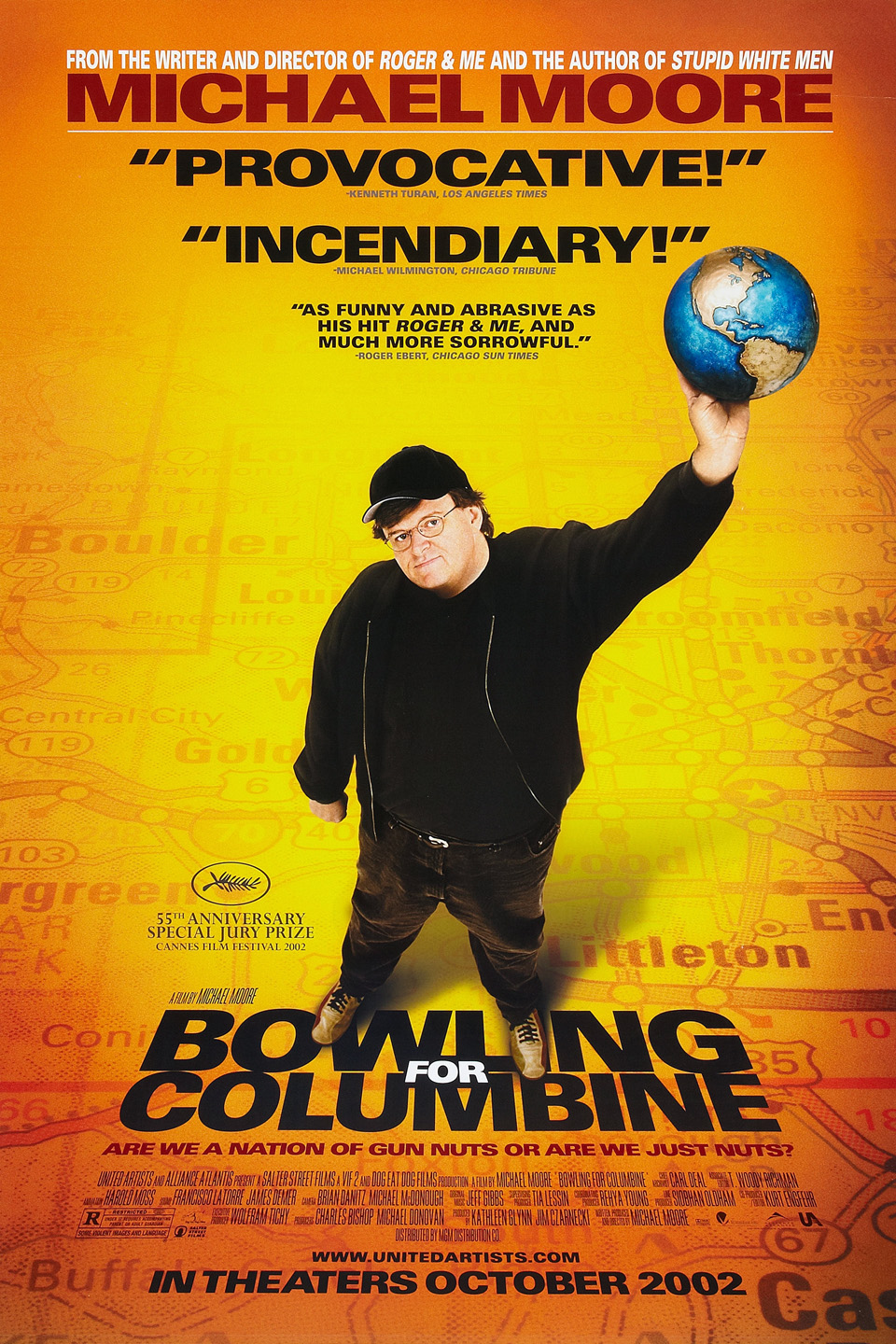
Bowling for Columbine
Director: Michael Moore
Released: October 11, 2002
Oscar nominations:
Best Documentary (won)
Here's a little fun (not really) fact about me: Bowling for Columbine is the first documentary I ever saw. I'm not just talking in the theater (because I've never seen a doc in the theater), but the first documentary I ever saw anywhere. Kinda sad considering it only came out nine years ago.
Michael Moore is a blowhard. I know it, you know it, we all know it. However, the guy knows how to make an entertaining movie (although I do question his "facts" at times). Obviously gun control is a very serious issue, but the movie is pretty funny at times. I especially love the scene at the beginning where he tries to score a free gun by signing up for a bank account and asks the teller, "Should you really be giving out free guns at a bank?" Hahaha...I have a feeling that most banks aren't giving away free guns and that particular bank is a very rare minority. At least, I hope so!
Before I saw the movie, I thought the title referred to people raising money for the victims of the Columbine school shooting by having a bowl-a-thon or something. Which seemed both stupid and kinda insensitive. But Moore explains that the killers had bowling class in the morning and attended it before they went on their rampage. However, if you've read the Dave Cullen book, you would know that's not true. Duh. So the title is stupid, confusing and untrue. But it's got panache.
The movie is about gun control (specifically in the U.S.) and that is a very B-R-O-A-D topic and Moore goes all over the place in his film. There's so much about the topic that it's very easy to get lost in the shuffle and I feel like he's trying to cover so much in a two hour movie. It would have been more interesting if he had focused his documentary on a specific subject, like school shootings. Columbine may be mentioned in the (stupid, confusing, and untrue) title, but it's a very small fraction of the film. It seemed like the late '90s had a surge of middle and high school shootings (I would know because I was in high school at the time and remember all of them) and I feel like Moore missed a huge opportunity by not interviewing (or at least attempting to) any of the students who shot up their school.
There are plenty of interviews, most of them with well-known people. He interviews Terry Nichol's brother (who is clearly not stable) who tells him he knew Timothy McVeigh and how he had an obsession with guns. He interviews Matt Stone of South Park fame who grew up in Littleton and they make it sound like he attended Columbine, but he didn't because I looked it up. He interviews Marilyn Manson because he was always (and sometimes falsely) listed as one of the artists school shooters from the late '90s listened to. The holy grail of his interviewees is Mr. NRA himself, Charleton Heston, who famously (infamously?) held a convention in Denver, like two days after Columbine happened, which was pretty insensitive. However, I thought Moore was a little unfair on him and never seemed to give him a chance to answer his question. I don't think everyone who owns guns are evil. I'm sure for every dumb____ who decides to go on a shooting rampage, there's probably hundreds of people who own guns and are responsible.
One of the dumbest moments in the film is when he tries to get an interview with Dick Clark and let's see if I can remember how this goes: Back in 2000, a first grader brought a gun to school and shot and killed a little girl (whether intentional or not, I'm not sure). He got the gun from his uncle's house because he and his single mom were living with him and his mom was working overtime at a restaurant chain owned by Dick Clark (or something to that effect) so he was trying to reach Clark to ask him about the murder. Now, c'mon, Dick Clark had nothing to do with why the boy brought a gun to school. Maybe his stupid uncle shouldn't have left a gun lying around in the house or maybe his mother should have told him that it's not a toy. DUH!!!!!!!!!!
One of my favorite moments in the film is when Moore takes a few of the students who were injured in the Columbine massacre to the K-Mart headquarters and tells them that they wanted them to stop selling bullets because the kids he's with were injured/paralyzed by their bullets. I hate K-Mart so much so that scene made me cackle with glee because I'm evil. Of course they had to discontinue selling bullets because they're on camera and would look like the greedy and cold-hearted corporation they are if they didn't.
Entertaining movie, but only take it at face-value.
The Help
Director: Tate Taylor
Cast: Viola Davis, Emma Stone, Octavia Spencer, Bryce Dallas Howard, Allison Janney, Sissy Spacek
Released: August 10, 2011
Viewed in theaters: August 17, 2011
The Help is the name of the latest movie I saw in the theater starring Viola Davis and Octavia Spencer as Abilene and Minnie, two black maids working for white families in 1960s Jackson, Mississippi. It's also the name of the novel by Katherine Stockett which it's adapted from. It's also the name of the book within the novel and the movie which aspiring writer Skeeter (Emma Stone) writes anonymously with the help of Abilene, Minnie, and other maids about what it's really like for these maids to work for white families.
Abilene works for Skeeter's friend, Elizabeth Leefolt. She cooks, cleans, and is basically the mother for the Leefolt's two year old daughter. Minnie used to work for the uppity Hilly Holbrook (Bryce Dallas Howard) and her senile mother (Sissy Spacek), but was fired and now works for Celia Foote who lives way out of town and is shunned by Hilly and the rest of her friends because Celia married the man Hilly had deep feelings for. Skeeter gets a job writing a column for her town's newspaper where she has to answer questions about cleaning. She asks Abilene to help her with the articles until Skeeter decides she wants to write something of importance and after Hilly makes a big fuss about building separate bathrooms for the help, Skeeter sees her friend's true colors start to show and gets the idea for her book. At first Abilene is hesitant because if either of them get caught, it would be very serious, but decides it's important to get her story out there and agrees as long as Skeeter is very careful about the whole thing and doesn't use her real name. Minnie shares her stories too, but Skeeter is told that her book can only be published if she gets a dozen more maids to tell their stories. After the murder of Medgar Evers, more maids volunteer to speak to Skeeter about their experience as a maid.
The movie does a pretty good job of following the book, but there are some things that are left out. If you haven't read the book, the following might be slight spoilers:
The relationship between Minnie and Celia has been edited quite heavily in the film. While they do have THAT scene between them (if you've read the book, you know which one I'm talking about), it builds up in the book and you find out why Cecelia has been hiding in the bathroom and never leaves the house. In the movie, it's the first time Cecelia was crying in the bathroom and Minnie barges in on her. They also sort of skimmed over Cecelia being worried that her husband was going to find out about Minnie. She kept her a secret from him in the movie too, but didn't seem concerned if he found out about her.
They keep the relationship between Skeeter and Stuart, but it's very downplayed in the movie where he's a jerk to her, then apologizes and they date, then he breaks up with her when she tells him about the book she wrote. This is also the arc of their relationship in the book, but of course there are more scenes between them making their relationship more developed.
Skeeter's mother (Allison Janney) has cancer but while you learn of it the same time as Skeeter in the book, she already has it when we first meet her in the film.
See the movie, but also make sure you read the book. And have tissues handy for both!
Reality Bites
Director: Ben Stiller
Cast: Winona Ryder, Ethan Hawke, Ben Stiller, Janeane Garofalo
Released: February 18, 1994
I knew Ben Still was in this movie and that he had directed movies (like Tropic Thunder) before, but I didn't know he had directed this one. Of course, this was pre-There's Something About Mary, so nobody knew who he was back then.
The movie follows Lelaina (Ryder) and her friends, recent college grads trying to find their place in the "real world" (otherwise known as Houston). Boy, am I'm glad I wasn't in my early twenties in the nineties! What a bunch of self-centered emo whiners! Oh, wait, I think I just described every early twenty-something throughout the course of history.
Lelaina, who was the valedictorian at her college, has scored a job as a producer for a TV show hosted by Frasier and Nile's dad, but gets fired and has to lower herself to a more pedestrian job. She's living in an apartment with her best friend Vickie (Garafalo) who is a bit of a slut (well, it's true!) and is worried she might have AIDS (oh, remember how popular AIDS were in the nineties - they even had an entire episode of Beverly Hills, 90210 dedicated to it!). Lelaina's other friend, Troy, also lives with them and he gets jealous after Lelaina goes on a date with Michael (Stiller), a video executive because, you see, Troy has feelings for her, but won't admit that he does. Lelaina also has feelings for him, but won't admit that she does and keeps dating Michael to make Troy jealous and Troy dates other women to make Lelaina jealous. Oh, the complications of love triangles!
Lelaina wants to make a documentary about her and her friends' life and always has a camera with her capturing moments of their everyday life. Michael tells her that he's found somebody in New York who's interested in buying the documentary, but when she sees an advanced screening of her footage, they've changed everything around and made it into a bit of a joke. This is where the movie gets its title because the documentary was called "Reality Bites".
This movie is probably most famous for introducing "Stay" by Lisa Loeb to the world. Who doesn't love that song? I never hear it on the radio anymore, but everytime I hear it on my iPod, I always have to sing along. I kept waiting to hear it in the movie, but they don't play it until the end credits...and it's the second song they play during the credits!
Dave
Director: Ivan Reitman
Cast: Kevin Kline, Sigourney Weaver, Frank Langella, Ben Kingsley, Ving Rhames, Charles Grodin
Released: May 7, 1993
Oscar nominations:
Best Original Screenplay - Gary Ross (lost to Jane Campion for The Piano)
When Bill Mitchell, the President of the United States (played by Kevin Kline), suffers a stroke while having an affair with one of his interns, a normal guy named Dave Kovic (also played by Kline) is called in to "pose" as Mitchell as he could be his twin. It's the idea of the Chief of Staff, Bob Alexander, (Langella) because his plan is to feed Dave everything he wants Dave to do as POTUS, but Bob is the one making all the calls.
It turns out that Dave looks so much like the President, he has everyone fooled, including the First Lady (Weaver). The President and First Lady have been having marital problems lately and haven't been spending much time together except for press conferences, but she knows something is amiss when her husband all of a sudden starts caring about things and wanting to help people because the real President was known for being kind of a prick.
There are lots of cameos in this film, most of them being politicians who I didn't know at the time and didn't know now. One of the cameos I did know but shouldn't have was John McLaughlin of The McLaughlin Group. If you're under fifty, you probably have no idea what The McLaughlin Group is. It's a boring show that was on Friday nights on PBS and it had the host, who was, like, 100 years old and other old geezers on it talking about really boring political issues. I only know this show because my brother (who was high school aged around the time) wanted to watch it because he was into politics. I always wanted to watch my TGIF shows like Boy Meets World or Step by Step, but noooooo! We had to watch the stupid McLaughlin Group! Ugh!
There's a funny cameo with Oliver Stone being interviewed by Larry King because he thinks there's a conspiracy behind President acting differently all of a sudden. If I hadn't seen JFK recently, I probably wouldn't have gotten the joke. Arnold Schwarzenegger even has a cameo and this was way before he became the Govenator.
Limitless
Director: Neil Burger
Cast: Bradley Cooper, Robert De Niro, Abbie Cornish
Released: March 18, 2011
Imagine you could take a pill and it would let you use one hundred percent of your brain instead of the supposed twenty percent we can only access. That is exactly what happens when Eddie (Cooper), a struggling writer, takes the pill which is offered to him by his ex-girlfriend's brother. Before he took the pill, he looked like a homeless person, his apartment was a mess, and he hadn't written one word of his story. When he takes the pill, his mind suddenly become clear, he seems to remember everything he ever learned in his entire life, and he finishes his book in four days. He also gets a sleek and clean makeover.
When the effect wears off, he knows he has to get more pills, but his ex's brother has been killed, but Eddie manages to find them in his oven. Taking one pill a day makes him smart and powerful. He can suddenly become fluent in a foreign language, do difficult math problems in his head, and know the answer to everything at anytime. He even states he has a four-digit IQ which is just ridiculous. If you had a four-digit IQ, then you would be the smartest person in the world and everyone else around you would seem quite stupid in comparison. You would be bored by everything too if you had an IQ that high! At one point in the movie, his girlfriend takes a pill because she's carrying a stash of them around for Eddie and is being chased by one of the bad guys who wants to kill her, so she takes a pill so she'll know what to do. At that point I was thinking that she was going to start taking them too and they were going to become the most self-important and pretentious couple in the world. Luckily she didn't like that she didn't feel like herself, so that's the only time she takes it.
This movie has an interesting premise, but it doesn't quite deliver in the end. There are too many plot holes that aren't mended by the end. During one scene when he's on the drugs, Eddie goes through an entire evening only remembering snippets of it. He finds out a girl he remembers being with was killed and apparently somebody saw him leave the hotel room where her body was found. He hires people to remove any of his fingerprints from the room, but we never found out if he murdered her or if it was someone else. Also, it sounded like the drug wasn't going to be made anymore, so I don't know how he was going to keep this charade going of being smart and powerful if he didn't have the thing that was making him smart and powerful anymore.
Interesting premise, but falls flat. I will give the film props for being the first time I've ever seen a child being used as a weapon (well technically, the ice skates were the weapon, but a kid was in the ice skates when they were being used!).
Frost/Nixon
Director: Ron Howard
Cast: Frank Langella, Michael Sheen, Kevin Bacon, Rebecca Hall, Oliver Platt, Sam Rockwell
Released: December 5, 2008
Oscar nominations:
Best Picture (lost to Slumdog Millionaire)
Best Director - Ron Howard (lost to Danny Boyle for Slumdog Millionaire)
Best Actor - Frank Langella (lost to Sean Penn for Milk)
Best Adapted Screenplay - Peter Morgan (lost to Simon Beaufoy for Slumdog Millionaire)
Best Editing (lost to Slumdog Millionaire)
This film is based on a theater play of the same name that came out a couple years before. Both are based on the 1977 interviews the 37th President of the United States (that Lyndon Johnson sure was sandwiched between two of the most well-known Presidents of the 20th century, wasn't he?) gives to British journalist David Frost who's more known for hosting variety-type shows than being a hard-hitting journalist. I didn't even know these interviews existed until the movie was making its promotional rounds. Obviously I never saw them because I wasn't born yet, but I was familiar with Richard Nixon and the Watergate scandal.
Because of that, it would be a huge deal to score an interview with Nixon and Frost and his producer end up paying big bucks for it. There's many terms and agreements they must abide to, such as only using 25% of their interview to discuss Watergate. Months before the interview, Frost and two assistants he hires for research, dig up any and all information they can find about Watergate so they're fully prepared.
Langella (Nixon) and Sheen (Frost) reprise their theater roles in the film. Because the first time I saw the actual David Frost was from a clip they show of the interviews in the special features, I thought Sheen did a good job of portraying him, but because I was so familiar with Nixon as a public figure, the first scene I saw with him played by Langella, I just didn't buy him as Nixon, but as the movie went on, I was able to let myself believe he was Nixon.
During the first couple of interviews, Frost has a difficult time getting certain questions asked because Nixon keeps it focused on his more positive achievements during his time in the White House and doesn't let Frost get a word in. The final interview is when the real questions are finally answered and Nixon has no choice but to answer them.
I've never seen the actual interviews, but if you were to watch them, then watch the movie, you would see that they are verbatim.
I avoided this movie for awhile because I thought it would be boring, but it was actually pretty good and kept me interested.
JFK
Director: Oliver Stone
Cast: Kevin Costner, Gary Oldman, Sissy Spacek, Tommy Lee Jones, Joe Pesci
Released: December 20, 1991
Oscar nominations:
Best Picture (lost to The Silence of the Lambs)
Best Director - Oliver Stone (lost to Jonathan Demme for The Silence of the Lambs)
Best Supporting Actor - Tommy Lee Jones (lost to Jack Palance for City Slickers)
Best Adapted Screenplay - Oliver Stone and Zachary Sklar (lost to Ted Tally for The Silence of the Lambs)
Best Cinematography (won)
Best Sound (lost to Termination 2)
Best Film Editing (won)
Best Score - John Williams (lost to Alan Menken for Beauty and the Beast)
I've only seen a few Oliver Stone movies. They range from ones I really liked (Platoon) to the God-awful (Alexander - which, by the way, I had to see in the theater because other members of my family wanted to see it and my choice for seeing National Treasure was overruled). I would say his heyday for great movie-making was the late '80s/early '90s which JFK falls nicely into.
I watched the special edition of the DVD which is about three hours and twenty minutes, so I treated it like a miniseries and watched it over a span of about three or four days. Whether or not you believe there's a huge conspiracy behind the assassination of the 35th President of the United States (which the entire movie is based around), you can't deny this is a fascinating film.
First of all, the star power is pretty amazing. I already listed the actors with the most screen time, but the film also includes Jack Lemmon, Walter Matthau, John Candy, Kevin Bacon, John Larroquette, Ed Asner, Donald Sutherland, Laurie Metcalf, and Wayne Knight.
The film begins with a little montage of Kennedy's life in office and soon begins after his death on November 22, 1963 in Dallas and goes all the way to 1969. It's based on a book written by New Orleans District Attorney Jim Garrison (played by Costner) who becomes obsessed with proving that there was a huge cover-up behind Kennedy's death. He becomes so obsessed that he ignores death threats and puts his family second to the case - he reminded me of Robert Graysmith in Zodiac and how he was obsessed with finding the identify of the killer.
The movie does make a pretty good case of there being a conspiracy linked to JFK's death, but then again, it's what the movie/Stone wants you to think. Garrison and his team interview witnesses who saw Kennedy's assassination first hand and their recounts don't match up with what's documented by the government/police; the doctor who performed JFK's autopsy testifies that government officials kept a close eye on him as he looked at the body and wasn't allowed to examine the gunshot wound; one of Kennedy's bodyguards tells Garrison he just happened to be sent to an assignment in Antarctica when the assassination occurred and that security was very lax (even if Kennedy had never been killed, I cannot ever imagine the POTUS being allowed to ride in a frickin' convertible - that just seems really stupid); it's determined that there's no way Lee Harvey Oswald (played by Oldman) could have shot Kennedy from the angle of the window he was supposedly at and there must have been two other assassins involved as well.
The CIA, FBI, Mafia, Secret Service, and even Vice-President Lyndon Johnson are all considered to be part of the cover-up. They wanted Kennedy dead because of his involvement in the Bay of Pigs and he wanted to pull troops from the Vietnam War. They also weren't happy with the changes he had in store for America. I guess Kennedy was a little too ahead of his time back then as the sixties weren't the most noble times for the U.S. Garrison also thinks they had something to do with the deaths of Martin Luther King and Robert Kennedy.
There's some gruesome footage of Kennedy's murder shown at a trial. For some reason, Stone feels the need to show a clip of part of Kennedy's head being blown off not once, but about six times. Yeah, didn't need to see that, Ollie. Luckily it's not a close-up, but you can still tell it's very graphic. He also shows a close-up photo of the deceased Kennedy presumably taken during his autopsy. It's very jarring because his eyes are open. Ever heard the term "dead eyes"? Yeah, it's ever creepier when the person in question is actually, you know, dead.
I was flipping through an almanac from 2000 and it has the Kennedy assassination listed as number 6 of the top 100 news stories of the century. Honestly, I think that's kinda low - I would rank it as at least one of the top three!
If you're fascinated by history, have three plus hours to kill, and even have an inkling that there was some shady business involved with Kennedy's murder, then give JFK a whirl.